
Ancient Duel
Par ancientduelgame
Statut actuel
À venir
Fin de campagne : 15/11/2026
History, Strategy & Ancient Duel
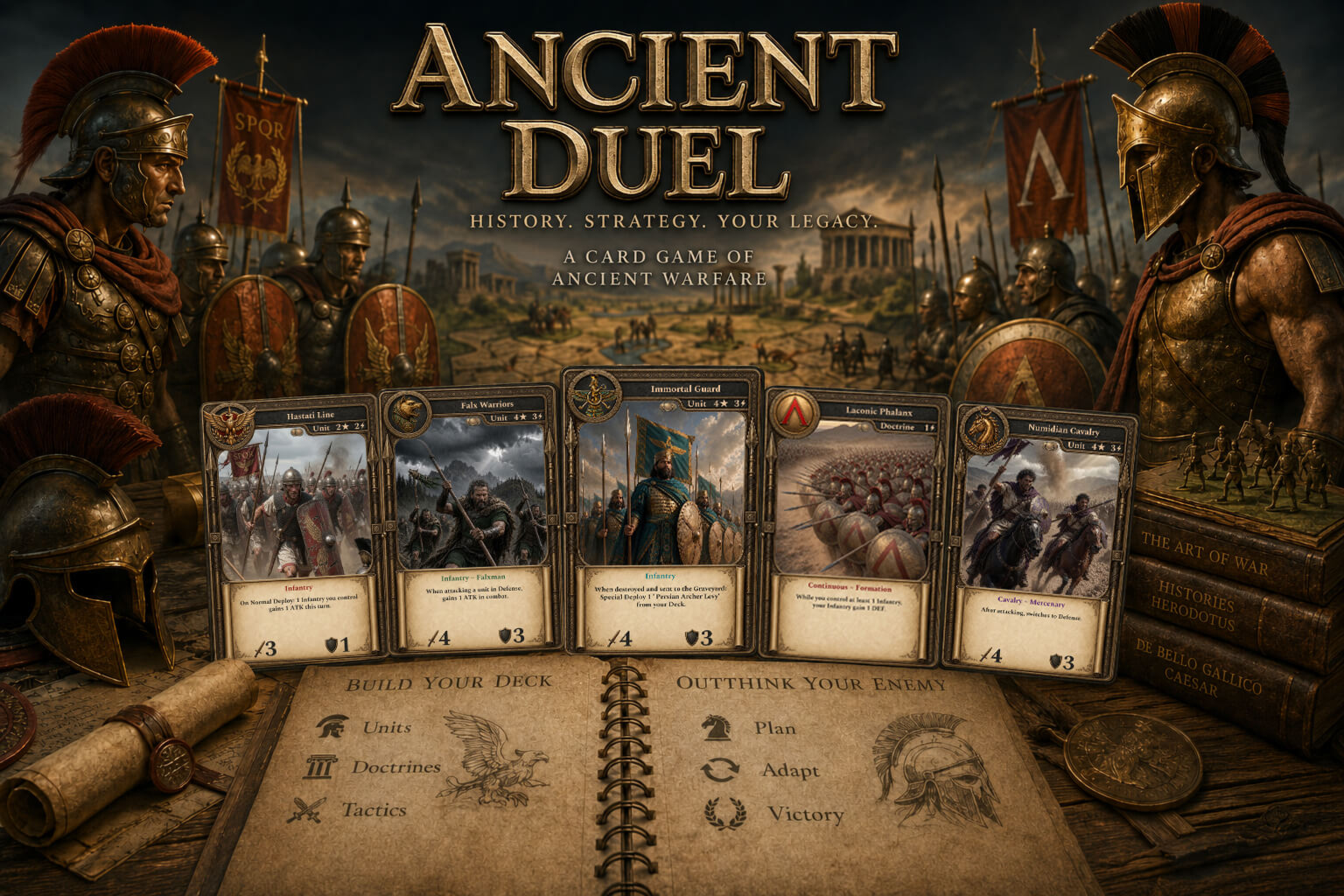
A while ago someone asked me whether Ancient Duel is an educational game. I said no, and then spent the rest of the evening annoyed at my own answer, because it isn't quite true either.
Ancient Duel doesn't teach history. It's a card game. But it is built on real ancient warfare, and I've watched enough people stop mid-match to ask "wait, what's a falx?" to know that something happens when history is the material a game is made of rather than a coat of paint on top of it. This article is my attempt to be precise about what that something is — and about where the history stops and my design decisions start.
What's actually in the game
Seven civilizations: Rome, Sparta, Macedonia, Carthage, Persia, Dacia and Egypt. 141 cards across them — 65 Units, 42 Doctrines, 34 Tactics. 19 battles rebuilt as campaign missions, most of them playable from both sides. 35 missions in total, each opening with a short historical briefing before the first card is drawn.
That's the raw material. Here's how honest I can be about each part of it.
What's historically grounded
The civilizations are real, obviously. So are the commanders: Leonidas, Alexander the Great, Darius, Hannibal Barca, Trajan, Decebalus, Ramesses. Every one of them led armies, and the campaign each anchors follows events that happened.
The unit types are where I spent the most research time, and they're the part I'd defend hardest. Rome's Hastati Line, Principes Line and Triarii Reserve are the three lines of the manipular legion. Sparta fields Perioikoi Spearmen and Skiritai Scouts — the free non-citizens of Laconia and the light troops from the Skiritis district. Macedonia has Pezhetairoi, Hypaspists and Companion Cavalry. Carthage recruits Balearic Slingers and Numidian Cavalry because Carthage recruited Balearic slingers and Numidian cavalry. Persia has its Cardaces and Scythed Chariots; Egypt its Medjay Guard; Dacia its Tarabostes Nobles and Comati Raiders, the two social classes Roman sources describe.
The doctrines are real formations and real operational methods. Testudo. The Laconic Phalanx. Sarissa Drill, for the pike that gave Macedonian infantry its reach. Hammer and Anvil, which is the name historians give to Philip's and Alexander's combined-arms system. Double Envelopment, which is what Hannibal did at Cannae.
And the battles are dated and located: Thermopylae (480 BC), Plataea, Granicus, Issus, Gaugamela, Megalopolis, Trebia, Lake Trasimene, Cannae, Zama, Sellasia, Pelusium, Papremis, the Nile against Perdiccas, Alexandria (30 BC), and the Dacian Wars from First Tapae in 88 AD to the fall of Sarmizegetusa in 106 AD.
What's historically inspired, but adapted
This is the largest category, and it's where design starts making decisions history didn't.
Take Sparta's Agoge Training. The agoge was a real state upbringing that produced the only full-time professional infantry in classical Greece. In the game it reads: "Your Level < 5 Infantry gain 1 ATK." That's not history — that's a designer deciding that decades of institutional training should show up as a small, reliable bonus on your cheaper troops rather than your elites. The idea is historical. The number is mine.
Persia's Immortal Guard is my favourite of these. Herodotus describes the corps as being kept permanently at ten thousand men, each casualty replaced at once. So the card reads: "When destroyed and sent to the Graveyard: Special Deploy 1 Persian Archer Levy from your Deck." The unit refills itself. Whether Herodotus was describing an administrative fact or repeating a story he'd been told is genuinely debated — but the card is honest about which reputation it's modelling.
Numidian Cavalry switches to Defense after it attacks, because Numidian horsemen fought as skirmishers who struck and withdrew rather than committing to a shock charge. Falx Warriors gain ATK when attacking a defending unit, because the Dacian falx was a hooking blade meant to reach past a shield — and Rome's answer was reinforced helmets and arm guards. Narrow Pass limits your opponent to one attack per turn, which is a rule-shaped way of saying "Thermopylae."
None of these are simulations. They're arguments about what mattered, compressed into one line of card text.
What's pure gameplay fiction
And then there's the part I'd rather state plainly than have someone discover and feel misled by.
Every number is invented. ATK, DEF, Energy and Level all run from 1 to 6. Spartan Hoplites are 4/3 and Falx Warriors are 4/3 not because those forces were equivalent but because a game where every stat is small and readable is a game a new player can hold in their head. The stats exist to be balanced, not to be true.
The timeline is broken on purpose. Ramesses commanded in the 13th century BC. Trajan died in 117 AD. They can meet across a table, and one of them will lose. Leonidas can fight Decebalus, six centuries apart. An Allied deck lets you field 30 Spartan cards alongside 10 Egyptian ones; a Coalition deck mixes three factions at once. No such army existed.
Each commander exists as two cards. Leonidas is both "King of Sparta" and "Voice of Defiance"; Hannibal is "Master of Maneuver" and "Master of Envelopment". That's a deck-building construct — two facets of one leader so you have a real choice about which version of him you build around — not a claim about two historical people.
Some rules are pure mechanism. The Kamikaze rule, where a losing attacker still leaves a lasting wound on the unit that killed it, exists because I wanted weak units to have a purpose beyond dying. The rule that only one Terrain Doctrine can be face-up at a time — so activating yours destroys your opponent's — compresses "both armies want the same ground" into something you resolve in three seconds.
I'd rather you know all of this. A player who can tell which parts of a game are load-bearing history and which parts are scaffolding can go and read about the first category without being quietly misinformed by the second.
History as a starting point, not a syllabus
Nobody memorises dates from a card game, and I've never tried to make that happen. What a game can do is put a name in front of you often enough that you eventually get curious.
You draw Sarmatian Allies for the fourth time and wonder who the Sarmatians were. You read "Medjay Guard" and wonder why Egypt's guards have a Nubian name. You lose to Double Envelopment and want to know whether that actually worked. You notice that Trajan's second card is called "Builder of Provinces" and that his campaign ends at a place called Sarmizegetusa.
Those questions get answered somewhere else — a book, an article, a documentary. The game's job is only to make the question occur to you.
Strategy starts before the first card is drawn
The second half of this is the part I care about as a designer rather than as someone who likes history: a duel is decided partly by choices you made before it began.
A deck is exactly 40 cards, up to 3 copies of anything, 1 or 2 Commanders from your primary faction, and at most 2 Terrain cards. Play pure, or Allied at 30 primary plus 10 from one ally, or Coalition at 26 / 8 / 6 across three factions.
Those constraints do the teaching. Forty slots is not many. Every Doctrine you add is a Unit you don't. Three copies of a card you want to see early raises the odds of drawing it and raises the odds of drawing a second, useless copy late. Splashing an ally faction gets you a tool your primary lacks and costs you ten cards' worth of consistency — and most effects only apply to cards from their own faction, so a mixed deck buys flexibility with synergy.
Then there's the interlock. Legionary Cohort gains DEF only if Testudo is face-up. Hammer and Anvil does nothing unless you control both Infantry and Cavalry. Companion Cavalry hits harder only while an Infantry unit stands beside it. Those cards aren't strong; they're strong together, which means a deck is a system and not a ranking. The most common mistake I see is forty individually good cards that never help each other once.
And then the plan meets the turn
You start at 20 life, draw 5, and every turn refills a single shared energy pool — 6 at first, rising by 1 from turn three up to a cap of 12. That pool pays for attacking (each unit costs its printed Energy), for deploying Level 5–6 units, and for activating Doctrines and Tactics. Unspent energy is lost at the next refill.
One shared pool for everything is the most important decision in the game, because it makes every turn a budget. Attack with the big unit, or deploy the commander? Activate the terrain, or keep energy for a second attack? You get one normal deploy per turn, so the unit you commit is the unit you're stuck with.
Then position. A unit in Attack Position can strike but is compared on ATK when struck. Set face-down in Defense, it's hidden, safe from ATK-vs-ATK trades, and compared on DEF instead — and your opponent can't see what it is until they attack into it. Beating an attacking unit deals the difference to your opponent's life; losing your own attack costs you the difference and your unit. So "should I attack" is rarely obvious, and "should I hold" is a real answer.
Your opponent has a plan too
This is the part that makes a duel a duel rather than a puzzle.
You cannot see your opponent's hand — only how many cards are in it. You cannot see their face-down units or their set Tactics. What you can see is both graveyards, in full, which is the honest information channel in the game: what they've already spent tells you what they might still have.
And Tactics resolve on your turn, not theirs. When you declare an attack, your opponent gets a window to respond with something they set two turns ago. Feigned Retreat cancels the attack outright and puts a fresh unit on their board. Pilum Volley strips 2 ATK and 2 DEF off your attacker mid-swing. Punic Ambush punishes you specifically for attacking a face-down unit. You commit energy to an attack and find out afterwards whether it was the right one.
So the plan you built survives about three turns. After that you're reading: two face-down cards and a passed turn probably means they're holding a response; a commander deployed early means the follow-up is coming. You build a strategy before the duel, and you rebuild it while the duel is happening. That gap — between the plan and the board — is where the interesting part of this game lives.
Losing is where the learning is
I don't think of the competitive side as aggression. A ranked ladder and a leaderboard exist for one reason: they make a loss worth examining.
A duel you lose leaves a specific question behind. Did I run out of energy at the wrong moment? Did I attack into a set card I should have suspected? Was my deck missing an answer to a strategy I'd already met three times? Every one of those has a fix, and the fix is either a different decision or a different deck.
That loop — lose, diagnose, adjust — isn't unique to Ancient Duel. The game just makes the feedback fast and the record legible.
Easy to learn, deep enough to master
I want to be careful here, because this is where game descriptions usually start making promises they can't keep. I'm not going to claim an age range or a cognitive benefit. What I'll claim is a design distinction I think about constantly: rule complexity and decision complexity are not the same thing.
Ancient Duel's rules are deliberately small. Every number is 1 to 6. Combat is one comparison: bigger wins. Six turn phases, five unit slots, one energy pool. You can be playing correctly within a few minutes, which is why the same rules work at a table with printed cards as they do online.
The decisions on top of those rules are not small. Which forty cards. Which two commanders, and which facets. Whether to hold a Tactic for a better window or use it now. Whether the face-down card across the table is a threat or a bluff. How to spend a budget that's always slightly too tight. Whether to change a plan that was correct two turns ago and isn't any more.
A game doesn't need complicated rules to produce complicated positions. It needs rules that interact. That's why I don't describe Ancient Duel as a children's game — a ten-year-old can play it, and so can someone who's been building decks for twenty years, and they're not playing a different game.
What I'm actually claiming
Not that Ancient Duel teaches history. It doesn't, and any game that says it does is overselling.
What it does: use real ancient warfare as its foundation, mark clearly where that foundation ends and my design begins, and put you in a position where you have to plan, anticipate, adapt and live with your choices.
If somewhere in there you get curious about who the Skiritai were, or why the double envelopment at Cannae is still taught, that's the best outcome I could ask for — and it happens because the history was real enough to be worth asking about.
Ancient Duel was never meant to replace history books — it was meant to make players curious enough to open one.
If a battle, commander, faction or card makes someone wonder, “Did this really happen?”, then the game has already achieved something beyond winning or losing a duel.
History provides the foundation. Strategy gives the player freedom.
And somewhere between the two, every Ancient Duel becomes a story of its own.
How Ancient Warfare Becomes Gameplay in Ancient Duel
A good unit in the wrong place is worth very little. That sentence is close to the whole of ancient warfare, and it is also the design problem I spent the longest time on.
Armies did not lose because their soldiers were individually worse. They lost because a formation was committed too early, or caught on ground that took away its advantage, or hit from a direction it could not turn to face, or left without the support it was built to fight alongside. The Theban Sacred Band, the Spartan hoplite, the Macedonian pikeman: each of them was formidable under the conditions they were designed for, and each of them could be made irrelevant by conditions someone else chose.
Which leaves a designer with an awkward question. How do you put that into a card game without building a military simulator nobody wants to play?
Armies were systems, not collections of warriors
The useful thing about ancient armies is that their parts were not interchangeable. Heavy infantry held ground and won by cohesion, which is also what made it fragile: a phalanx that kept its line was very hard to break from the front, and the same phalanx on broken or uneven ground stopped being a phalanx at all. Polybius makes exactly that point about the Macedonian formation, and it is one of the few tactical judgements from antiquity that reads like a modern analysis.
Light troops and missile infantry rarely decided a battle on their own, but they shaped it: slingers and archers harassed, disordered, and forced an enemy to react. Cavalry, in the Mediterranean world of this period, very seldom broke formed heavy infantry by charging into its front. What it did instead was exploit, going after flanks, rear, baggage, and anything already coming apart.
None of these parts is meaningful in isolation. Cavalry was dangerous because infantry pinned the enemy in place for it. Infantry could hold because someone kept the flanks honest. That interdependence is the thing I actually wanted in the game, more than any particular weapon or formation.
So in Ancient Duel a card is rarely worth reading on its own. Companion Cavalry hits harder only while you control an infantry unit. The Laconic Phalanx strengthens your infantry only while at least one infantry unit is already on the board. Hammer and Anvil, named for the system Philip and Alexander the Great built their army around, does nothing at all unless you control infantry and cavalry at the same time. The card text is doing something simple, but the habit it builds is the historical one: stop asking what this unit does, and start asking what it does next to that one.
Position can matter as much as strength
Thermopylae is the obvious case, and it is obvious for a reason. A pass narrow enough denies a larger army the ability to bring its numbers to bear, which is why the Greek position held for as long as it did and why it fell the moment a path around it was found. Gaugamela is the inverse: Darius chose flat, open ground precisely so that his numbers and his scythed chariots would have room, and lost anyway when Alexander the Great pulled the Persian line apart and drove at the gap it left. At Cannae, the Roman army was not outfought so much as out-positioned, its own weight of numbers turned into a liability once the wings closed behind it.
I did not want a movement system. Grids and facing rules produce a different kind of game, slower and more procedural than the one I was trying to make. What I wanted was for placement to carry a decision without carrying a rulebook.
So the battlefield in Ancient Duel is deliberately small. Each side has four positions for ordinary units and one central position reserved for the Commander, and that reservation is enforced: a Commander can only be deployed to the middle, and nothing else can be deployed there. The board is a formation with a leader in it rather than a map.
The decision lives in the other axis. A unit stands in Attack Position, where it can strike but is measured on its ATK when something strikes back, or in Defense Position, where it cannot attack but is measured on its DEF. A unit set face-down enters Defense hidden, and your opponent finds out what it is by attacking into it. A unit that was deployed this turn cannot change stance, so the posture you choose is one you live with for a turn. Several effects then move units between those stances, sometimes across the table: Alexander, King of Macedon can force any face-up unit on either side into the position of his choosing, once per turn.
The point is not that placement is visual. It is that where a card sits, and how it stands, is a commitment made before you know what the answer to it will be.
Terrain changes what an army is worth
Ground did not merely host ancient battles, it selected which army was allowed to be good. A river line raised the value of whoever held the crossing. Hills punished anyone attacking uphill in armour. Broken country ruined formations built for open ground. Commanders spent enormous effort trying to fight where their own strengths would count, which is a large part of what generalship consisted of.
Terrain Doctrines in Ancient Duel are not depictions of specific places. Narrow Pass is not a map of Thermopylae, and I would not defend it as one. It is an abstraction of a single idea: that the battlefield should have an opinion about what happens on it.
What makes them interesting is that there is only one battlefield. The terrain zone is shared, and only one Terrain Doctrine can be face-up at a time, so activating yours destroys whatever your opponent had established. Both players want the same ground and only one of them gets it, which is roughly the correct shape for the historical problem even though it resolves in three seconds.
Each one bends the rules toward its faction. Narrow Pass gives your units a point of DEF and limits your opponent to a single declared attack per turn, which is a rule-shaped way of saying that a confined space stops an army from using everything it has. Dacia's Forest Paths adds attacking power specifically against units in Defense, rewarding an army built to pry defenders out of position. Persia's Oasis Encampment weakens attackers as they come in, and Rome's Fortified Camp shuts off direct attacks in a turn where you have already lost a unit.
Commanders should change the battle, not just the numbers
This was the section of the design I cared about most, and the one I got wrong first.
The easy version of a famous general is a card with large numbers on it. That version is boring, and worse, it is historically backwards. Hannibal is not remembered for personal combat power. He is remembered for the Trebia, for Trasimene, for Cannae, which is to say for arranging battles so that his opponent's strengths stopped mattering. Alexander the Great is remembered for a system, and for knowing exactly when to commit himself to a gap. Leonidas is remembered for holding a position that could be held. What made these men significant was the way armies behaved around them.
So every Commander in Ancient Duel is built to change how you play rather than to win a fight by arithmetic. They are still units, and they still have to fight, but their numbers are the least interesting thing about them.
Hannibal Barca, Master of Maneuver forces an enemy unit into Defense the moment he arrives and can strip attack power from a target once per turn, which is a card about dictating the terms of an engagement rather than winning one. His other facet lets a unit slip back into Defense after attacking, so aggression stops being a one-way commitment. Leonidas, King of Sparta makes your units in Defense immune to enemy Tactics, changing what your opponent can even attempt. Trajan, Builder of Provinces protects a Terrain Doctrine from removal and pulls infantry back out of the graveyard, which is the closest I could get to Roman engineering as a playstyle rather than flavour text.
There is also a rule that matters more than any single card: only one Commander can be face-up on your side at a time, and deploying a second sends the first to the graveyard. You do not accumulate leadership. You choose it, and changing your mind costs you the man you already committed.
Timing is a weapon
A correct decision made at the wrong moment is not a correct decision. Reserves committed too early are just more men in the front line, and a charge launched before the enemy is fixed in place is a charge into an intact formation. Most of the interesting failures in ancient battle accounts are failures of timing rather than of courage or equipment.
The mechanism carrying this in Ancient Duel is a single shared energy pool. It starts at a maximum of six, grows by one per turn from the third turn onward, and refills at the start of your turn rather than accumulating. Everything competes for it: attacking costs each unit its printed Energy, deploying a Level 5 or 6 unit costs its Energy as well, and activating a Doctrine or Tactic costs one. Whatever you do not spend is gone when the pool refills.
One pool for every kind of action is the most consequential rule in the game, because it turns each turn into a budget rather than a checklist. Attacking with your heaviest unit and deploying your Commander in the same turn is frequently not possible. You also get one normal deployment per turn, so the unit you commit is the unit you have. The question the game asks, over and over, is not what you would like to do. It is what matters now and what can wait.
A unit is worth what stands beside it
Ancient formations were mutually supporting almost by definition. A shield wall works because of the man to your right, skirmishers screened the line and withdrew through it, and the whole logic of combined arms is that each element covers a weakness in another.
Ancient Duel expresses this mostly through conditions rather than through geometry. Spartan Hoplites become stronger if you control another unit at all. Shield-Bearer Youths reinforce an infantry unit as they arrive. Coordinated Charge only pays out when your cavalry attacks while you control infantry, which is the hammer and anvil compressed into one line of text. Medjay Guard, standing in Defense, prevents your opponent from targeting anything else, which is the clearest case of a unit whose value is entirely about what it protects rather than what it kills.
The practical consequence is that ATK and DEF are the beginning of evaluating a card, not the end. A 3/1 cavalry unit is fragile on its own and dangerous in the right company. Reading a board means reading the relationships on it.
Abstraction is the whole job
I want to be plain about the size of the simplification here, because pretending otherwise would be the same dishonesty the first article was written to avoid.
A real ancient battle involved thousands or tens of thousands of people, supply and water, morale that could collapse without warning, orders that arrived late or not at all, dust and weather, terrain the commander had not fully seen, troops of wildly varying experience, and a great deal of luck. No card game reproduces that, and a card game that tried would be unplayable long before it was accurate.
Design is therefore mostly deciding what to throw away. Ancient Duel keeps a short list: units depend on each other, ground matters, posture is a commitment, resources are finite, leadership changes behaviour, and you cannot see everything your opponent holds. Everything else goes. The aim is not to reproduce an ancient battlefield, but to preserve a few of the questions a commander would have recognised.
From battlefield problem to card effect
It may be more useful to show the process than describe it. Each of these began as a historical observation, became a design question, and ended as something a player has to decide.
Confined ground
A larger army cannot always use its advantage in a restricted space. The question was how a battlefield could take options away without rules about movement or distance, and the answer was a Terrain Doctrine that caps how many attacks the opponent may declare per turn. The decision it creates is when to spend energy establishing it, and whether to hold it for the turn the pressure actually arrives.
Cavalry as exploitation
Cavalry punished disorder and openings rather than winning frontal contests. The question was how to make it feel unlike infantry without a movement system, and the answer was conditional aggression: Median Cavalry hits far above its size when it attacks and is badly exposed if anything hits back, Numidian Cavalry drops into Defense after striking, and several cavalry effects fire only when infantry is also on the board. The decision is whether the opening in front of you is real.
Formation and cohesion
Formations survived because of what stood next to them. The question was how one unit could help another defend without a facing or adjacency system, and the answer was conditions that key off what you control, plus Tactics such as Hold the Line and Shield Wall Response that negate an attack on infantry outright. The decision is whether to spend that answer now or keep it for a worse moment.
Command
A commander changed how an army operated. The question was how to show that without printing bigger numbers, and the answer was Commanders whose effects alter what is possible at all: forcing enemy units into Defense, protecting terrain from removal, immunising defenders against Tactics, retrieving units from the graveyard. The decision is which version of a leader your deck is built around, since each exists as two different cards and only one may be on the field.
Why cards suit this better than they should
There is one structural feature of card games that fits military decision-making almost accidentally, and it took me a while to notice it. You do not have access to your own resources.
Your deck is what you might have. Your hand is what you can act on right now. Energy limits how much of that hand you can convert into anything this turn. The board limits where it can go. And your opponent's hand is invisible to you: you see how many cards they hold and nothing about what they are, though both graveyards are open, so what has already been spent is a genuine source of information.
That combination produces planning under uncertainty without a single extra rule. You commit to an attack and find out afterwards whether they set a response two turns ago. You hold a Tactic for a better window and risk never getting one. You read a passed turn and two face-down cards and decide whether that is a trap or an empty hand. Adaptation, risk and timing arrive as a consequence of the format rather than as systems bolted onto it.
None of this teaches military history, and I would not claim it does. What it can do is make certain questions feel natural before you have read anything about them. If a player notices that a narrow position blunts a stronger force, or that cavalry wants an opening rather than a wall, or that a commander is worth more for what he permits than for what he hits, the game has raised the question. History has the answer, and it is more interesting than anything I put on a card.
What is left when the simulation is gone
Ancient Duel does not try to model ancient warfare. It tries to keep a handful of its problems intact and hand them to two people across a table.
What do you commit, and what do you hold back. Which ground do you fight on, knowing your opponent wants the same ground. What do you spend now, knowing the pool refills and nothing carries over. When do you attack, and when is waiting the stronger move. What do you think is under that face-down card, and how much are you willing to stake on being right.
Those are small questions, expressed in numbers from one to six. They are also, in a much larger and bloodier form, the questions that decided who walked off an ancient battlefield. When a simple system keeps producing difficult decisions, that is the point where a game turns into strategy.
From Deck Building to Battlefield: How Strategy Works in Ancient Duel
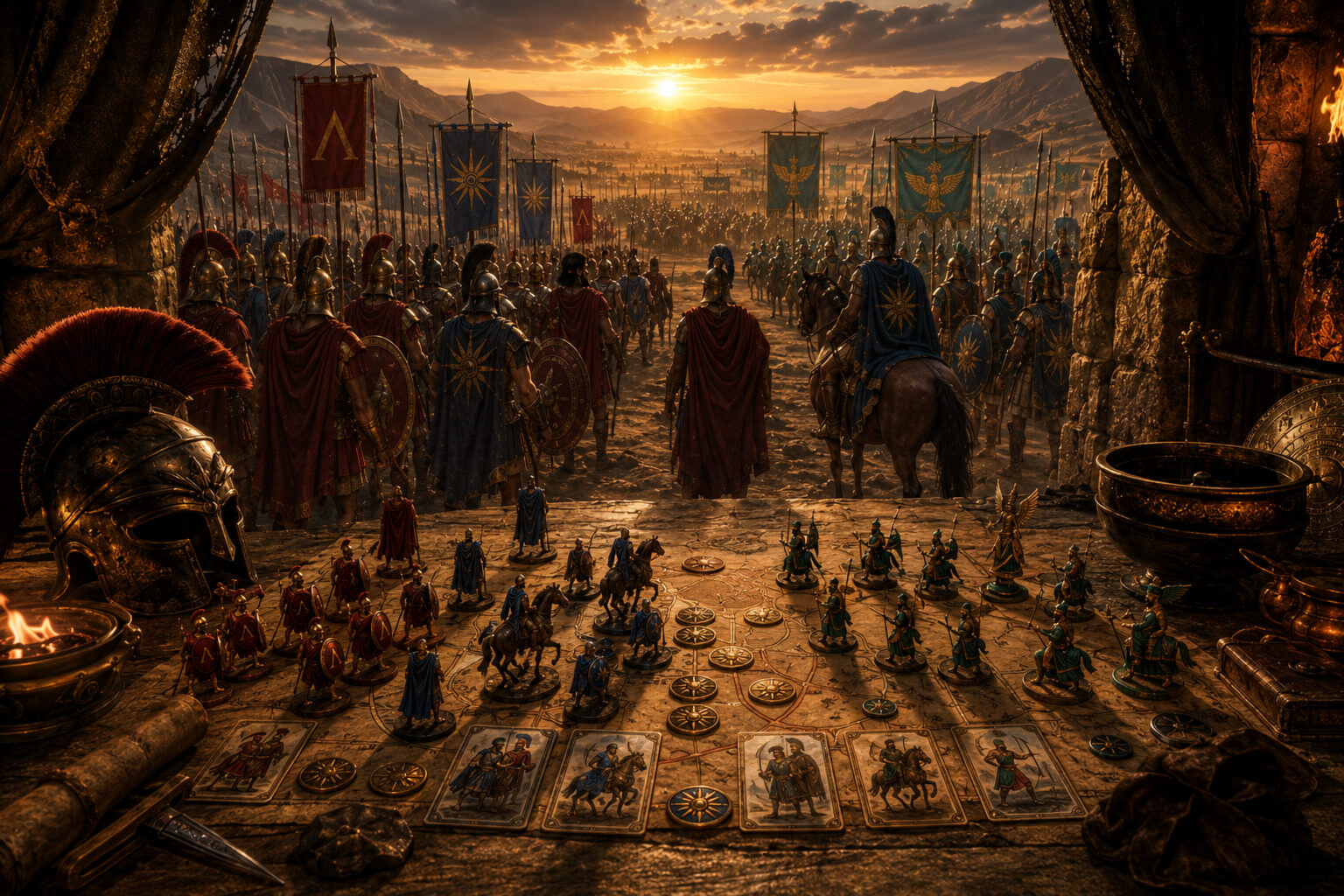
The first strategic decision in a duel is made before either player sits down. It happens in the deck builder, quietly, with no opponent in the room and nothing at stake yet, and it constrains everything that follows.
By the time the first card is drawn, you have already decided what your army is capable of. What you have not decided, and cannot, is which parts of it you will actually hold when you need them, or what the person across the table intends to do about any of it.
Forty cards is a budget, not a shopping list
A deck in Ancient Duel is exactly forty cards. You may run up to three copies of anything, one or two Commanders from your primary faction, and at most two Terrain cards. Those numbers sound like housekeeping until you try to build something, and then they behave like a budget.
Every card you include is a card you are not including. A third copy of something raises the odds you see it early and costs you a slot you might have given to an answer. An extra Tactic is one fewer Unit, and a deck that runs short on units loses to boards it should have been able to contest. A Terrain card can hold an entire strategy together and sit uselessly in your hand in the duels where it never becomes relevant.
The interesting cards make this sharper, because their value is conditional. Legionary Cohort gains defensive strength only when Testudo is face-up, so the Cohort is partly a bet that you will draw the Doctrine. Hammer and Anvil does nothing unless you control infantry and cavalry at the same time, which means including it commits you to a deck that reliably fields both. Companion Cavalry hits harder only alongside infantry. None of these is a strong card in isolation, and each of them asks you to spend more than one slot to make it good.
There is no set of forty best cards. There is a set of forty cards that work together, and building one means accepting that some perfectly good cards do not belong in it.
Consistency against flexibility
The deck shapes make this trade explicit. A Pure deck is a single faction, all forty cards. An Allied deck is thirty cards from your primary faction plus ten from one ally. A Coalition deck, available once you have unlocked three or more factions, splits twenty-six, eight and six across three.
Pure is the most consistent thing you can build. Faction effects apply to cards from their own faction unless stated otherwise, so a single-faction deck has every internal condition pointing the same way, and it draws what it expects to draw. The cost is that whatever your faction cannot do, you cannot do either. Sparta is not going to develop a cavalry plan because you would like one.
Allied buys you a tool your primary faction lacks, and pays ten cards of consistency for it. Those ten cards are not a free extension of your deck; they are ten slots that no longer contribute to your main plan, and a fair number of their effects will not reach across the faction line. Coalition goes further and gives you the widest range of answers, at the price of a real risk: a Coalition deck can end up as a collection of individually strong cards that never assemble into anything. Twenty-six cards is not many for a primary plan, and eight and six are barely enough to make a secondary one function.
The honest version is that a very consistent deck becomes predictable, and a very flexible deck often fails to draw its pieces together. Neither is the correct answer. Choosing between them is the first real strategic decision the game asks of you, and it is one you make with no information about who you will be facing.
The Commander is the first decision, not the last
Commanders are easy to treat as a finishing touch, the last card slotted into a finished list. In practice they work better as the thing you build around.
You may run one or two, they must come from your primary faction, and each leader exists as two distinct cards representing different facets of the same person. Running both versions of a leader is allowed. Running the same card twice is not. That structure means the choice is rarely about raw power and usually about direction.
A Commander who strengthens infantry in Defense pulls your deck toward holding ground, which raises the value of defensive Tactics and makes a Terrain card that rewards patience worth its slot. A Commander who improves cavalry pushes you toward units that punish openings, and toward the Doctrines that need both infantry and cavalry present. A Commander who protects a Terrain Doctrine from removal changes how confidently you can invest in terrain at all, because it removes the main reason not to.
Pick the Commander last and you get thirty-nine cards with a leader attached. Pick the Commander first and you get a deck that agrees with itself.
Then you draw five cards
This is where the plan meets its first complication, and it does so before anyone has done anything to you.
You spent your time assembling a forty-card system. The duel opens by handing you five cards from it. Your deck is what you might be able to do. Your hand is what you can do now, and the two are frequently not the same thing.
You can open with setup and no payoff: the Doctrine that makes your units work, with none of the units. You can open with payoff and no setup, holding the conditional cards whose conditions are nowhere in sight. You can draw three Tactics, which are answers to things that have not happened yet. You can draw expensive units on a turn when the energy to deploy them is several turns away. Occasionally you draw precisely the shape you built for, and those duels teach you the least.
Playing well means playing the incomplete version of your plan that this particular duel gave you. That is not a compromise imposed by the format. It is most of the skill.
Energy turns options into priorities
Energy is a single shared pool. It starts at a maximum of six, grows by one per turn from the third turn onward up to a ceiling of twelve, and refreshes at the start of your turn rather than accumulating. Whatever you do not spend is gone.
Everything draws on the same pool. Attacking costs each unit its printed Energy. Deploying a Level 5 or 6 unit costs its Energy as well. Activating a Doctrine or a Tactic costs one. You will regularly have five reasonable things to do and enough energy for two.
So the question is never what is available. It is what earns the spend this turn. Do you attack now, or spend the turn developing a board that makes next turn's attacks better? Do you commit the Commander, or hold the energy for the answer you may need on your opponent's turn? Do you establish your Terrain while the board is quiet, or keep it back for the turn the pressure actually arrives? Do you take a second attack, or leave yourself the option of activating something?
Because unspent energy does not carry over, hoarding is not a strategy either. The pool does not reward patience, only correct timing, and those are different things.
The board runs out of room
There are four positions for ordinary units and one central position reserved for the Commander. That is a small space, and it fills faster than new players expect.
Deploying is not only spending a card. It is spending a slot. A perfectly reasonable unit played on turn two can be occupying the position you want on turn four, and units do not politely step aside. It is common to reach a point where the problem is not that you lack the right card. It is that you have nowhere to put it, because your earlier decisions are still standing there.
This gives board development a shape that is easy to miss at first. Filling the board quickly applies pressure and forecloses your own options. Holding back keeps you flexible and lets your opponent build unopposed. You also get one normal deployment per turn, so the board fills at a fixed rate and cannot be corrected quickly once it is wrong.
Having an attack is not the same as having a good attack
The most common mistake I have watched is attacking because an attack is legal.
An attack is a commitment of energy, and it exposes the attacking unit to whatever the defender has arranged. Before declaring one it is worth knowing what the exchange actually produces: whether the numbers favour you, whether the face-down card next to the target is a set Tactic waiting for exactly this, whether winning the exchange leaves your unit somewhere useful or somewhere isolated, and whether the damage you gain is worth the position you give up.
Declining an obvious attack is frequently the stronger line. Holding a unit in Defense, keeping energy available, and letting your opponent be the one who commits first can be worth more than the points on the board. Tempo and aggression get confused constantly, and they are not the same thing. Tempo is about who is being forced to react.
Information accumulates
You cannot see your opponent's hand, only how many cards are in it. You cannot see their face-down units or their set Tactics. What you can see is the board, and both graveyards, in full.
The graveyards are the part players underuse. A deck holds at most three copies of any card, so once you have seen two of something, the third is the only one left, and once you have seen three, that threat is gone for the rest of the duel. If a faction's signature Tactic has not appeared by turn eight, you are making a decision about whether to play around it or accept the risk. If their Terrain went to the graveyard early, the ground is available in a way it was not before.
None of this needs to be turned into arithmetic. It is closer to bookkeeping. The player who remembers what has already been spent knows more than the player reading only the current board, and that gap widens the longer a duel runs.
Reading what the other player declines to do
After a few turns you start playing the person as well as the cards, and the useful signal is usually an absence.
An opponent who ends a turn with energy unspent has either nothing to do or something waiting. A player who passes on an attack that looked good either saw something you did not, or wants you to think they did. A face-down card followed by an unusually inviting opening is a question being asked. A Commander held back several turns past the point where it could be deployed is being saved for a turn where it will do more.
This is not psychology and it is not bluffing in the poker sense. It is simply that when both players understand the rules, the choices someone does not make are informative. You will misread these signals often. Reading them at all is still better than treating the opponent as a source of random events.
When the plan becomes the problem
The deck builder produces a plan built under ideal conditions. The opponent exists to make sure those conditions never occur.
There is a difference between following your strategy and being trapped by it. The trap looks like this: you built around a combination, the pieces are not arriving, and you keep holding cards for a setup that is not going to happen while your opponent develops freely. Every turn spent waiting makes the wait more expensive.
Knowing when to abandon the plan is a skill in itself. Sometimes a card built as a combo piece is simply a body that needs to hold a position this turn. Sometimes the deck built for a long game has to attack early because the long game has already been lost. Sometimes you concede the terrain rather than spend three turns contesting ground that has stopped mattering. A plan is useful right up until protecting the plan becomes more important than winning the duel.
The duel continues in the deck builder
A loss produces information that is worth more than the loss cost you, but only if the question afterwards is the right one.
"What did I misplay" is the obvious question and often the least useful. The better ones point back at the build. Did I run too few units and lose boards I should have contested? Did I fill slots with situational cards that were dead in most duels? Did I run one copy of a card the whole deck depends on? Did those ten allied cards cost me more consistency than the tool they bought was worth? Was there a plan I simply had no answer to, and is that a gap I am willing to leave open? Does my Commander actually support this deck, or did I include it because it is the strongest card in the faction?
The deck builder and the battlefield are not separate systems. The battlefield is where the deck is tested, and the test result is the material you take back to the builder. Build, play, observe, diagnose, adjust, play again. Most improvement happens in that loop rather than inside any single duel.
There is no perfect deck
I would not claim Ancient Duel is perfectly balanced. No card game with this many interactions is, and anyone who tells you otherwise has not played theirs enough.
What I will say is that a deck which executes its plan very well can still have real weaknesses, and that this is the intended state rather than a flaw to be patched out. If forty cards could answer every situation, deck building would have no cost, and a decision with no cost is not a decision.
The weaknesses are part of the deck's identity. A Spartan defensive build accepts that it will struggle against something that refuses to engage. An aggressive Dacian build accepts that it loses long games. Choosing which problems you are willing not to solve is as much a part of strategy as choosing which ones you will.
Simple rules, compounding decisions
Nothing described here is individually complicated. Forty cards. Three copies. Five in hand. A pool that refreshes. Four slots and a fifth for the Commander. Attack or Defense. Numbers from one to six.
The difficulty comes from the way these constraints multiply. Your deck determines what you can draw. Your draw determines what your energy is worth this turn. Your energy determines what you can put on a board that has limited room. The board determines which attacks exist. The attacks determine what ends up in the graveyards, which changes what both players know. And every one of those states is being pushed on by someone who wants a different outcome.
No single choice in that chain requires deep analysis. The chain does, because each link narrows the next.
From deck building to battlefield
In the deck builder you decide what your army is supposed to do. On the battlefield you find out what it can still do while somebody is actively trying to stop it.
The deck is a plan made in ideal conditions, with full information, unlimited time, and no opponent. The duel subjects it to incomplete information, limited energy, limited space, a draw you do not control, and another person's intentions. Strategy is not really located in either place. It lives in the distance between them, and in how well you handle the fact that the distance is never zero.
Simple Numbers, Deep Decisions: Why Ancient Duel Uses Values from 1 to 6

Every number in Ancient Duel is small. Attack, Defense, Energy and Level all live on a compact scale built around one to six, and a unit's value never climbs above twelve or drops below one. That was a deliberate constraint, and the reason for it is less about arithmetic than about a problem I could not design my way around: the game has to work on a table, with printed cards, without an app helping anyone.
Why keep the numbers small
A card with 4 attack and 3 defense can be read without thinking about it. More usefully, a modifier of plus one is meaningful against that number. So is minus one. The gap between four and five decides fights, which means a small effect is never rounding error.
When the range is narrow, every point carries weight. You are never adding up a string of modifiers to find out what a unit currently is, because there are not enough digits involved for that to become work. This is a choice about where I wanted the effort to go, not a claim that larger scales are worse. Plenty of card games run into the hundreds and are excellent. Ancient Duel goes the other way because of what it also has to be.
Complexity does not have to live in the numbers
There is a difference between numerical complexity and decision complexity, and the two get treated as the same thing far too often.
An attack value of 4 is numerically trivial. The decision around it usually is not. Whether to attack with that unit depends on which target you pick, whether that target is in Attack or Defense position, what its defense actually is after everything currently affecting it, whether a Terrain Doctrine is bending the exchange, what your Commander is contributing, whether the face-down card beside the target is a set Tactic waiting for precisely this, how much Energy the attack costs and what else that Energy could buy, and what the board looks like afterwards if the exchange goes the way you expect.
None of that is arithmetic. All of it is judgement. Keeping the numbers small was a way of making sure the difficulty of a turn comes from reading the situation rather than from doing sums.
The physical game changes what a number has to do
A digital game can change a number on screen and consider the matter closed. The interface tracks state, players never see the bookkeeping, and a value could be 147 without costing anyone anything.
A physical game has no such luxury. Somebody has to be able to see the current state, change it, and still be reading it correctly six turns later. Ancient Duel had to work as a printed game and a Print & Play download, which means every value in the system needs a practical physical representation using things people already own.
A d6 turns out to be almost perfect for a scale built around one to six. It is the most common die in the world, it costs nothing, it is easy to read from across a table, and it sits comfortably on a card without covering it.
One thing needs saying plainly, because it is the single most common misunderstanding: the dice are never rolled. Nothing in Ancient Duel is randomised by a die. If a unit gains two attack, you do not roll to find out how much. The effect already told you. You pick up a d6, turn it to 2, and put it on the card. The die is a physical memory of a value the rules have already determined.
How dice track a unit
Buffs and debuffs are tracked differently, and the difference is not the colour of the die. It is where the die sits relative to the number it is talking about.
A buff sits beside the value
When an effect raises a stat, the die goes next to the affected number on the card: beside ATK if the buff is to attack, beside DEF if it is to defense. It shows the size of the bonus, not the result.
current value = printed value + die, up to a maximum of twelve.
A card printed with 4 attack that gains two shows a d6 set to 2 beside the printed 4. The unit is at 6, and both halves of that fact stay on the table: the 4 the card came with, and the 2 something else contributed. That matters, because the moment the aura leaves or the equip is destroyed it is a 4 again, and keeping the printed value visible keeps that fragility visible with it.
A debuff sits over the value
A weakened stat works the other way round. The die is placed on top of the printed number, covering it, and it shows the current value directly.
A card printed with 4 attack reduced to 2 has a die set to 2 sitting over the printed 4. You read 2, because 2 is what the unit is. There is nothing to subtract and no penalty to hold in your head, which matters because a wounded unit gets compared against attackers several times before the effect expires. Doing four minus two on every one of those comparisons is exactly the small repeated cost that makes a physical game feel like paperwork.
Why position and not colour
Green for a buff and red for a debuff is a nice touch, and the rulebook suggests it. It is not what the system runs on.
Most people do not own two colours of d6. If colour were carrying the meaning, a player with six identical white dice would be stuck: a 2 on a card could be a bonus or a penalty and there would be no way to tell. Because placement carries it instead, that player is fine. A die beside the number adds to it. A die over the number replaces it. Six white dice work exactly as well as a matched green and red set, and the colour becomes what it should be, a convenience that makes the board quicker to scan rather than the thing that makes it readable at all.
That is the same principle as the score sheet, and it runs through the whole component list: preferred components should make the game easier, never decide whether it works.
Twelve above, one below
No value goes above twelve or below one. Both limits come from the same place.
The highest printed value on a card is six, and a d6 shows at most six. Six plus six is twelve, so the ceiling is exactly what a single die can express on top of the strongest printed number. There is no situation that needs a second die stacked on the first, a two-digit token, or a note off to the side. The physical representation and the rule limit are the same shape.
The floor of one exists for the same reason from the other direction. A value never has to be shown as zero or as a negative, so a d6 can still express any weakened state a unit reaches. Nothing in the system requires a die face that does not exist.
Both limits are enforced the same way in the digital engine: every computed stat passes through a single clamp that will not return less than one or more than twelve. That matters more than it sounds, because it is the guarantee that the two versions of the game cannot drift apart. A unit that would read 14 online is a unit a table could not represent, and the moment those two disagree, one of them has stopped being Ancient Duel.
Energy and life, with ordinary dice
Energy has a maximum of twelve and refreshes every turn instead of accumulating. On each of your first two turns you have six, and from your third turn it grows by one, to seven, eight, nine, and onward to twelve. Whatever you did not spend last turn is gone.
A single d12 tracks that perfectly, and two d6 added together do the same job for anyone who does not own one. Energy of eight is a die showing 8, or a 6 and a 2 sitting next to each other. Neither is rolled. You set them to what you have and turn them down as you spend.
Life starts at 20 and is best tracked with a d20 spindown die, which is designed for exactly this: you rotate it one face at a time as the number changes rather than hunting for the value. It is the one component I would actually recommend buying, and it is still not required. Any way of writing down a number that starts at 20 and goes down works, which brings us to the part of the system I care about most.
Not everyone has a pile of dice
Here is the practical problem. A board can hold five units per side, each of which may be carrying modifiers, plus Energy and life for both players. Track all of that with dice and you can find yourself wanting fifteen or twenty of them.
I did not want the Print & Play philosophy to quietly become: download the cards, print them, then go and buy a bag of dice before you can play. That is not print and play. That is print, shop, and play.
So the game ships a score sheet, and it is not a lesser option or an accessory. It is a complete alternative that tracks exactly the same state with a pencil.
How the score sheet actually works
Each player gets a sheet with rows for life, Energy, and five unit slots. The whole system rests on one rule: write the new value to the right of the old one, and the last number written is the current one. You never erase anything. The row becomes a history, and the rightmost entry is the truth.
LP starts at 20. After every hit or heal you write the new total in the next box. At zero you have lost. The row reads as the whole arc of the duel: 20, 18, 15, 16, 9.
E is one row per turn, and each row has its maximum pre-printed: T1 (6), T2 (6), T3 (7), T4 (8), up to (12) where it stays. A detail worth catching is that T1 means your first turn, not the first turn of the game, so both players read their own row structure the same way. Within a row you write what is left after each spend, not what you spent. A row reading (7) 5 2 0 says you began the turn with seven, spent two, then three, then two. A new turn is a new row, and anything left in the old one is gone, which the layout makes visually obvious.
U1 through U5 are your five unit slots, matching the five positions on the board, including the middle one that only a Commander can occupy. Each row carries a single combined value in the form A/D. A unit with 3 attack and 4 defense is written 3/4. An empty slot is a dash. As things change you keep writing along the row, and the last mark is the current state.
The sheet's own example shows how much that row can say. U1 reading 3/4, then a dash, then 5/2, then 6/2 is the story of a unit that died, was replaced by a different unit, and then got buffed, all legible at a glance without a single erasure.
Temporary values go in parentheses
Anything that will expire is written in parentheses. A unit at 4/5 that takes a Kamikaze wound becomes (2/5). At the start of your turn you look at the parentheses on your sheet, check whether the effect has expired, and if it has, write the normal value back. The row would then read 4/5, (2/5), 4/5.
The parentheses are doing the job that a red die does in the other system: marking a value as borrowed rather than permanent, so you know it needs revisiting.
One-turn buffs are not written on the unit rows at all
This is the convention I am happiest with, and it is the one people expect least. Effects that last only until the end of your turn do not go on the U rows. The U rows record what persists between turns: equips, auras, Kamikaze wounds.
A buff lasting only the current turn goes on that turn's Energy row instead, written with a sign and a stat letter. U1 +2A means unit one has two extra attack. U3 -1D means unit three has one less defense. U2 +1/+1 covers both stats at once. Because that Energy row closes when your turn ends, those effects expire on their own. There is nothing to remember and nothing to undo. The bookkeeping cleans itself up because it was written somewhere that stops being current.
Continuous effects need a re-check
The one place the sheet asks for real attention is continuous effects. Commander auras, continuous Doctrines and equips change the values of other units, so when one of those cards enters or leaves play, several rows can change at once. The sheet tells you to re-check all your units and rewrite whatever moved. Deploy a Commander whose aura strengthens your infantry and three rows may need a new entry.
This is the honest cost of the paper version. The digital game recalculates that instantly and silently; on paper you do it yourself, and it is the moment most likely to produce a mistake. It is also the moment where writing across a row rather than erasing pays off, because the previous values are still there if you need to reconstruct what happened.
A worked example
Say U1 holds a unit printed 4 attack, 3 defense. The row currently reads 4/3.
An equip gives it two permanent attack. That persists between turns, so it belongs on the unit row: you write 6/3 to the right of the previous entry. With dice you would instead place a d6 set to 2 beside the printed attack value, and the unit reads as 4 plus 2.
Now a Tactic gives it one defense until the end of your turn. That does not go on the U row. It goes on the current turn's E row as U1 +1D, alongside whatever Energy figures are already there. Your unit is effectively 6/4 for this turn, but only the 6/3 is written where it will still matter tomorrow.
Your turn ends. The E row closes with it, the temporary defense goes with the row, and U1 still reads 6/3, which is correct without anyone having to remember to remove anything.
The sheet is a layout, not a dependency
The printed score sheet gives you the boxes, the pre-printed Energy maximums per turn, and the reminders at the top. That is worth having.
What it is not is a requirement. The structure is seven labels and some space: LP, E, and U1 through U5. If you printed your cards and ran out of sheets, or never printed sheets at all, you can draw those rows on any piece of paper in about fifteen seconds and keep playing. The convention of writing to the right, the parentheses for temporary values, and putting one-turn buffs on the Energy row all work exactly the same in a notebook. The only thing you lose is the pre-printed turn maximums, and those follow a sequence you will have memorised by your third game.
If a printed component becomes the thing standing between someone and a game they already downloaded, the design has failed at something more basic than balance.
Three interfaces, one game state
The important idea underneath all of this is that dice tracking, sheet tracking and the digital client are not three rule sets. They are three ways of displaying the same state.
Dice are the most visual. They sit on the card itself, they are read instantly, they involve almost no writing, and moving them is satisfying in a way paper is not. Their cost is that you need enough of them.
The sheet needs almost nothing: one page and a pencil per player. It centralises everything into one place you can scan, and it keeps a history that dice throw away the moment you turn them. Its cost is more writing and, on continuous effects, more attention.
The digital version does the same tracking automatically. That is the whole of its advantage. It does not change a rule, alter a value, or resolve anything differently. If a physical board has a unit printed 4 with a 2 beside it, the digital board shows the same unit at 6; if a die showing 2 is covering that printed 4, the digital board shows 2. The automation is a convenience layered over a system that was designed to work without it, which is deliberately the wrong way round from how most digital-first games get ported to the table.
Small ranges make modifiers matter
There is a design consequence to the compact scale that I did not fully appreciate until playtesting.
In a narrow range, a single point is a real event. Moving a unit from 3 to 4 attack can decide an exchange that was going to be lost. A minus one applied at the right moment changes what your opponent can safely attack into. You never need a card that grants a large bonus for the bonus to feel like it did something, because there is no headroom for a small change to disappear into.
Wide ranges absorb small changes; narrow ones expose them. That makes modest, conditional effects worth printing, which in turn is what lets so many cards in the game be about the relationship between units rather than about raw statistics.
It also keeps the cards readable. Attack, defense, Energy and Level all fit comfortably, effect text stays short because the numbers inside it are short, and a player can evaluate an unfamiliar card in a couple of seconds. That is true on screen and on cardstock, but the cardstock is the one that set the constraint.
The numbers are simple, the state is not
Picture a mid-game board. A unit printed at 4 attack with a green 2 on it. Energy at 8. Life at 14. Two cards face-down across the table. A Terrain Doctrine face-up that neither player established this turn.
Every one of those facts is trivial to represent. A die, a die, a die, two cards lying face-down, one card face-up. Anyone could set that board up correctly from a written description.
What none of that tells you is whether to attack. Whether to spend the Energy now or hold it for a response on your opponent's turn. Whether the face-down card is the Tactic that punishes exactly this attack, or nothing at all. Whether the unit is worth risking or worth protecting for two more turns. Whether contesting the terrain is worth what it costs you elsewhere.
The state is easy to see. What to do with it is not, and that gap is the entire point.
Where the difficulty belongs
A number printed on a card should be understood at a glance. A buff should be one die, set by hand, sitting on the card. A weakened unit should be readable without subtraction. Energy should fit on a single d12 or two ordinary d6. Life should fit on a d20, or on a row of a sheet, or on a line in a notebook. If you have no dice at all, the same state should still be trackable with a pencil, and if you have no printed sheet, you should be able to draw one.
That part of the game is meant to be easy, and I spent a disproportionate amount of time making sure it stayed easy.
What you attack, what you protect, what you sacrifice, where the Energy goes, when the Tactic fires, which ground is worth holding, what the other player is preparing, and how much risk is acceptable this turn: that is where the game is supposed to be hard. The numbers should be the easy part. The decisions are not.
▶ Vidéos (0)
Pas encore de vidéo pour ce jeu.
Commentaires (0)
Connecte-toi pour commenter ou répondre.
Pas encore de commentaire. Lance la discussion.