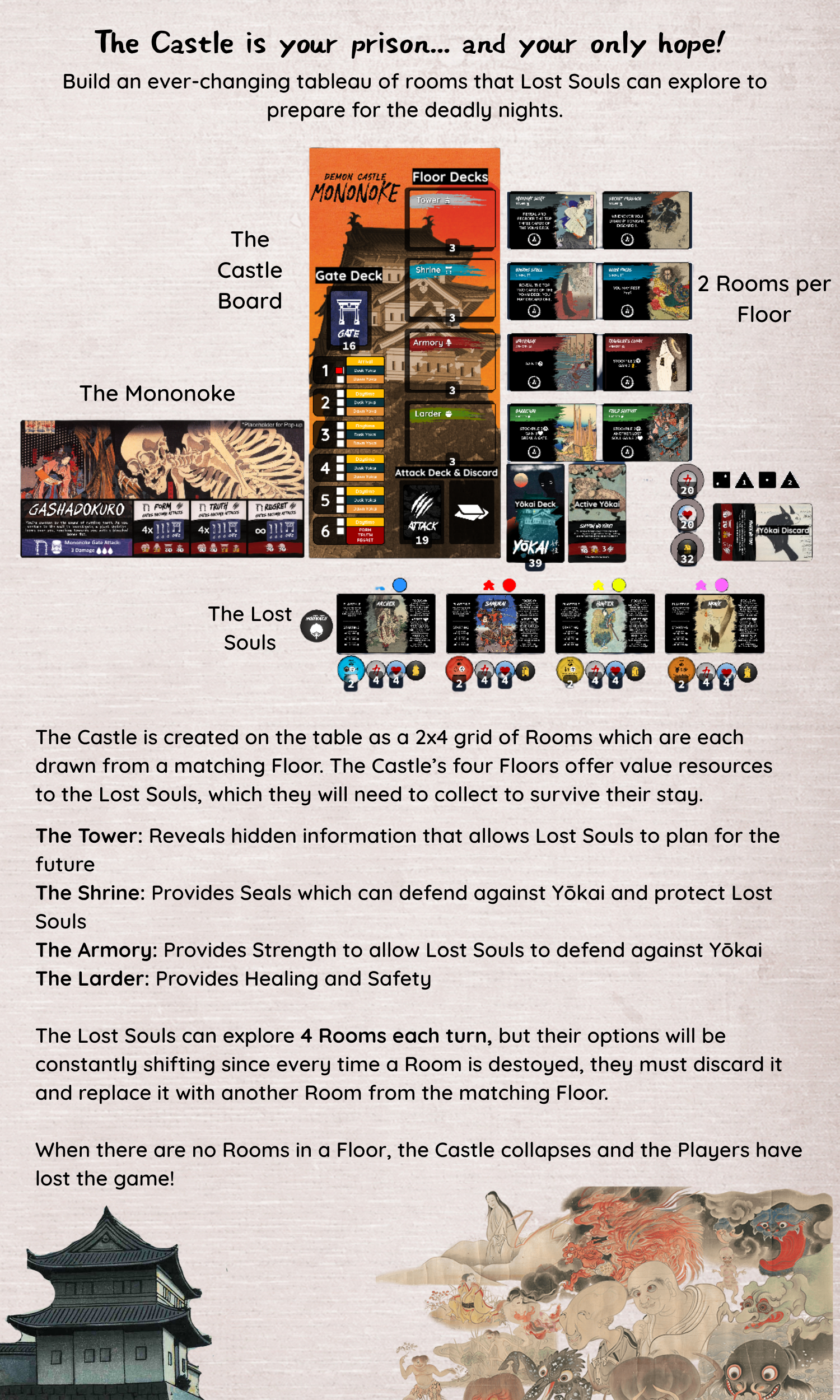
The Castle is never the same, whenever a room is destroyed, a new one takes its place. New combinations are always being unlocked and discovered!
The Mononoke - Form, Truth, & Regret
The Players final challenge in the Castle will always be facing off against the titular Mononoke, at least 5 of which will ship with the game. Depending on the number of Gates that were broken by Yōkai or by the Players themselves, since the Castle will give them opportunities to gain additional resources at the price of breaking them, this final encounter can be massively challenging!
What's in the box?
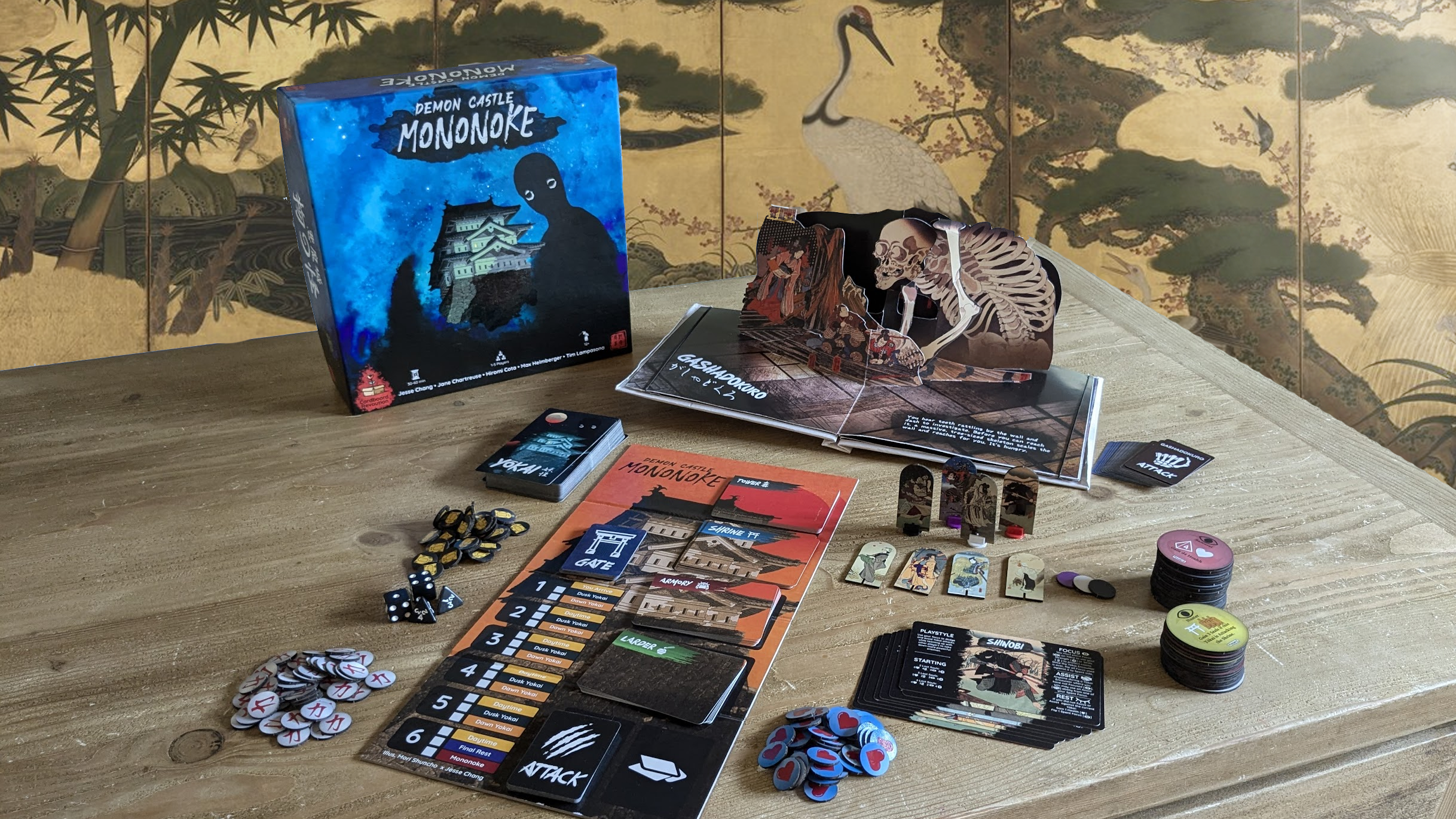
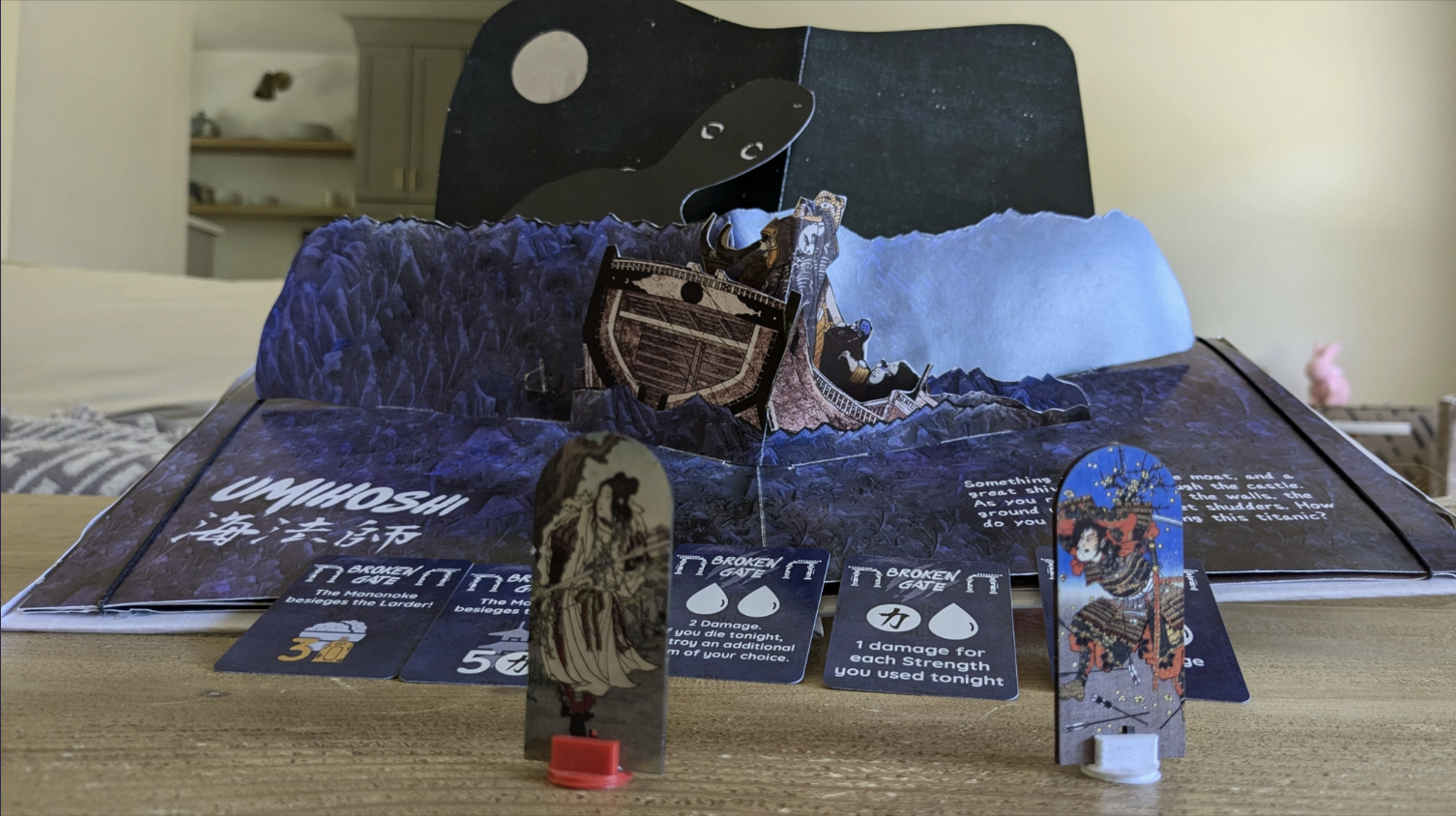
We designed DCM to have a ton of table presence while maintaining a modest footprint.
Center stage is the
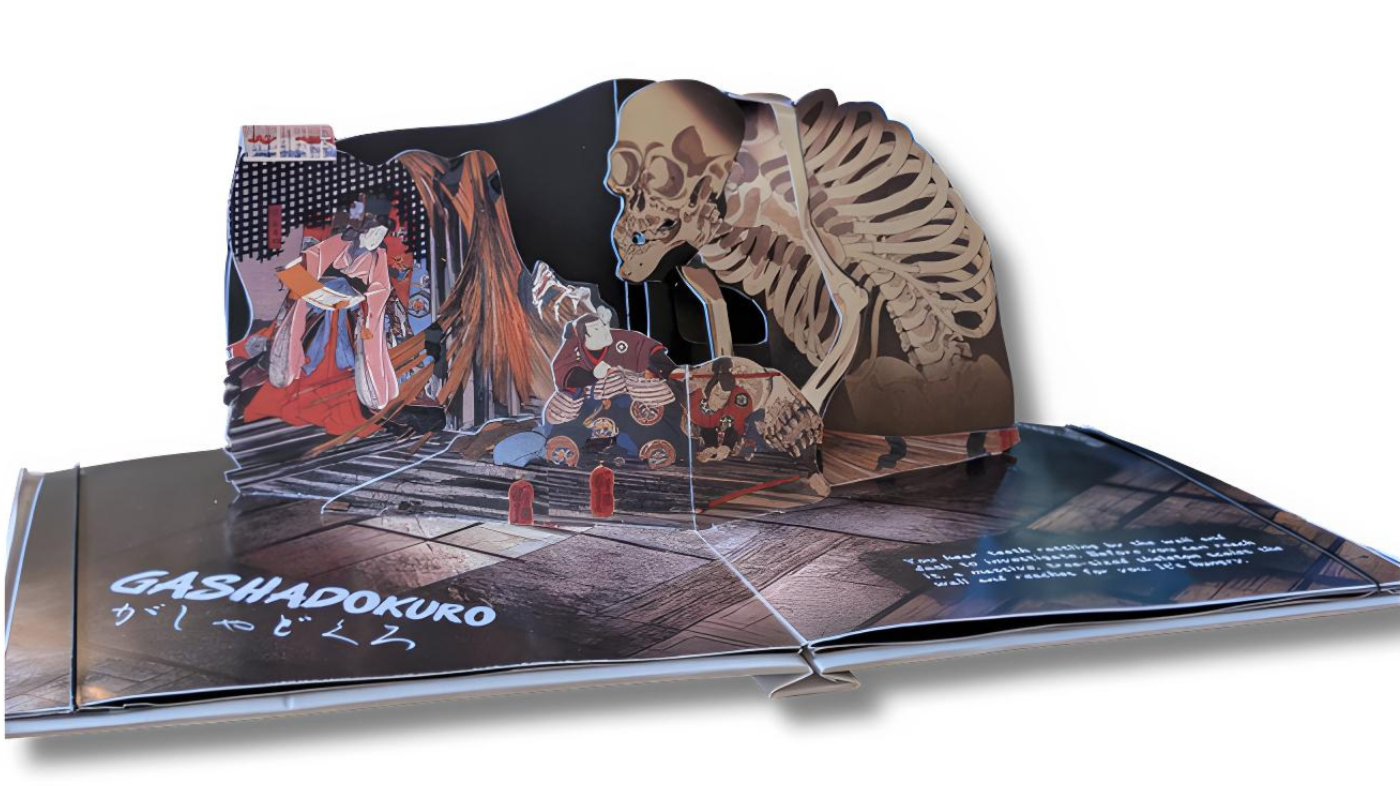
Book of Demons, where the game's antagonists
literally pop out of the page. Created by paper engineer and artist,
Dario Cestaro, these transformations of some of our favorite Ukiyo-e triptychs, such as
this one by Utagawa Kuniyoshi,
are real attention grabbers. We love opening them to new players and seeing the childlike wonder that only opening a pop-up book can inspire. At least 5 Pop-up Mononoke will ship with the game, with the potential for several more to be unlocked by reaching our stretch goals.
The Mononoke is supported by a rogues gallery of
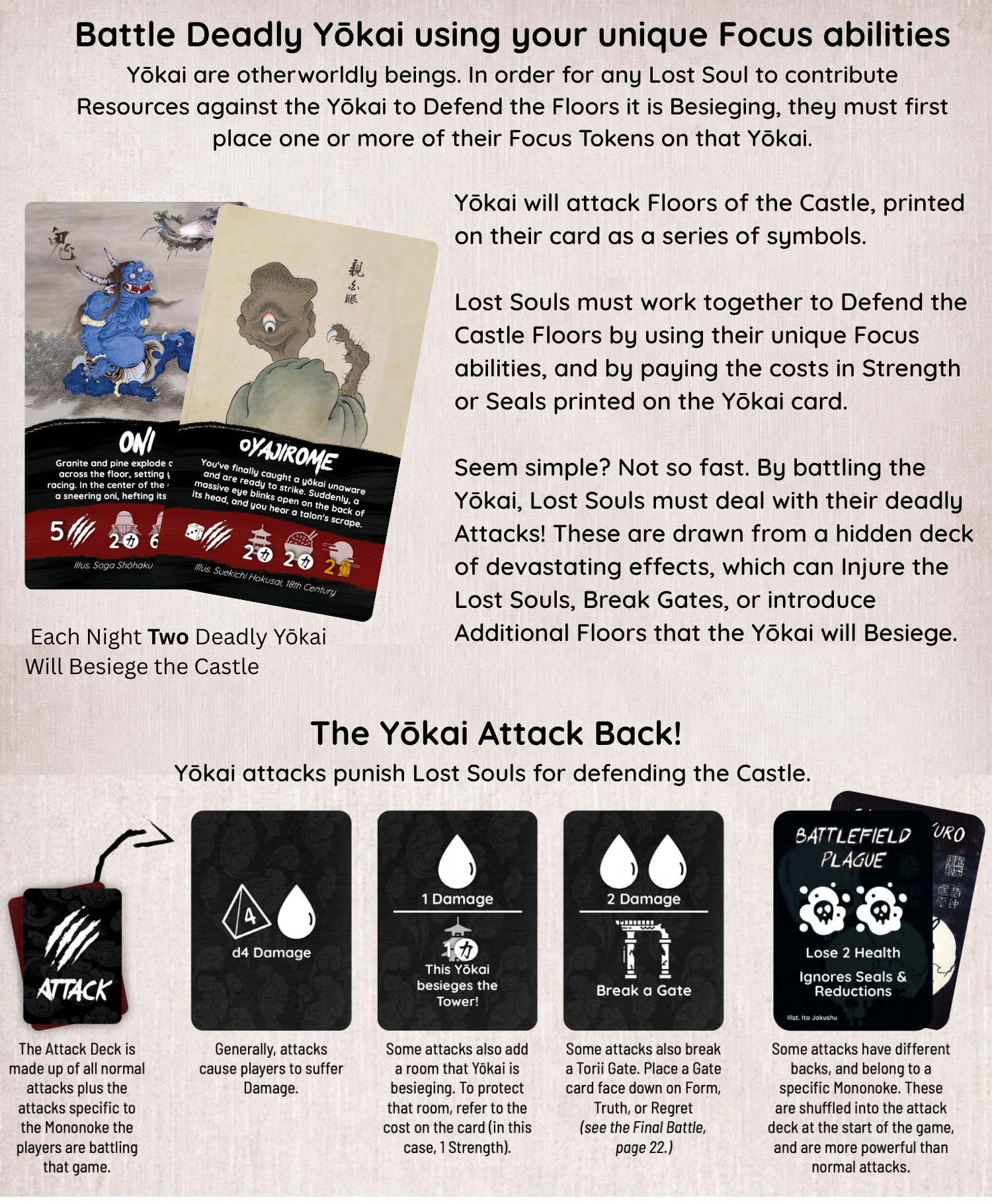
40 unique tarot-sized Yōkai cards. We started developing this game from a love of this art, and these cards are minimalistically formatted to show it off. Every game of DCM features a random selection of
10 Yōkai that appear across the game's 6 nights.
Each is introduced by an
original immersive fiction from talented writer
Hiromi Cota which are intended to be read aloud to the table before they besiege the Castle.
The eponymous Castle is a sprawling collection of 40 unique Rooms, which provide an tableau of actions that Players will use to prepare their defense against the Mononoke and Yōkai. Only 28 of the 40 Rooms are used during each game, providing significant variance in setup, and since only 8 Rooms are available to Players at any given time, with their disappearance and reappearance unfolding along with the game, each new Castle is unlikely to resemble one you've seen before.
Players are embodied as one of
8 tarot-sized Lost Soul cards. Each Lost Soul comes from an immoral past, written also by
Hiromi Cota, which precedes their karmic imprisonment in the Demon Castle.
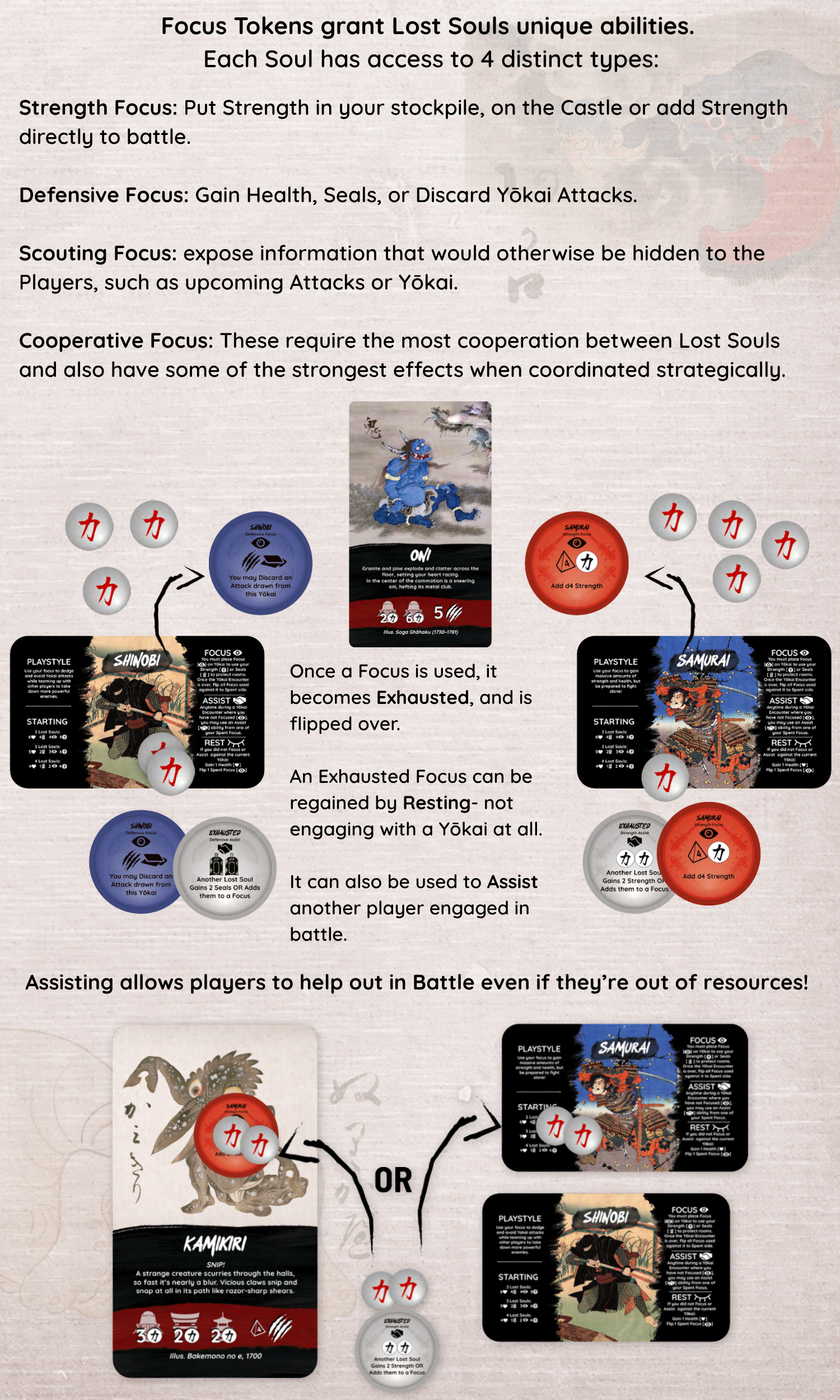
Each Lost Soul also brings along by 4 Large Focus Tokens, which represent their unique capacities to confront otherworldly beings. No two Lost Souls bring the same Focus to the table, and each Focus requires rest to be used repeatedly. Collaborating between the other Lost Souls to use the right Focus at the right time is the beating heart of DCM and the mechanic that keeps all players at the table involved - no single Lost Soul can do it all!
These above core components are supported and complemented by the following additional components:
- 14 American-Sized Mini-Poker Yōkai Attack cards
- 20+ additional American-Style Mini-Poker cards that represent Special Mononoke Attacks (final count dependent on Stretch goals)
- 16 Torii Gate America-Style Mini-Poker cards
- 32 Poker Sized Room Cards
- 1 Folding Castle Board that holds the Room cards, the Yōkai Attack cards, and Torii Gate cards (See above)
- 120 Circular Strength, Health, and Seal tokens - 40x of each
- 2 six-sided dice
- 2 four-sided dice
Play Demon Castle Mononoke Now
Screentop.gg is a free, browser-based, tabletop games platform with no sign-ups or subscriptions required. Simply click the link and you're good to go!
Some helpful hints for navigating Screentop.gg:
- Hovering over any game component and pressing SPACEBAR will MAGNIFY that component - this makes things much easier to read without adjusting your zoom!
- DOUBLE-CLICKING any stack of components will select the entire stack of those components
- Holding SHIFT and clicking any stack of components will select one additional instance of that component per click
- The F-KEY will Flip a component
- The Z-KEY will shuffle a selected stack of components
- A more extensive user guide can be access within screentop by clicking the circular info icon in the top-right of the in-game screen.
Learning to Play the Game:
Our resident rules-teacher Jane has recorded a twofer: How to play the game, and how to use Screentop.gg!
Reviews and Watch it Played!
We were able to give Arwen a preview copy of Demon Castle Mononoke at PAX Unplugged this year, and in her review she independently identified a lot of what we at Cardboard Revolution love about our game.
Please check our her stellar review followed by an and interview with Tim, Jane, and Max where we get into what it's like to develop games as a cooperative, how we developed Demon Castle Mononoke, and how we all really just love little guys.
Also check out this wonderful gameplay overview and review by Sir Thecos!
For those who want to see a
full game, check out
Jane's Solo Let's Play Video, which will covers the core concepts of the game and demonstrates a game from start to finish.
We had the pleasure of playing Demon Castle Mononoke on Jamie Dagger's stream, where we yapped about game design, Yōkai mythology, and managed to play a very drawn-out game in between!
The Lore
A game of Survival, inspired by Storytelling.
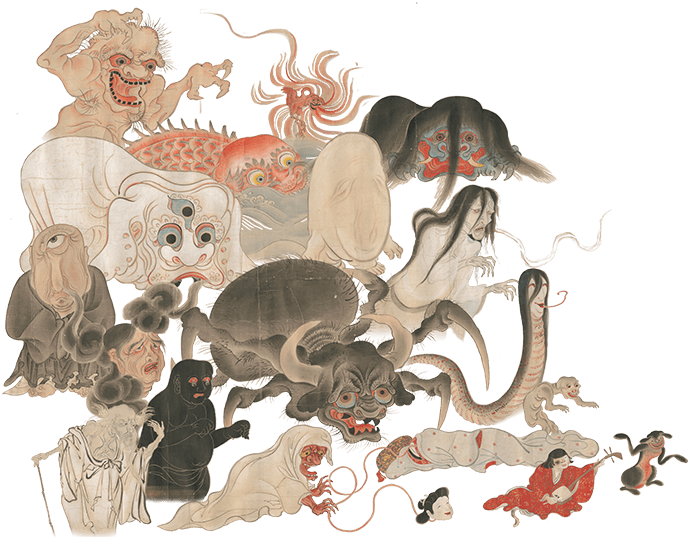
Hyakumonogatari Kaidankai (百物語怪談会) or "A Gathering of One Hundred Supernatural Beings” is a game where attendees would gather at night with 100 lit candles and take turns telling tales of demons and spirits. After each story the teller would snuff another candle, until only one remained lit - a final ward blocking those supernatural creatures from the human world. One Hundred Ghost Stories in a Haunted House - Illst. Katsushika Hokusai (1790)
Demon Castle Mononoke puts Players in that supernatural world - embodied by Ukyio-e era art.
Players act as Lost Souls, travelers with unsavory pasts who find themselves trapped in an abandoned (and very haunted) Castle. Their arrival there isn't a coincidence, they have been lured by the Mononoke, a strange and powerful supernatural event, which by its sheer volume of spiritual power has attracted a menagerie of other demons and spirits, know as Yōkai.
The Lost Souls, the Mononoke, and the Yōkai are all given in life in the game's components by largely unaltered prints of 18th-19th century art.
The Player's ability to cooperate will decide whether they ever leave these walls or instead die trapped in their wreckage.
Playing Demon Castle Mononoke is about choosing between awful options. During each of the game's 6 turns, the Lost Souls will weather a long night under siege by malign and unpredictable spirits, followed by a never-long-enough day, during which they must scour the Castle for resources to carry them through the next inevitable night.
Only through careful deliberation, and consideration of each other's strengths and weaknesses, will they emerge with their bodies and spirits intact.
And this is a story that can be told again and again...
We've built variability into every aspect of Demon Castle Mononoke. From the Mononoke and Yōkai, to the construction of the Demon Castle, to the Players themselves - no two setups will look the same.
We also believe in games that have an easy time finding their way to your table.
Demon Castle Mononoke can play as a true co-op game between 2-4 players, but is also a delightful solo experience when played two-handed by a single player.
For groups who prefer competition, a single player may also choose to take on the role of the Mononoke, making active decisions where the co-op version of the game relies on randomness. This makes All vs. One style play available for up to 5 Players and also allows Demon Castle Mononoke to be played as a 1v1 asymmetric duel.
Solo Mode and Let's Play
Demon Castle Mononoke is great with friends but we've taken great care to ensure that the game plays just as well solo! The setup for a solo game of DCM is identical to a two player setup with the solo player taking control of two Lost Souls. This "two-handed" mode of play offers a deep tactical experience similar to Spirit Island, where coordinating the actions of each hand is a different experience than playing with others, but one that can be equally satisfying while allowing players to deeply explore the game's design space as a challenging solo puzzle.
You can see what a solo game of Demon Castle Mononoke looks like in this Let's Play video with designer Jane Chartreuse.
All vs One Mode
In this game mode, a single player becomes the Mononoke, turning the game into a battle of wits between them and the players acting as Lost Souls.
The Mononoke player decides the order that Yōkai will visit the Castle, while making a hidden wager about whether the Lost Souls will confront the first or second Yōkai that Night.
Lost Souls must account for what the Mononoke thinks they will do, since successful wagers grant the Mononoke additional resources that allow them to setup traps around the Castle or place curses upon the Lost Souls.
My favorite part? The Book of Demons becomes the Mononoke Player's screen! It's used to hide their resources, and the backside includes a summary of the all v one rules, so the Mononoke Player gets to feel like a true villain.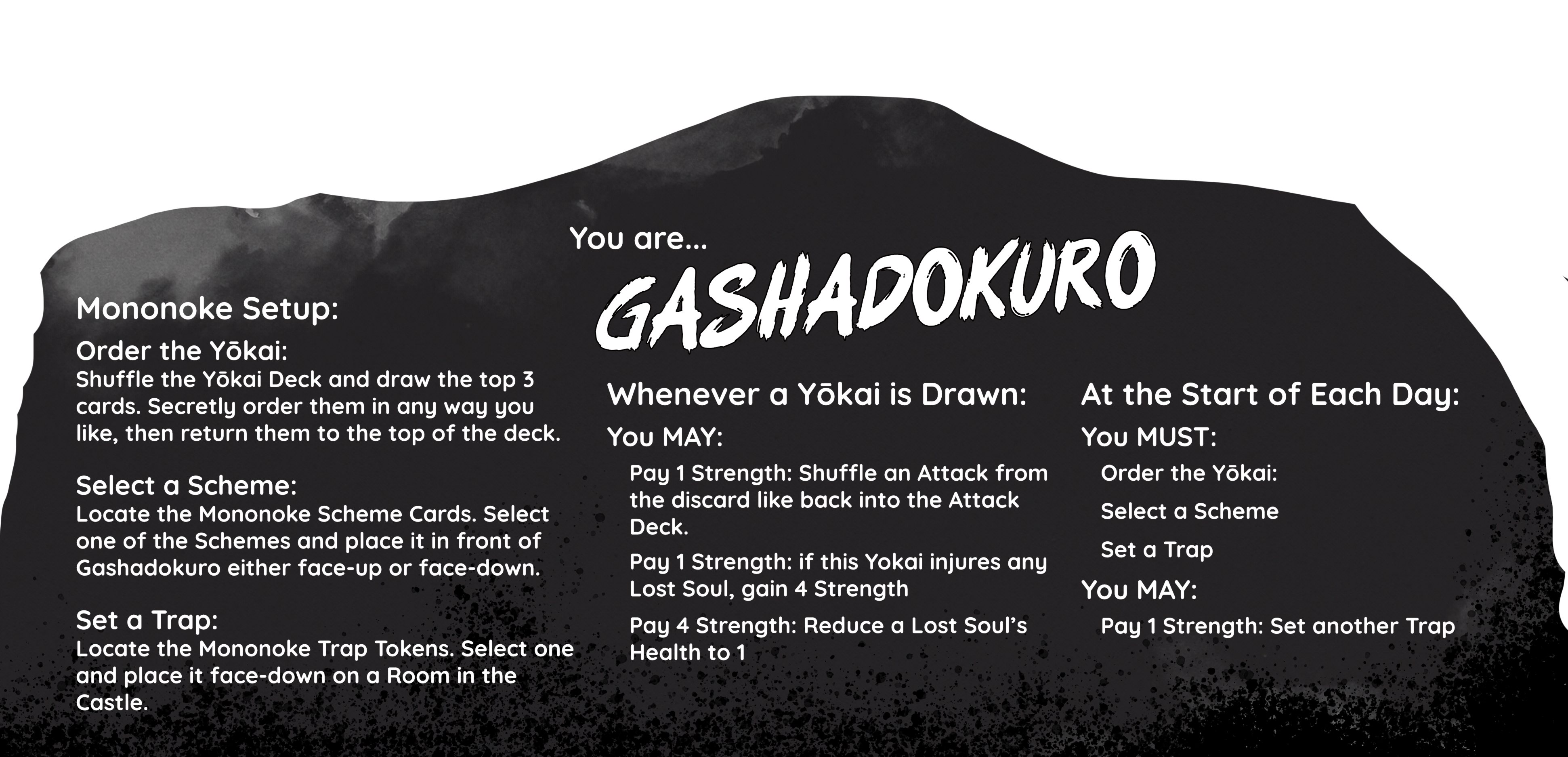
How does it work?
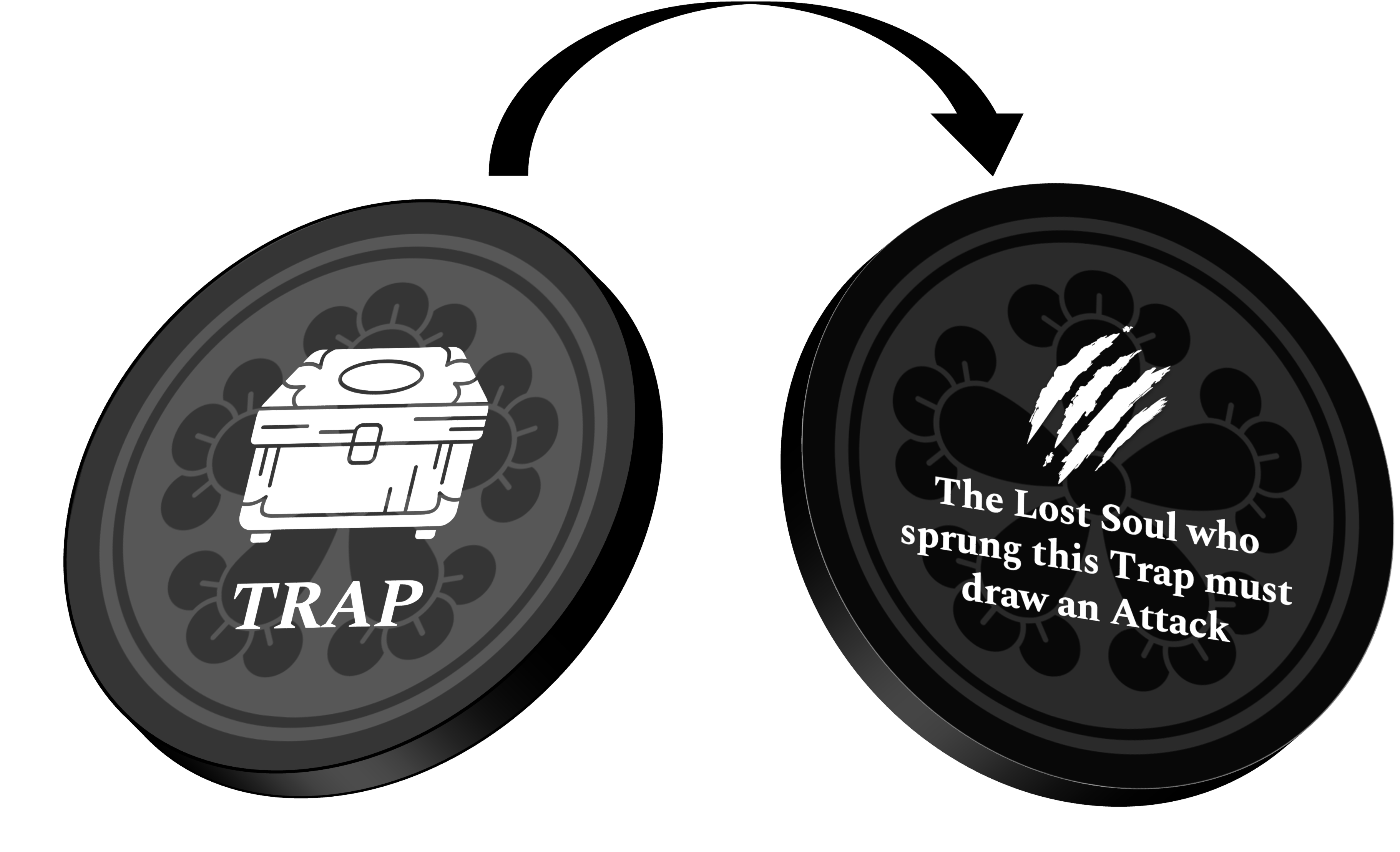
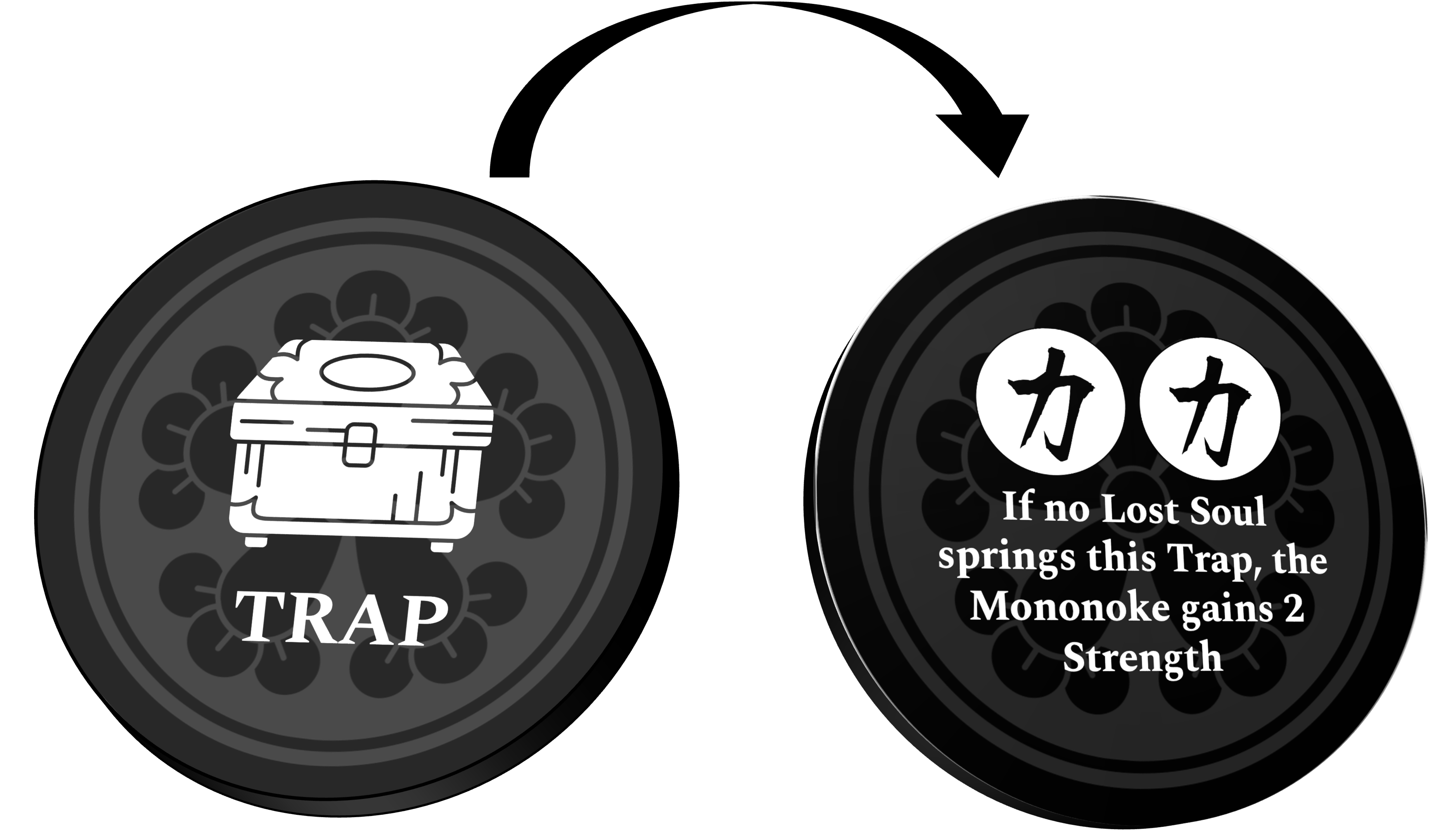
The Mononoke player has immense power. They gain a few unique components to mess with the Lost Souls’ heads, manipulate their Yōkai minions, and set deadly traps in the castle. Every turn, the Mononoke player places a trap on a Castle room, and arranges the top 3 cards of the Yōkai deck however they like. These traps are a real head fake. Some damage the Lost Soul who springs the trap, but others only trigger if nobody springs them!
Suddenly, the Lost Souls face an extra layer of trickery! Did they place the trap in that room knowing we’d ignore it? Or are they thinking that we’re thinking that??
Not only that, the Mononoke player has their own stockpile of Strength tokens that they can spend to add more traps or plan out more Yōkai encounters.
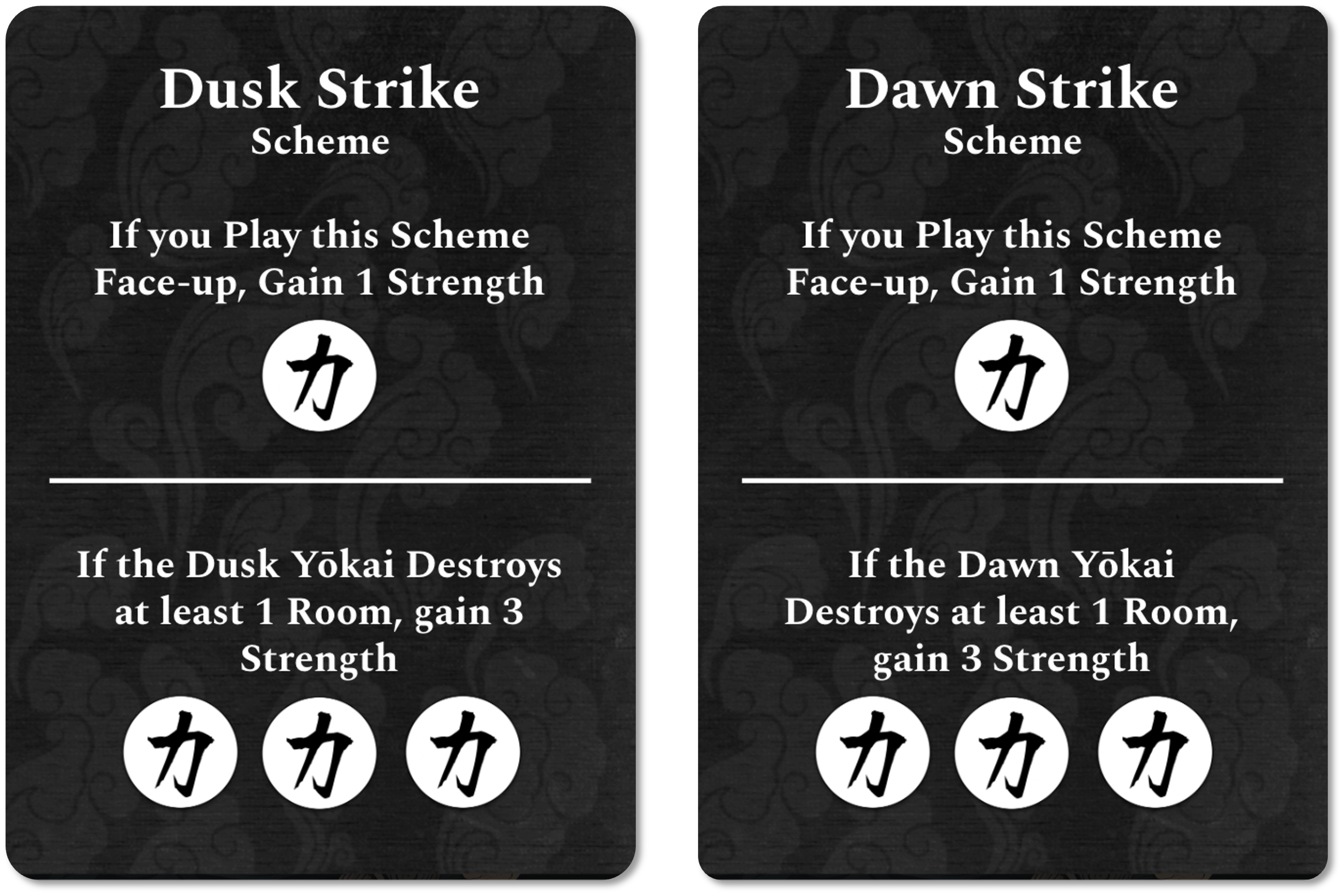
The Mononoke player can gain strength through more mind games, Schemes. Each turn, the Mononoke player places 1 Scheme on the table, either face up or face down which acts as a bet on which of the two Yōkai Besieging the Castle this turn will destroy at least one Room. If they wager properly, they gain 3 Strength, but they can also gain an additional Strength by revealing their bet at the start of the turn. Do you take the guaranteed 1 Strength by revealing it or does keeping it secret grant you an edge to take home 3? Maybe revealing it is just a deeper head game since of course the other Players know you chose to reveal it...
Every time the Plays have to draw a new Yōkai, The Mononoke may use the Strength they've collected to apply additional evil effects, such as manipulating the Attack deck or draining the Lost Souls’ Health.
This game mode turns Demon Castle Mononoke into a completely unique experience. One of my favorite ways to play this game is actually as a 1v1 duel, with one player taking the role of the Mononoke and another playing as 2 or more Lost Souls. The game becomes about bluffing, scheming, and reading your opponent, perfect for scratching that competitive itch.
Cardboard Revolution Co-op and The Demon Castle Mononoke Team
Cardboard Revolution is a Worker-Owned Coop
We believe in equity for labor and providing a space for artists and designers to make the games they want to make.
Why Worker Owned?
Studies show that worker owned cooperatives are more productive, more equitable in their pay, and more likely to offer benefits than traditional business structures.
Additionally, we believe that workers deserve a voice in the outcomes of their labor. It's vital to us that all members of the cooperative maintain say in what we produce and how we produce it. For instance, we refuse to use generative AI in any aspect of making our games, including image generation, text generation, or consultation - we have plenty of generative capacity among our co-op members already :)
How Does It Work?
Cardboard Revolution employs a profit sharing model between all its members. Our designers, artists, playtesters, and editors share control of our collective profits and we democratically allocate those funds to future projects. Designers and contributors to any given project maintain separate individual ownership stakes in that project and we regularly offer ownership stakes to non co-op members for their contributions. This hybrid model of collective and individual ownership allows individuals to maintain the integrity of their creative vision while also balancing compensation based on how much each member has contributed to an individual project. The result? Revolutionary games that put the creatives first!
The Demon Castle Mononoke Team
Jesse Chang (he/him) is the graphic designer on the project. When he's not making memes in Photoshop, he's fighting Isshin for the umpteenth time in Sekiro or another 200 hours in making his next gunpla. Or he's out in the field taking macro photos of frogs and bugs.
Jane Chartreuse (she/her) Is a designer on Demon Castle Mononoke, and hopes to grow up to be the Medicine Seller from another "Mononoke". She likes games that feel like stories and mechanics that feel knobs of hi-fi stereos.
Hiromi Cota (she/her) wrote the flavor text on the cards & the opening fiction, performed cultural consulting, and lent her voice to the trailer. She has been a special operations heavy weapons expert, adjunct professor, rave journalist, and the flaming-sword-swinging lead in a heavy metal opera. When not working on board games, Hiromi works on her second master's degree, writes, develops, designs, & consults on tabletop roleplaying games, and gets into sword fights as an actor-combatant.
Tim Lampasona (He/Him) is a game designer and lover of mythology. He loves designing cooperative games that tell a story, so Demon Castle Mononoke was a natural fit. In addition to designing games, Tim is a lecturer of biology who loves using games in the classroom to help teach complex topics to students. He hopes this game will players learn about the fascinating and mysterious world of Yōkai and the mythology surrounding them.
Campaign Spending Breakdown
Cardboard Revolution is a proud Co-op. We value creative freedom, fair compensation for labor, and enjoy being transparent about how we do it.
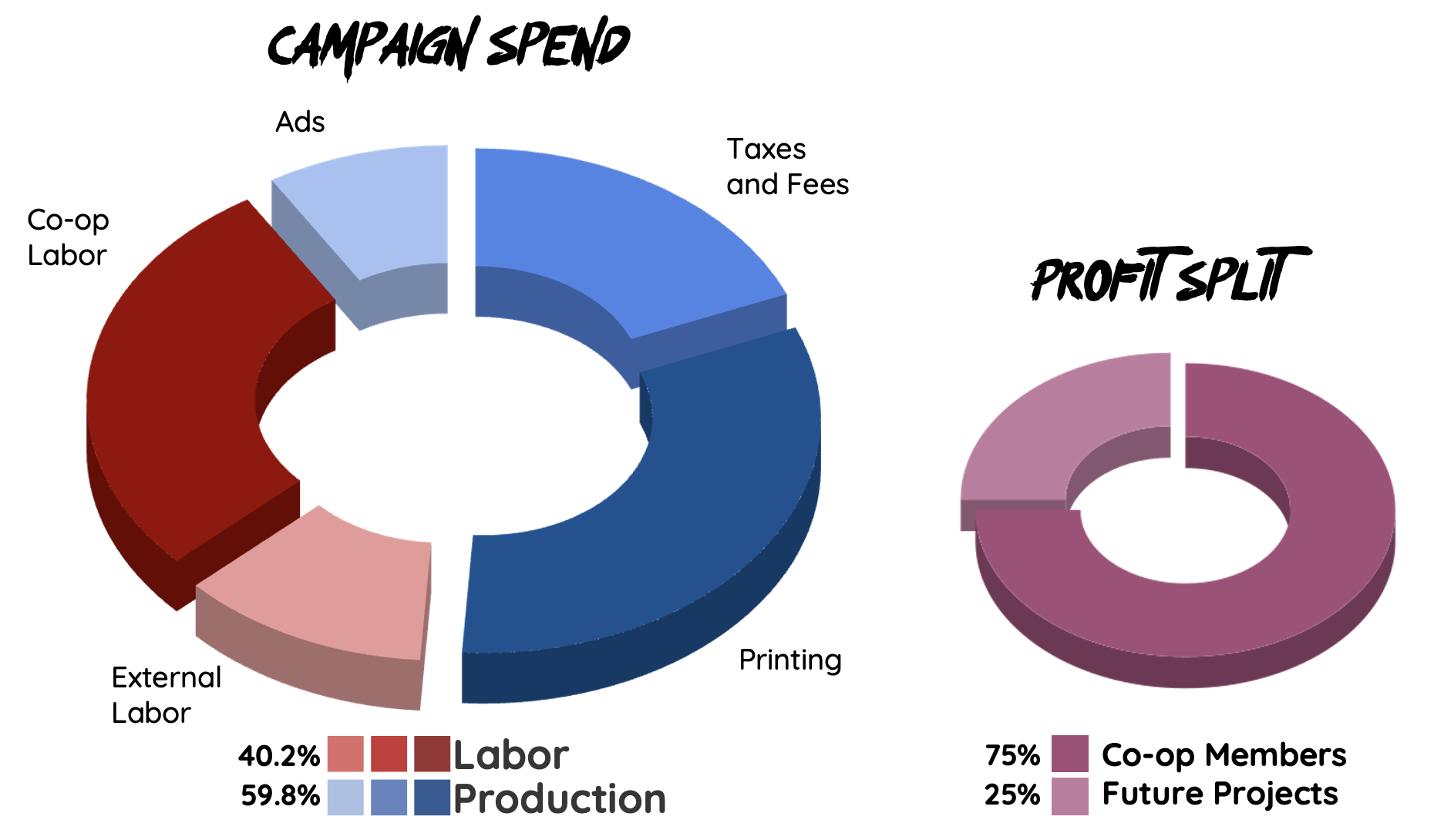
The following diagram shows a breakdown of our Labor, Production, and Future Investment allocations that would result from the funding of this campaign. This breakdown does not include charges related to shipping which are 1-to-1 matched to the cost of getting the game to each backer based on the rates for shipping to your location.
Co-op Designers: Not all our members contribute equally to all of our projects. Co-op Designers includes the folks who performed a large share of the development work for Demon Castle Mononoke, not just in game design, but, visual design, accounting, leading playtesting, and running this campaign. Designers are the project leaders and share decision making power across the game's production life-cycle. Co-op Designers each have a direct ownership stake in the game.
Co-op Contributors: Are members who have contributed to the game by playtesting, and creating content for specific elements of Demon Castle Mononoke. Contributors often assist with the direction of the project, but if a decision is not completely agreed upon, they they often defer to Designers. Like Designers, contributors also have direct ownership stake in the game, just not quite as large.
Non Co-op Contributors: Compensating labor with equity is naturally riskier compared to paying for that labor up front. We offer an ownership stake in the project to all contributors who are not members of the co-op while also paying a fair wage for the commissioned work.
Future Projects: Cardboard Revolution is designed to allow us to make art the way we'd like to. We set aside 25% of each project's profits to invest in the next adventure. These funds are available to be democratically allocated by co-op members, including those who have not directly contributed to Demon Castle Mononoke.
Stay in Touch with Cardboard Revolution
Meet the Mononoke
Throughout the the campaign we will be revealing game play details for each of our fantastic Mononoke
These updates will initially go out to all campaign followers and then also be posted here.
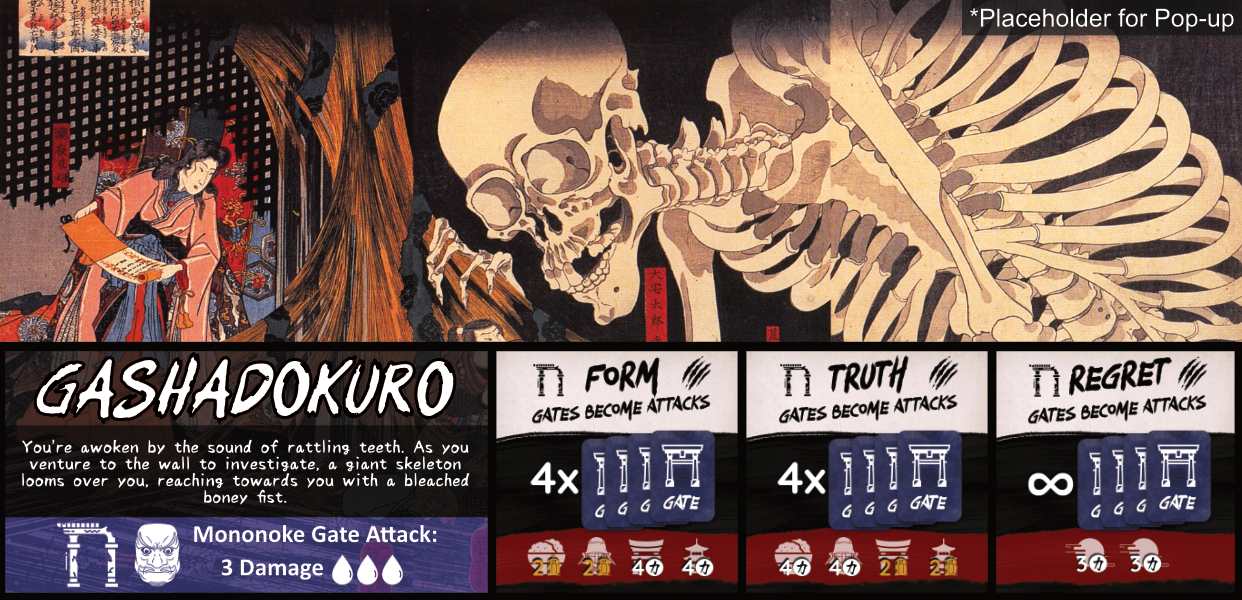
Gashadokuro - The Original Bone Smasher
Gashadokuro (がしゃどくろ) literally means "rattling skeleton," and for good reason! They are massive Mononoke, made up of the bones of warriors killed in battle but denied a proper rest. As such, they are filled with endless grief and rage, lashing out at the living. It is said that the Gashadokuro wander around at 2 AM, devouring any human they come across. One of the earliest stories about the Gashadokuro goes back to the 900s and appears in a semi-historical tale.
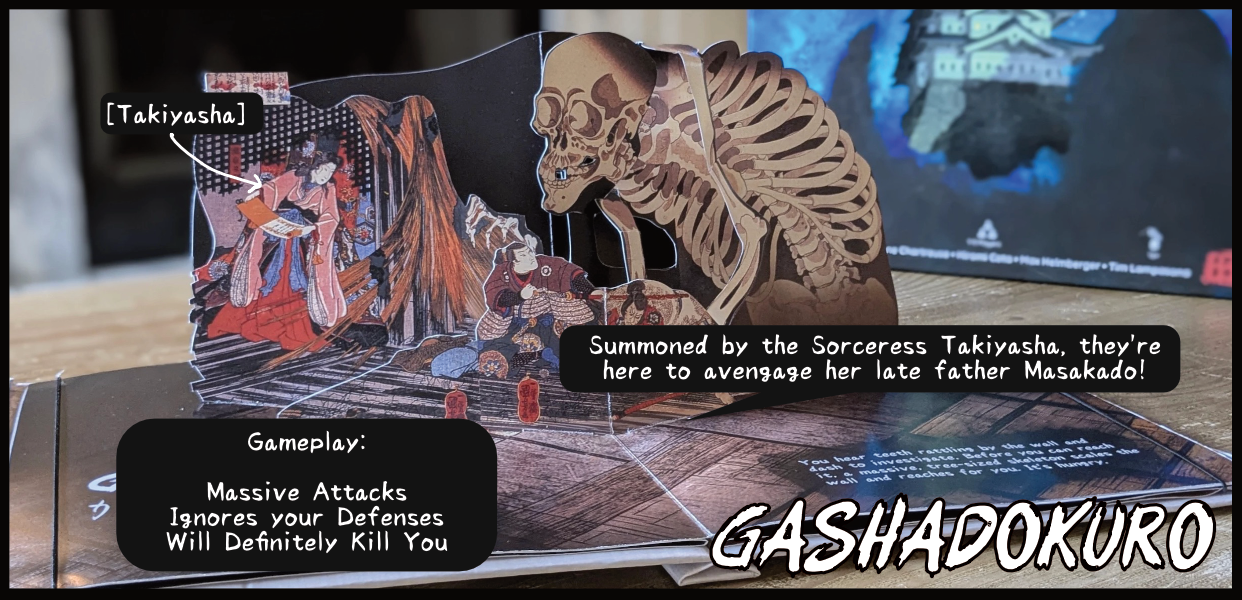
Around that time in Japan, a samurai named Taira no Masakado from the Kantō region was ambushed by three cousins after a dispute over marriages, which led to several duels and small battles where Masakado’s outmatched army inflicted serious casualties against a much larger opposing force. Over time, these grudges led Masakado to begin a rebellion known as the Tengyō no Ran where he seized nearby provinces and declared himself the “New Emperor.” In 940, his cousin Taira no Sadamori and Fujiwara no Hidesato killed him, decapitated him, and brought his head to Kyoto.
After his death, the story turns supernatural. Masakado’s daughter, Takiyasha Hime, a powerful sorceress, was enraged by how he was treated. Using the bones of fallen soldiers, she created the first Gashadokuro and unleashed it on Kyoto to reclaim her father’s head.
The creature caused chaos until Masakado’s head was moved to Shibasaki, a fishing village that later became Tokyo. His head was eventually worshipped there, and a grave still stands near the Tokyo Imperial Palace today.
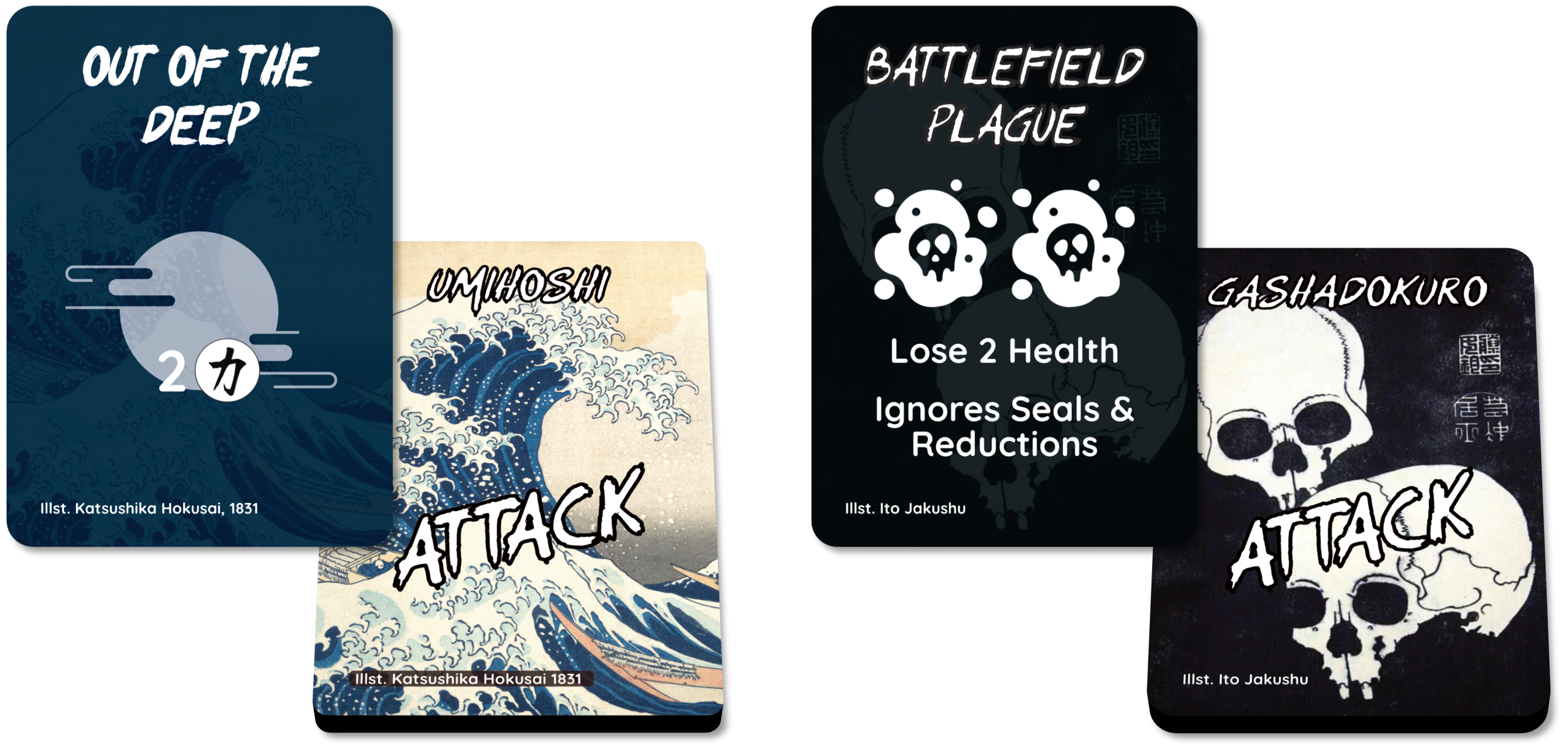
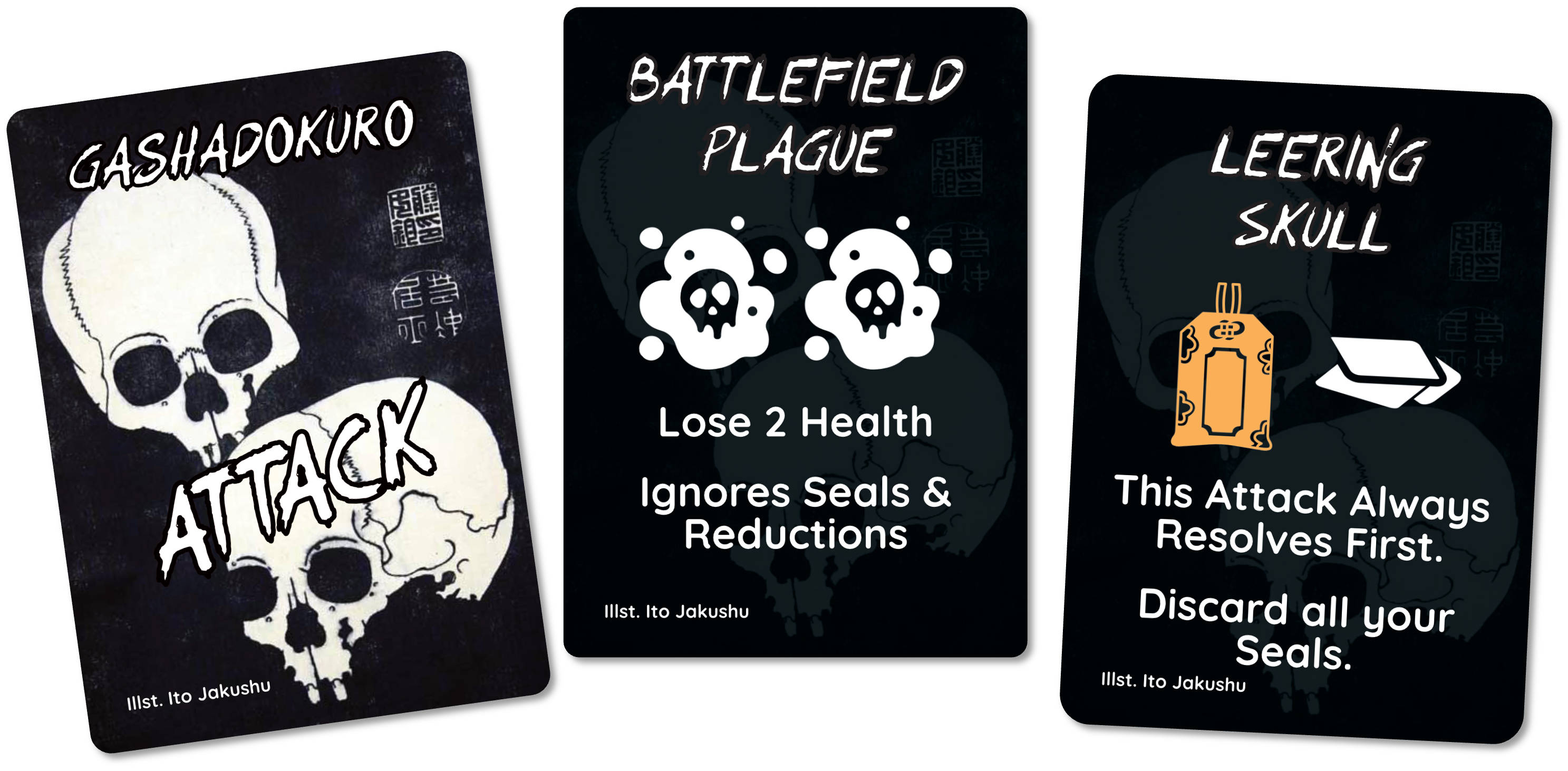
In Demon Castle Mononoke, Gashadokuro focuses on Damaging the Players by enhancing his Yōkai with powerful Attacks that can get past the Player’s defenses.
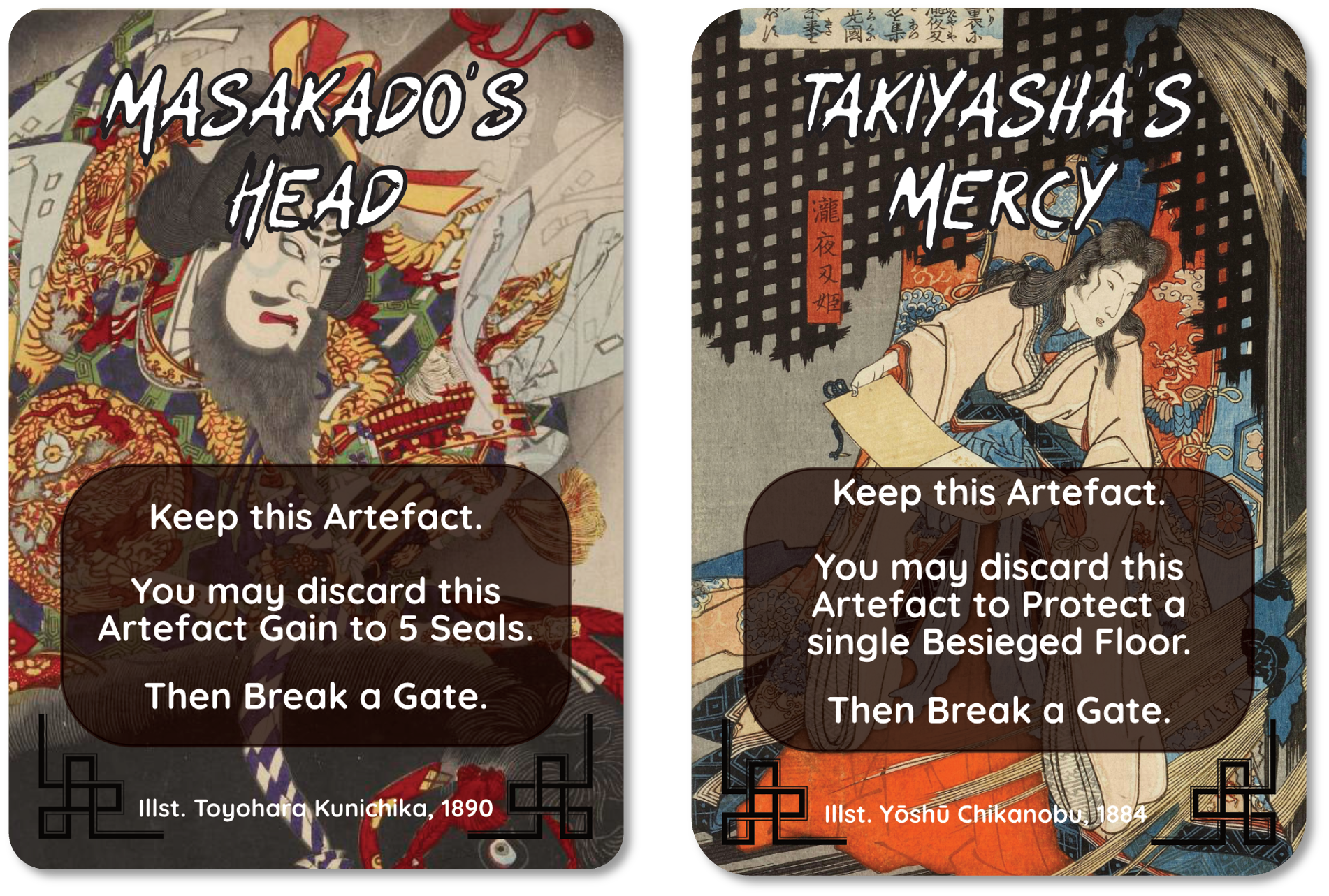
Throughout the game, some Mononoke attacks may actually be powerful artefacts related to that Mononoke's mythos. For instance, players can return Masakado’s Head to regain defensive resources or appeal to Takiyasha's Mercy to prevent Gashadokuro’s Yōkai from destroying the Castle.
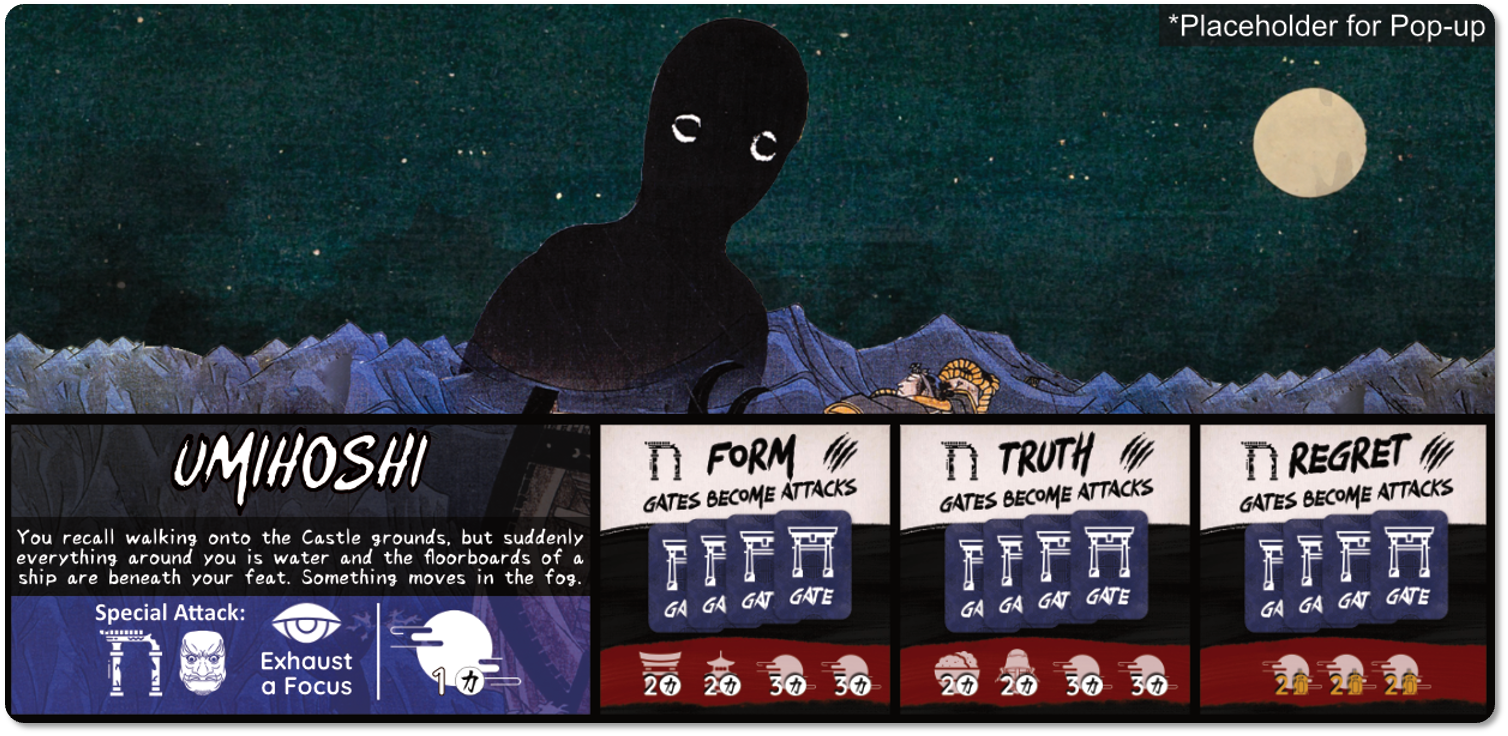
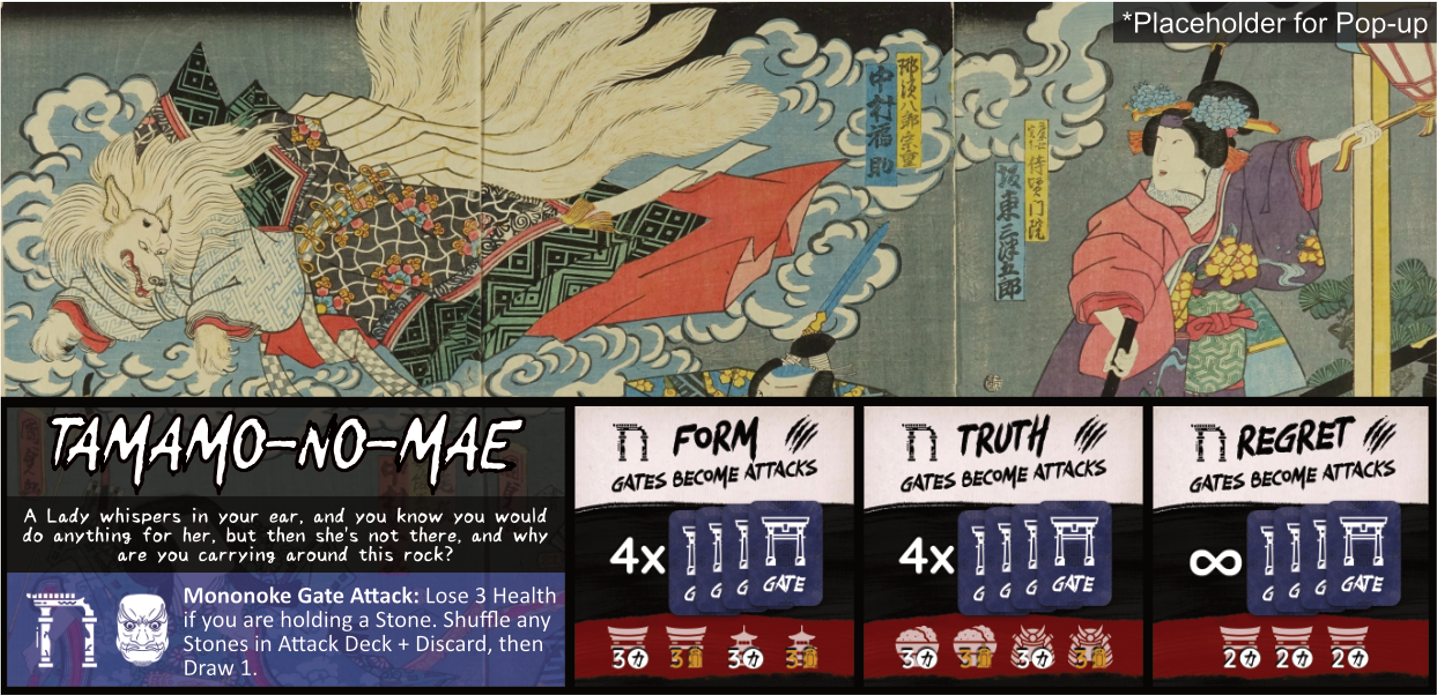
Each game of Demon Castle Mononoke ends with a three-stage final confrontation with the Mononoke where Players must confront its Form, Truth, and Regret. Depending on their ability to protect the Torii Gates, which act limit the Mononoke's true power, during the course of the game, this final enounter can range from difficult, to brutal. In this final confrontation Gashadokuro employees his usual tricks of damaging the Players to knock them out of the action and clear a path to destroying the Castle directly. Imagine this in pop-up form :)
Umihoshi - The Shadow at Sea
Today’s Mononoke is Umihoshi (also called Umibōzu), a mysterious shadowy human-like sea spirit. The origins of the spirit are sadly unknown, but stories about it pop up all over Japan.
Umihoshi tends to appear around sailors just after calm seas have suddenly turned rough, its huge head emerging from the water to stare menacingly at those on board. Sometimes it just smashes the vessel to splinters, other times it asks for a barrel, then uses it to scoop water into the vessel to sink it. It’s rumored that clever sailors can survive by handing it a bottomless barrel and sailing off while it’s confused. Others claim that they are afraid of smoke and carry pipes at sea to ward them off. Most encounters with Umihoshi happen at night, perhaps accounting for the massive discrepancies in its reported size, somewhere between human-scale to gigantic depending on the account.
In the essay Usō Kanwa (1851), there’s a tale from Kuwana (what is now Mie Prefecture) about an Umihoshi sighting. Locals avoided sailing at the end of the month, fearing the creature might appear and sink their ships, but a sailor named Tokuzō ignored the warning and went out anyway. An Umihoshi about 3 meters tall appeared, with red, mirror-like eyes. It stared at Tokuzō asked, “Are you frightened?” Tokuzō replied, “There is nothing more frightening than getting through life in this mundane world,” and the creature vanished.
As for what they actually are, some believe Umihoshi are the spirits of people who drowned at sea, sometimes even drowned priests. Whatever the origin, the core story stays pretty consistent across Japan: a strange sea spirit that must be tricked to avoid shipwreck.
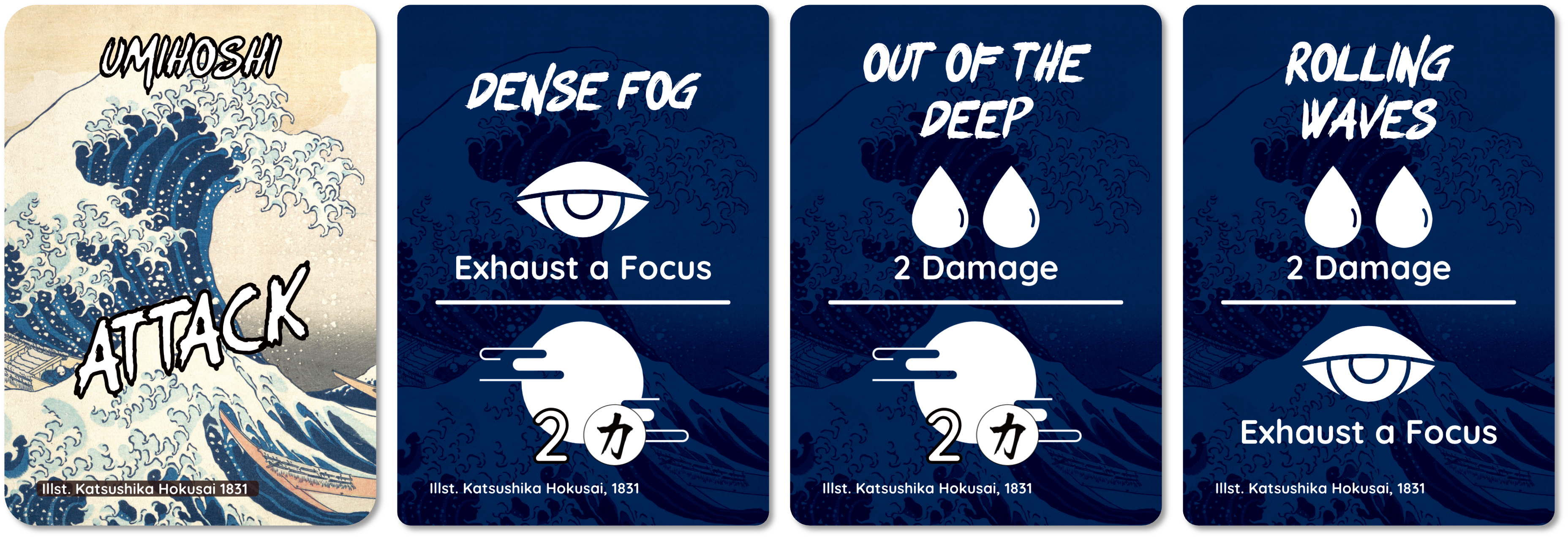
We’ve emulated Umihoshi’s shadowy and stormy presence in Demon Castle Mononoke by giving it unique Attacks that add Shrouded Besieged Floors to Yōkai while also Exhausting the Lost Soul’s Focus as they are caught at sea.
Attacks which add new Besieged Floors to Yōkai are one of our favorite mechanics because it forces Players to think about committing extra resources to their defense in case these Attacks are drawn. Having those Besieged Floors be Shrouded, so Players can’t know which Floors of the Castle will be damaged, makes these even more nerve wracking. Combining that with Attacks that Exhaust Focus, which Lost Souls need in order to deal with incoming Yōkai in any capacity, make Umihoshi a Mononoke that poses a greater threat to the Castle early in the game, forcing Players to be very considerate about how they time their Rests. Have you noticed we’ve designed quite a challenging game here?
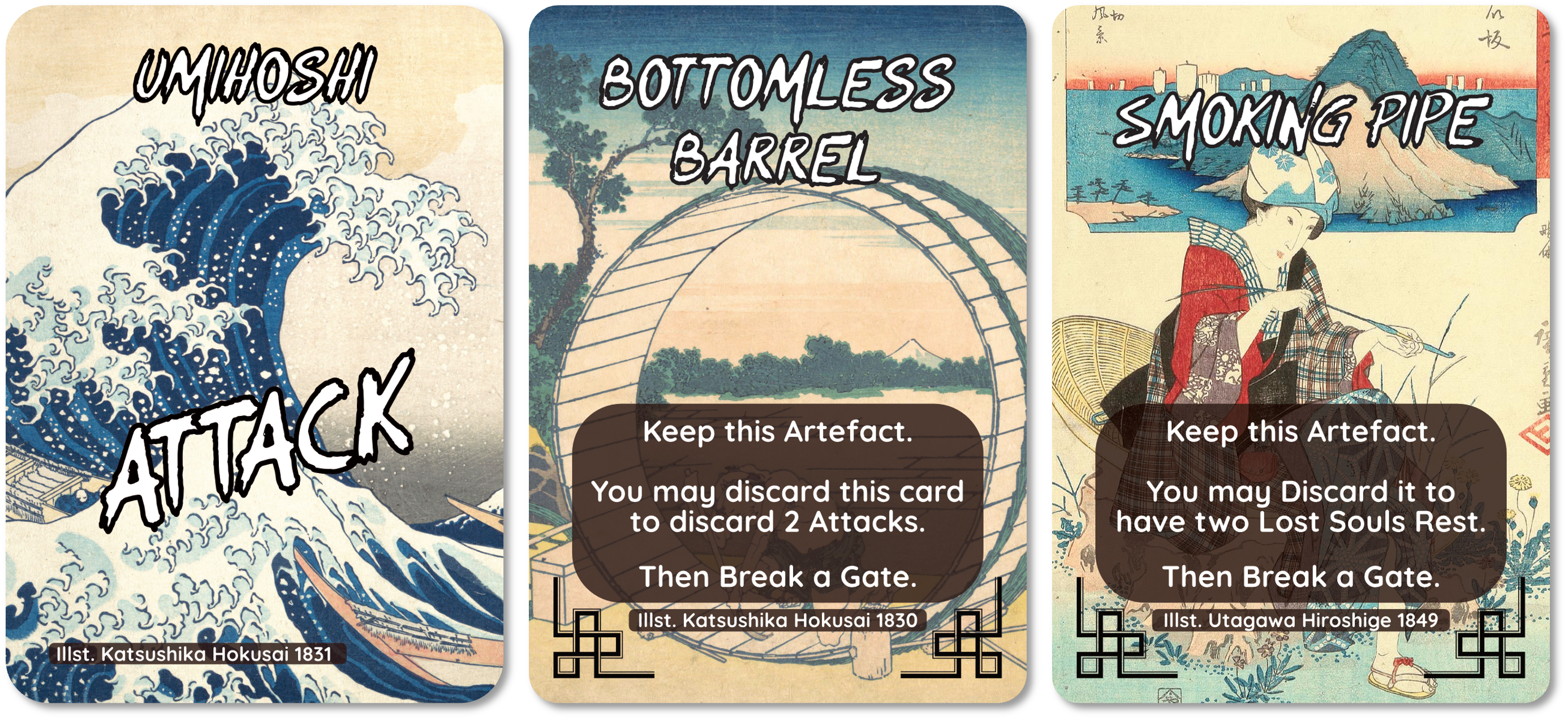
Thankfully, we’ve also included some reprieve in Umihosi’s Artefact cards, the Bottomless Barrel and the Smoking Pipe! The Bottomless Barrel is one of most powerful Artefacts in the game, allowing a Lost Soul to discard 2 incoming Attacks, while the Smoking Pipe can turn the tides of any Yōkai Encounter by providing two Lost Souls an immediate Rest to gain back their Exhausted Focus.
Tamamo-no-Mae - The "Foxy" Courtesan
Tamamo-no-Mae is one of Japan’s most infamous fox spirits, a dazzling courtesan whose beauty and intellect captivated the imperial court, while masking something far more dangerous. In legends tied to the late Emperor Toba, she appears as the emperor’s favored consort, radiating impossible grace and knowledge. Behind that perfection lurks a kitsune, an ancient fox yōkai, draining the emperor’s life force while hiding in plain sight.
When her true nature is exposed by court astrologers and onmyōji, Tamamo-no-Mae flees, transforming into a powerful fox spirit. She is eventually hunted down and slain on the plains of Nasu, but death does not end her story. Her lingering malice crystallizes into the Sesshōseki, the “killing stone,” a cursed rock said to poison any living thing that comes too close, as if her spirit refused to dissipate.
The legend continues as the Sesshōseki becomes a symbol of restless vengeance and supernatural residue, until in some tellings a Buddhist monk performs rites to pacify her spirit. Even today, the tale of Tamamo-no-Mae blends seduction, transformation, and lingering curse, a fox who was never fully exorcised, her essence split between myth, stone, and shadow.
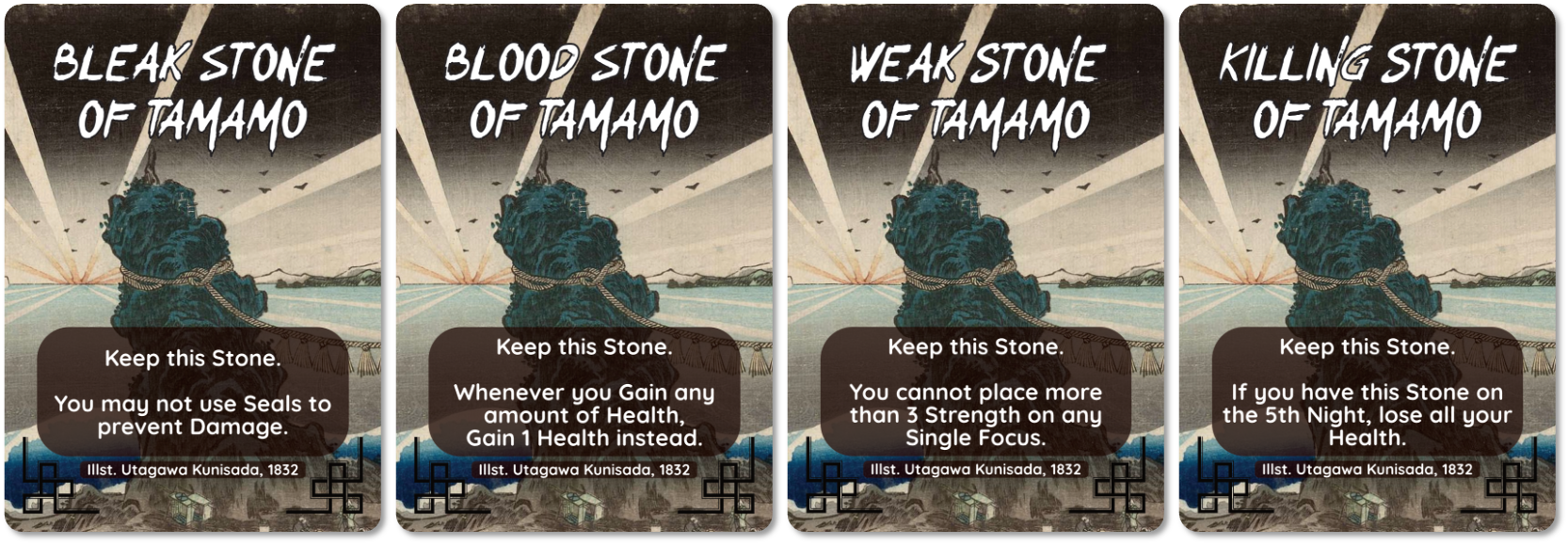
In Demon Castle Mononoke, her cursed stones play an important role in her mechanics.
Hidden in her attack deck are a series of stones, each of which attaches to the unfortunate lost soul who drew it. While holding a stone, the Lost Soul may be weakened, constrained, or cursed to an early demise!
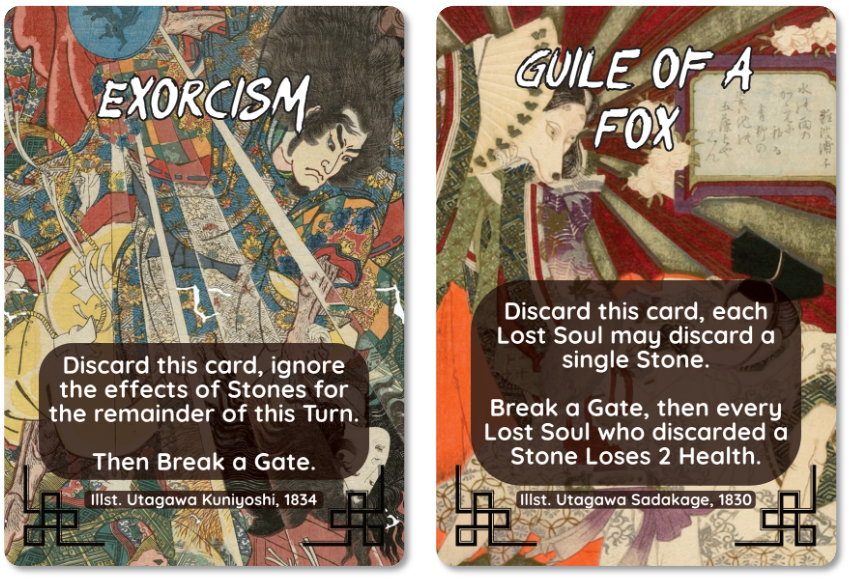
Luckily, there is some respite in the deck, a lucky few Lost Souls may draw a powerful bit of magic instead, allowing them to exorcise some of this evil, at least temporarily.
And of course, she will be represented as a full 3-D popup, like all other Mononoke. Once we fund, our paper engineer Dario can get to work making her emerge from the page, flying above the battlefield on mystical energies beyond our comprehension.
Osakabehime - The Original NEET
Osakabehime is a Mononoke said to dwell in the highest tower of Himeji Castle. She’s usually described as a mysterious princess-like spirit who rarely shows herself to humans. Some stories portray her as a beautiful noblewoman dressed in layered robes, while others describe her as something more unsettling, with animal-like features or an eerie, supernatural appearance.
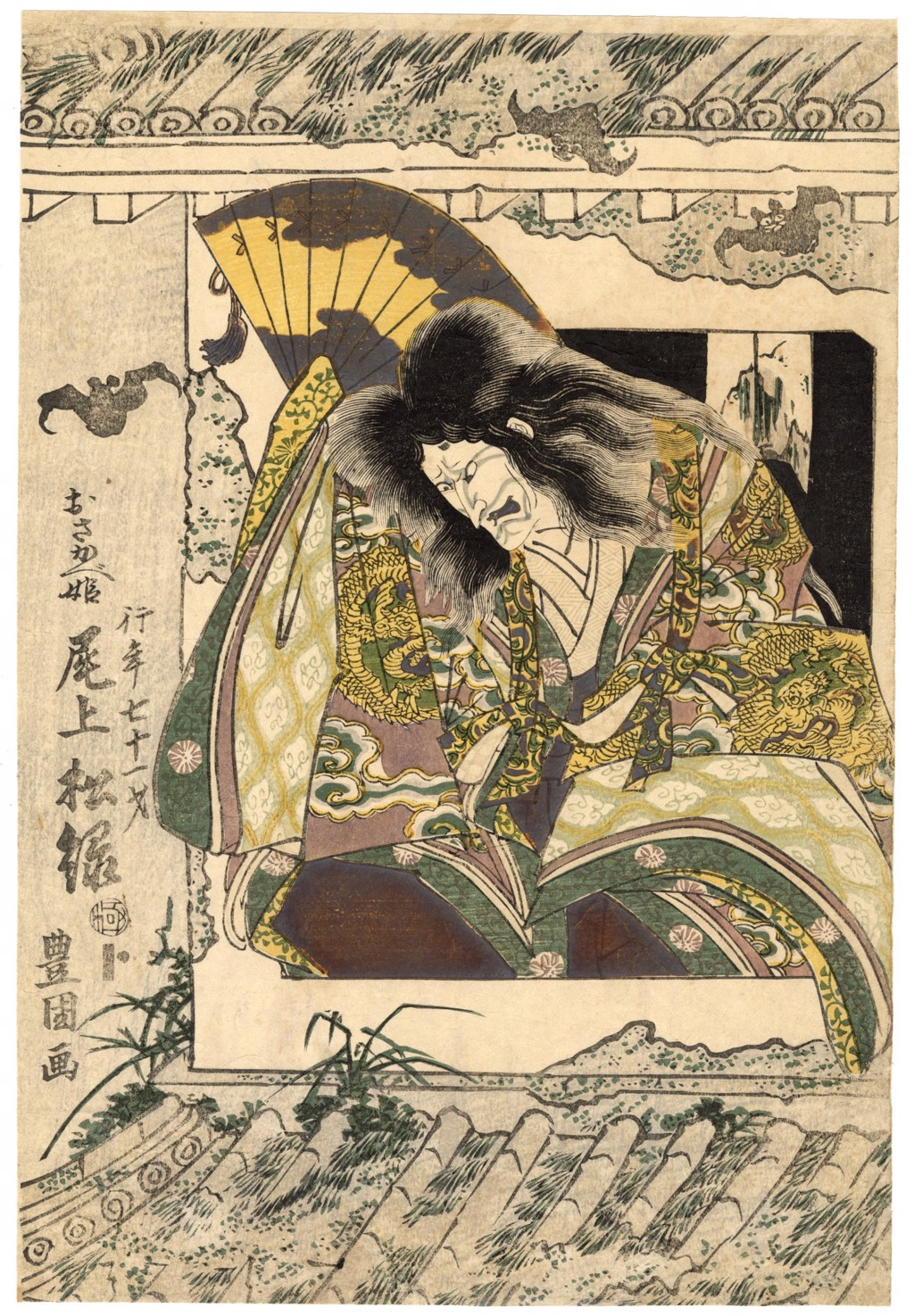
Onoe Shoroku I as Osakabehime by Toyokuni I (1769 - 1825)
Osakabehime was believed to possess immense magical power and deep knowledge of both humans and spirits. According to legend, she could command lesser yōkai and watch over the castle grounds from the shadows. People feared encountering her, believing it could lead to madness, sickness, or death, and even hardened samurai were said to avoid the tower where she lived.
One well-known legend tells of the warlord Ikeda Terumasa, who became disturbed by strange happenings inside the castle after taking control of it. Determined to uncover the source, he sent a trusted retainer into the tower. The man encountered Osakabehime, who questioned him closely about the outside world and demanded loyalty and secrecy before allowing him to leave alive. When the retainer reported what he had seen, the story spread, strengthening the belief that a powerful spirit truly haunted the castle.
Despite her fearsome reputation, Osakabehime was not always treated as evil. Some tales portray her as lonely and isolated, a supernatural being more interested in remaining hidden than attacking people. Over time, she became one of Japan’s most famous castle Yōkai and remains closely tied to the legends surrounding Himeji Castle.
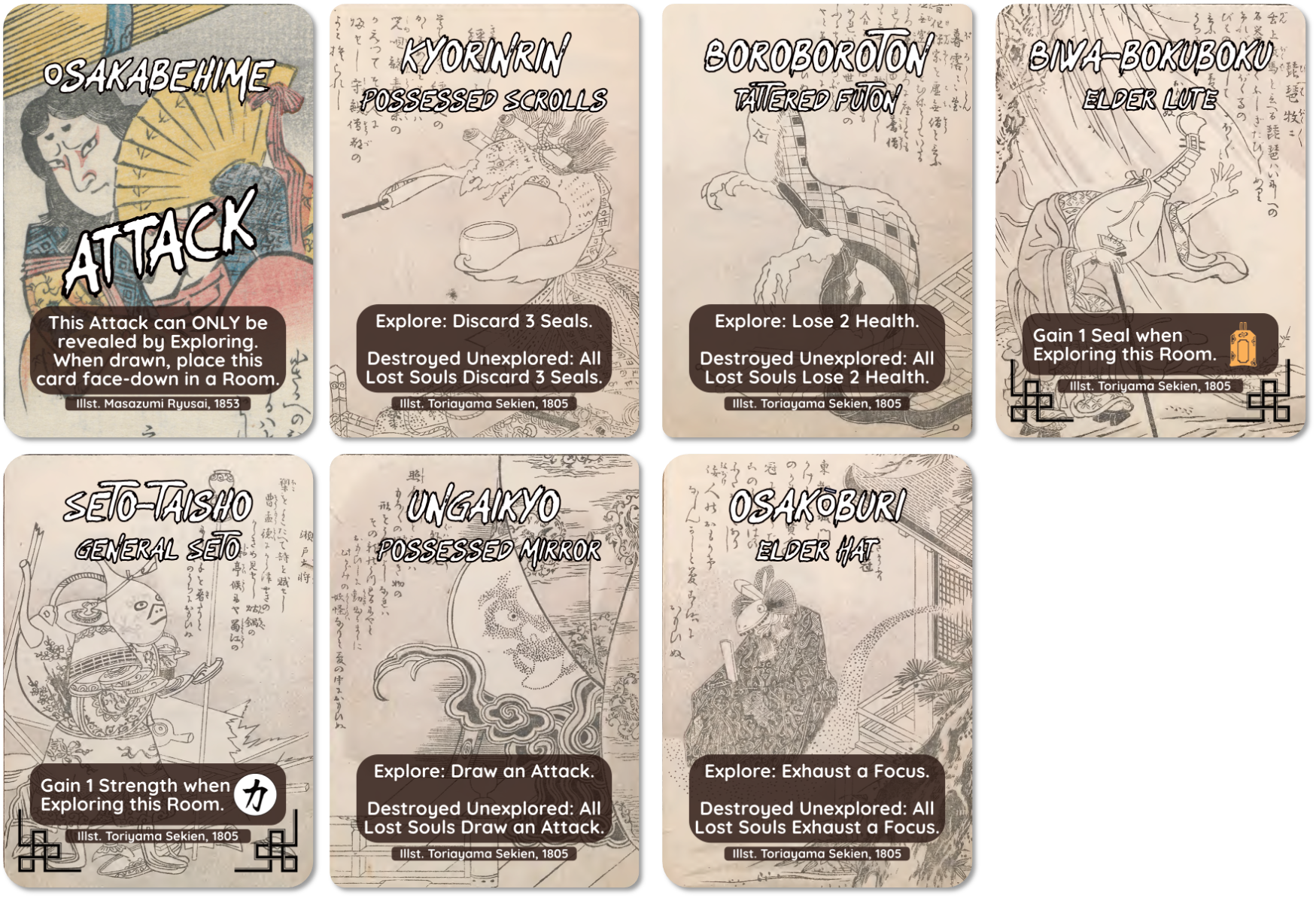
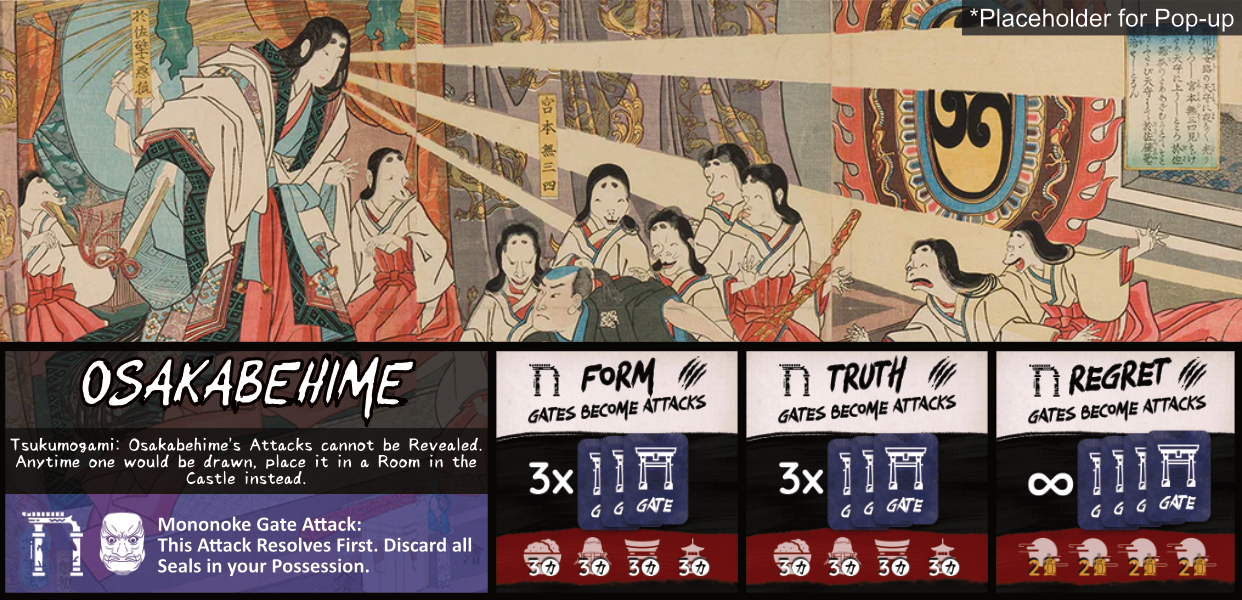
Since Osakabehime was known to have an affinity with familiars, we saw an opportunity to introduce Tsukumogami, Living Tools, into her rules in Demon Castle Mononoke. Obsakabehime’s Attack and Artefact cards are all Tsukumogami which she has allowed to reside in her Castle. Unlike normal Attacks, they are placed into the Castle when drawn, and can only be revealed when exploring them.
Tsukumogami will occupy rooms and negatively affect Lost Souls who explore those Rooms.When a Room is destroyed, any Tsukumogami in that Room will be discarded as well, but if the Tsukumogami was not explored first, its negative impact will be even worse.
Thankfully not all Tsukumogami are malevolent. Exploring Rooms that are occupied with Tsukumogami can also provide additional resources when the Tsukumogami is a generous one.
For Osakabehime’s Form, Truth, and Regret, she Focuses on depleting the Lost Souls Seals before hitting the Castle with an extremely strong Regret. Players can circumvent this by being very careful about maintaining Gates or leverage Lost Souls focus abilities that can generate Seals during the Encounter.












Commentaires (0)
Connecte-toi pour commenter ou répondre.
Pas encore de commentaire. Lance la discussion.