From the sun-scorched fields of Apulia to the fog-drenched marshes of northern France, the fate of nations once rested on the shoulders of a handful of chosen warriors. In an age when honor was worth more than life, Italian, French, Spanish and English knights stepped forward to fight not for themselves — but for the glory of their people. This is their story. This is Disfida.
Disfida is the new game by Michele Quondam (author of Temple of Horrors, Dominance, Trinidad, Medioevo Universale GX, Virus, Gladiatori, among others) for 1–4 players, reaching up to 8 players with the expansion! A match lasts about 40 minutes.
In Disfida, players choose from four factions — Italian and French (included in the core box), Spanish and English (available as add-ons) — and lead their champions to victory on the battlefield. Its high replayability keeps every clash fresh, with no two battles ever playing out the same way. Easy to learn and intuitive to play, yet rich in tactical depth, Disfida rewards both new players and seasoned commanders.
The game includes a Solo Mode using Bots. Additionally, the "One player, 2 knights" variant allows players to choose from a variety of scenarios and adapt the match to any number of players.
You can pick up your game (English edition) at our booth during SPIEL Essen 2026 and skip the shipping costs! Pre-order now to secure the exclusive pledge price and all stretch goals—on-site copies will be limited.
Why pledge?
- Innovative Cube-Bidding: Leave dice to the commoners. Resolve combat through tense psychological bidding and pure, cold strategy.
- Special Campaign Price: Take advantage of an exclusive 40% discount by pledging now (Disfida Bundle)!
- The Disfida System: A tactical skirmish experience where honor is a resource. Master a game where every move is a technical duel on foot — no luck, just skill. The knight movement system is innovative and tactical, allowing for feints and bluffs.
- Availability: Disfida will not be available through standard retail distribution and will be very difficult to find internationally after the campaign. Pledging now is the only way to secure your copy!
- Four Iconic Factions: Relive the 16th century with Italian Knights, French Gendarmes, Spanish Rodeleros, and English Men-at-Arms. Each faction features exclusive miniatures and unique Knight Cards.
- From Barletta to Guînes: Play through a rich Historical Campaign covering the legendary challenges of Trani (1502), Barletta (1503), and the frontier duels of Guînes and Balinghem (1520-1540).
- Deluxe Components: Every box comes "Gamefound Ready" with premium miniatures and real metal coins to handle ransoms and victory points.
- Solo & Zero Downtime: Always stay in the heart of the action with simultaneous turns and a dedicated, challenging Solo Mode.
Contents
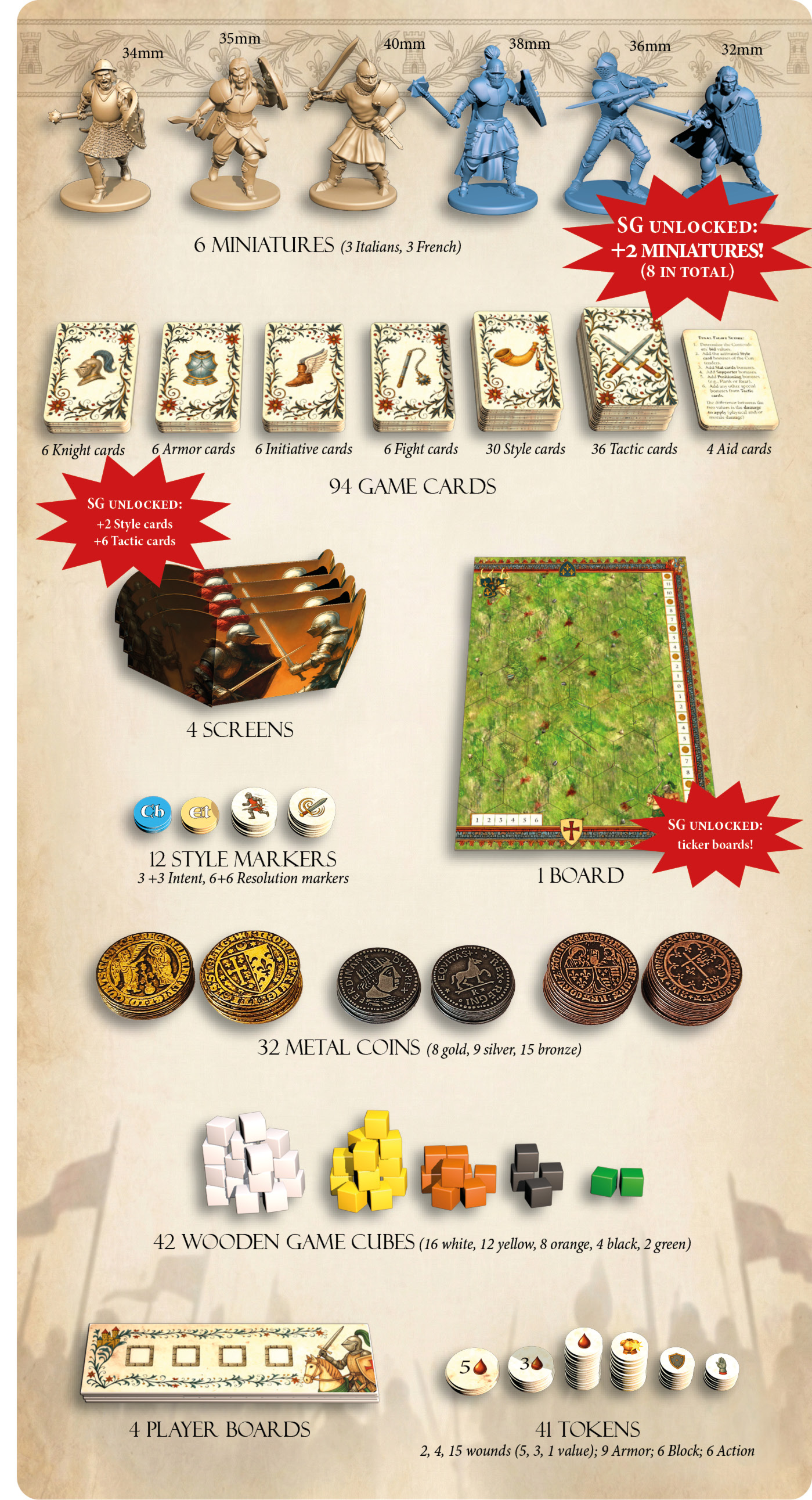
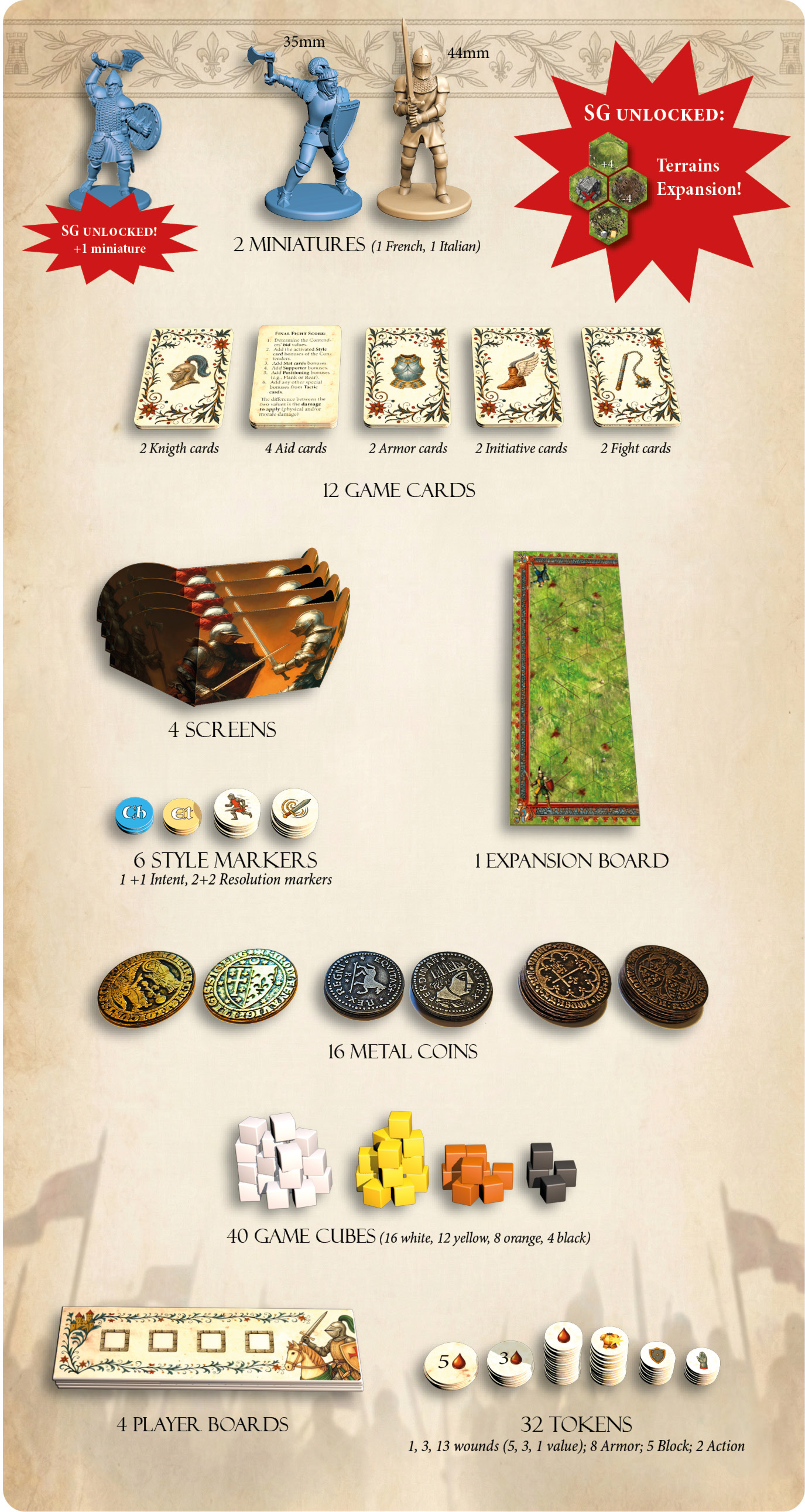
In addition to the base game, this campaign also features the expansion that increases the maximum player count to 8! Here is what’s inside:
Videos
The videos were filmed using handmade prototypes that still feature the old title. We recently changed the game's name from "The Challenge of Barletta" to "Disfida".
Historical background
The 16th century: in a Europe fractured by the ambitions of great empires, the clash between nations was often distilled into a single, crystalline moment — a challenge between champions chosen from the best of their side. This game draws inspiration from extraordinary moments when warfare paused to become ritualized combat, governed by rules, with witnesses, judges, and shared codes of honor.
The most celebrated challenge unfolded in Barletta, at the dawn of the 16th century. Born from a French insult to Italian valor, it saw thirteen knights led by Ettore Fieramosca face as many French challengers in open combat. The Italians did not merely defend their lives — they restored their reputation and dignity, proving that the spirit of a people could shine even in an age of foreign dominance.
But Barletta was not an isolated event. It was the culmination of a tension born earlier in Trani, where eleven Spanish and eleven French champions faced each other in brutal, hours-long hand-to-hand combat on foot, ending in a draw that only fueled the thirst for vengeance between the two powers.
As the decades passed, the tradition of the challenge crossed the Alps into the English-held Pale of Calais. Between 1520 and 1540, around the fortresses of Guînes and Balinghem, the rivalry between the English knights of Henry VIII and the French gendarmes of Francis I reached its peak — knights met between the mud of the marshes and the splendor of royal pavilions. It was here, in 1520, that the two kings themselves faced each other in the most magnificent display of chivalric pageantry the Renaissance ever witnessed: the legendary Field of the Cloth of Gold.
Now, it is your turn. From the dust of Apulia to the mists of France, lead your champions, defend your banner, and shape the course of history.
"Knights Tournament" painting by Zygmunt Ajdukiewicz.
Game Highlights
Style Token, Style Card, and Block Tokens
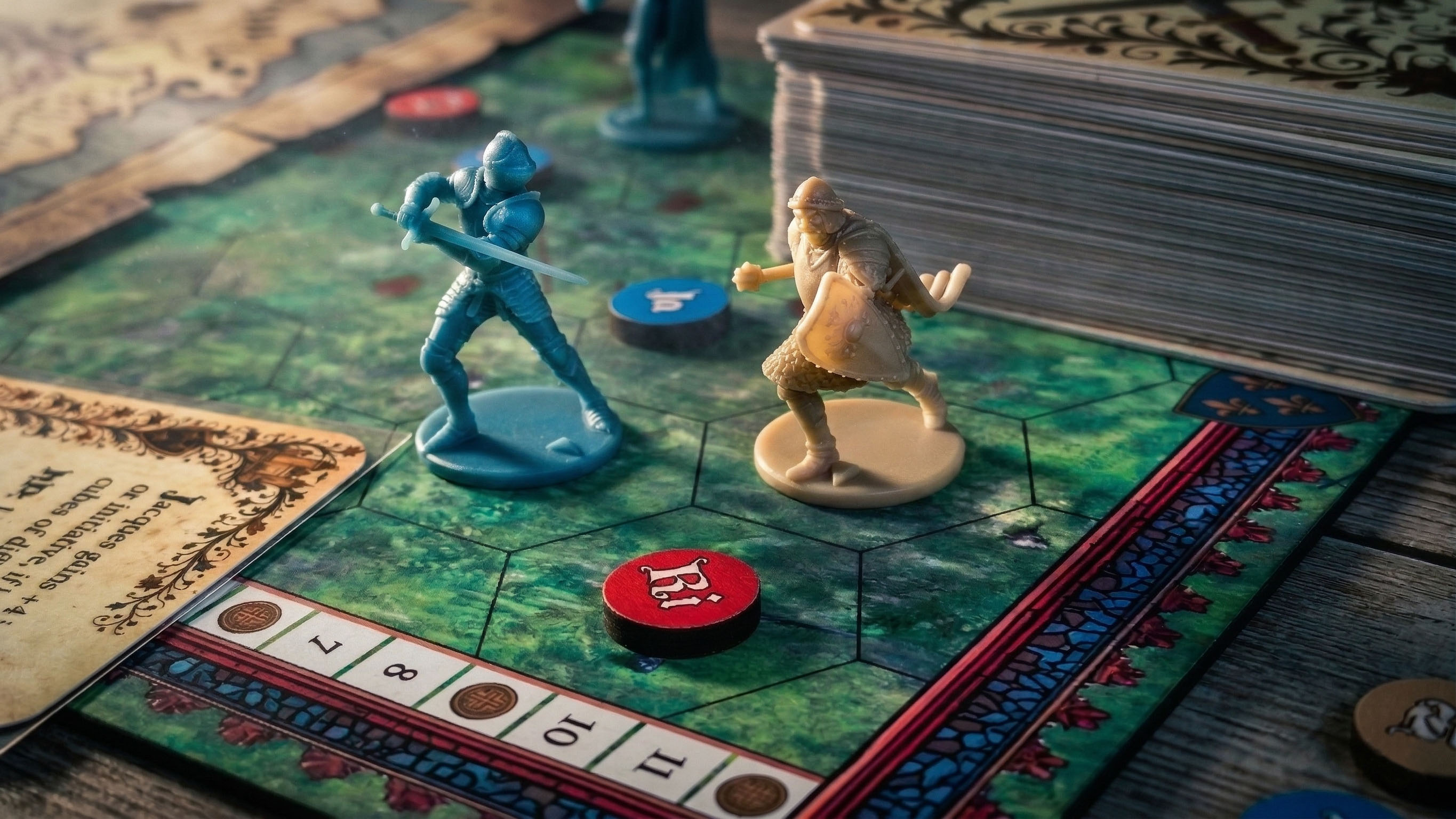
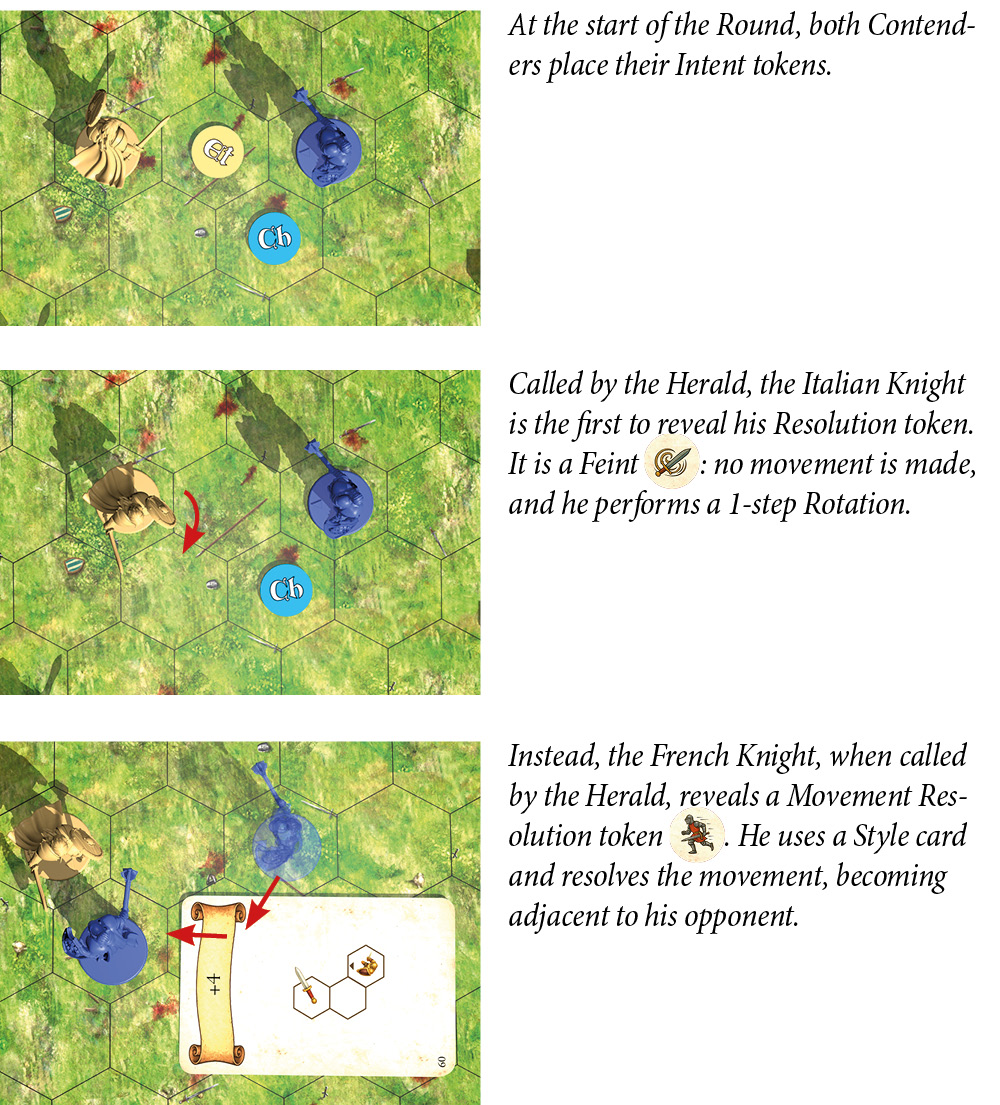
In each round, every player signals their future movement using an Intent token. This must be placed in a hex adjacent to their miniature to indicate the first hex of the subsequent move. Be careful, however: on their turn, the player will reveal one of the two Resolution tokens available, one of which represents a Movement and the other a Feint. If the latter is revealed, the Knight remains in his hex.
The Style card is played during your turn and determines the knight's movements. Each card defines one or more movement patterns, and, as mentioned, the first step must coincide with the Style token's position. If the knight manages to complete the entire planned trajectory, they earn a significant bonus. If, instead, the movement is interrupted by an obstacle or an opponent, the bonus is lost, making every move a crucial choice between audacity and caution.
Adding another layer of strategy is the potential use of Block tokens. After completing their movement and rotation, players may place a cube in one of their frontal hexes. Anyone entering this hex during their turn must stop immediately, losing their card activation and preparing to face combat in a disadvantaged position.
The Cube Engine
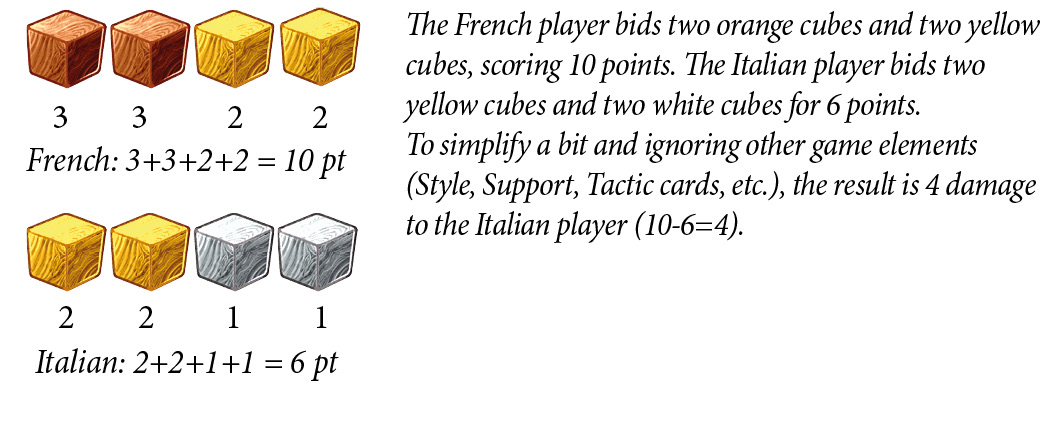
Forget the dice, because in The Challenge of Barletta, colored cubes represent your Knight's resources and skills. Every combat is decided through a secret bid made behind the screen, where the color values determine your attack strength: black cubes are worth 5 points, orange 3 points, yellow 2 points, and white 1 point.
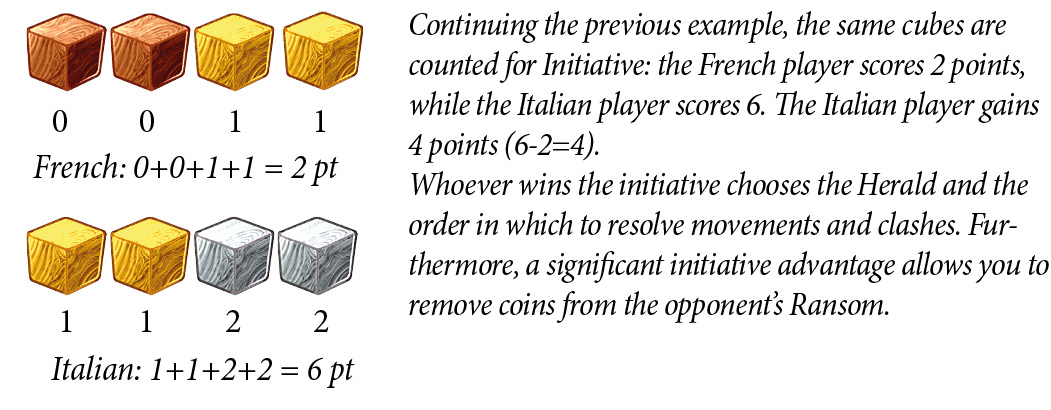
The use of brute force leads to resource depletion; at the end of the confrontation, the cubes of the highest color used in the bid are downgraded to the next lower color, forcing you to balance every decision carefully. These same white and yellow cubes are then reassigned to calculate Initiative — white cubes are worth 2 points, and yellow cubes are worth 1 point, while others count for 0. Those who invest too much energy in the strike risk being less rapid, influencing the faction marker's position on the initiative track for the following round.
Different Game Modes
In this game, faction honor and personal glory intertwine in different ways depending on the chosen mode. Your faction fights for honor, but your fame will be the true measure of your greatness!
Cooperative: In this mode, success depends entirely on coordination between faction members. Each team has an initial sum of money representing the agreed ransom for each knight of the Challenge. This money, in Ducati, represents the group's standing and prestige, which is paid out gradually during the game rather than in full at the end, as happened in reality. Whenever a knight takes damage, it is both physical and morale. Morale damage removes coins from the team's Ransom Stake, while physical damage inflicts wounds. When a faction runs out of coins, it means they surrender—just as occurred historically when the French gave up.
Semi-cooperative: Your team must still aim for victory, but the individual's value emerges here. Ducati are not simply discarded; they are accumulated behind the screen of the player who inflicted the damage as their personal war booty. At the end of the game, if your faction has won, the player who accumulated the most Ducati and prestige is proclaimed Champion of the Challenge.
Individual: This is the ultimate challenge! The last knight remaining on the battlefield wins the game. If multiple knights survive when time runs out, victory goes to whoever collected the highest value in coins (Ducati) behind their screen. Because in Barletta, victory may be shared, but honor is always personal!
How to Play
1. Setup
Each player chooses their own Knight, featuring a unique ability, specific Hit Points (HP), and its own miniature. You will pair it with Statistic cards (Strike, Armor, Reaction) to determine your Knight's ability to attack, react, and defend.
The goal of the game is to claim the opposing faction's Ransom. Historically, each Knight had an individual ransom of 100 Ducati upon surrender; in the game, this pool is shared by the entire faction and is depleted coin by coin during the clash. When a faction loses its last Ransom coin, it surrenders, and the opponent is declared the winner! Alternatively, if the ransom isn't depleted, the faction with the most Knights remaining on the field at the end of the game wins.
2. The Herald and Initiative
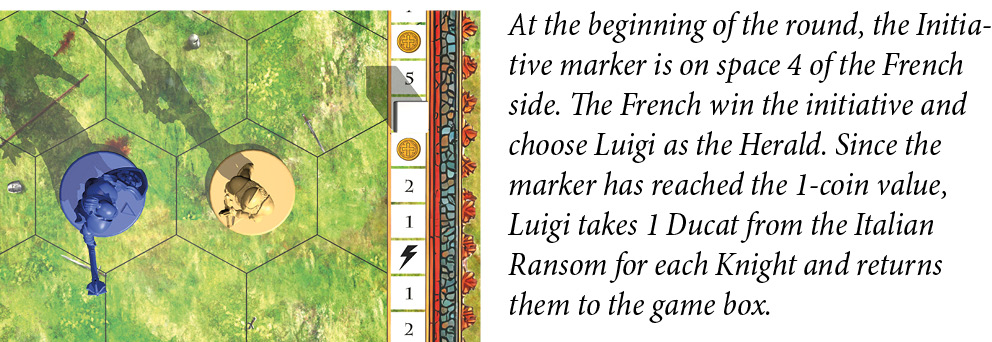
The faction with the highest Initiative points chooses the Herald from among its members. This key figure has the power to influence the rhythm of the battle by deciding the movement order and managing the sequence of individual engagements. Furthermore, a significant difference in initiative affects Morale: the faction lagging behind may lose coins from their Ransom.
3. Secret Planning and Movement
All players place a Style token face-down in a hex adjacent to their miniature to indicate the first step of their intended movement.
Following the turn order established by the Herald, each player reveals their token. It will show either a "Movement" or a "Feint" symbol. If a Feint is revealed, the Knight remains in their current hex. If a Movement symbol is revealed, the player must play a Style card featuring a movement pattern that enters the token's hex, and then execute the full movement shown on the card.
Finally, you may rotate your Knight by one step to center your attack, protect your flanks, or place Block tokens to intercept enemy advances.
4. The Combat
An attack is triggered when an enemy is within your Frontal Arc. Contenders secretly bid cubes behind their screens. Black is worth 5, Orange 3, Yellow 2, and White 1. Watch out: the highest-valued cubes played are consumed, degrading to lower-value colors after each clash. Adjacent allies provide crucial numerical bonuses to your attack strength (Support).
Once damage is applied, these same cubes determine the Initiative (in this phase, White is worth 2, Yellow 1, and others 0). You must find a balance between strength and speed — or choose to favor one and face the consequences.
5. Tactics
At any point during the encounter—from the first move to damage resolution — you can play Tactic Cards. These are "instant" cards that allow you to modify results and create powerful combinations.
6. Victory and Glory
The challenge ends after 6 rounds, or immediately if a faction is left with no Knights or no Ducati. If the battle is still ongoing when time runs out, the faction with the most surviving Knights claims victory!











Commentaires (0)
Connecte-toi pour commenter ou répondre.
Pas encore de commentaire. Lance la discussion.