
Twisted Lands TTRPG
Par 9thPersona
Statut actuel
Campagne en cours
Temps restant :
12 jours et 17 h
(fin le 10/11/2026)
Fonds récoltés : 12 547 €
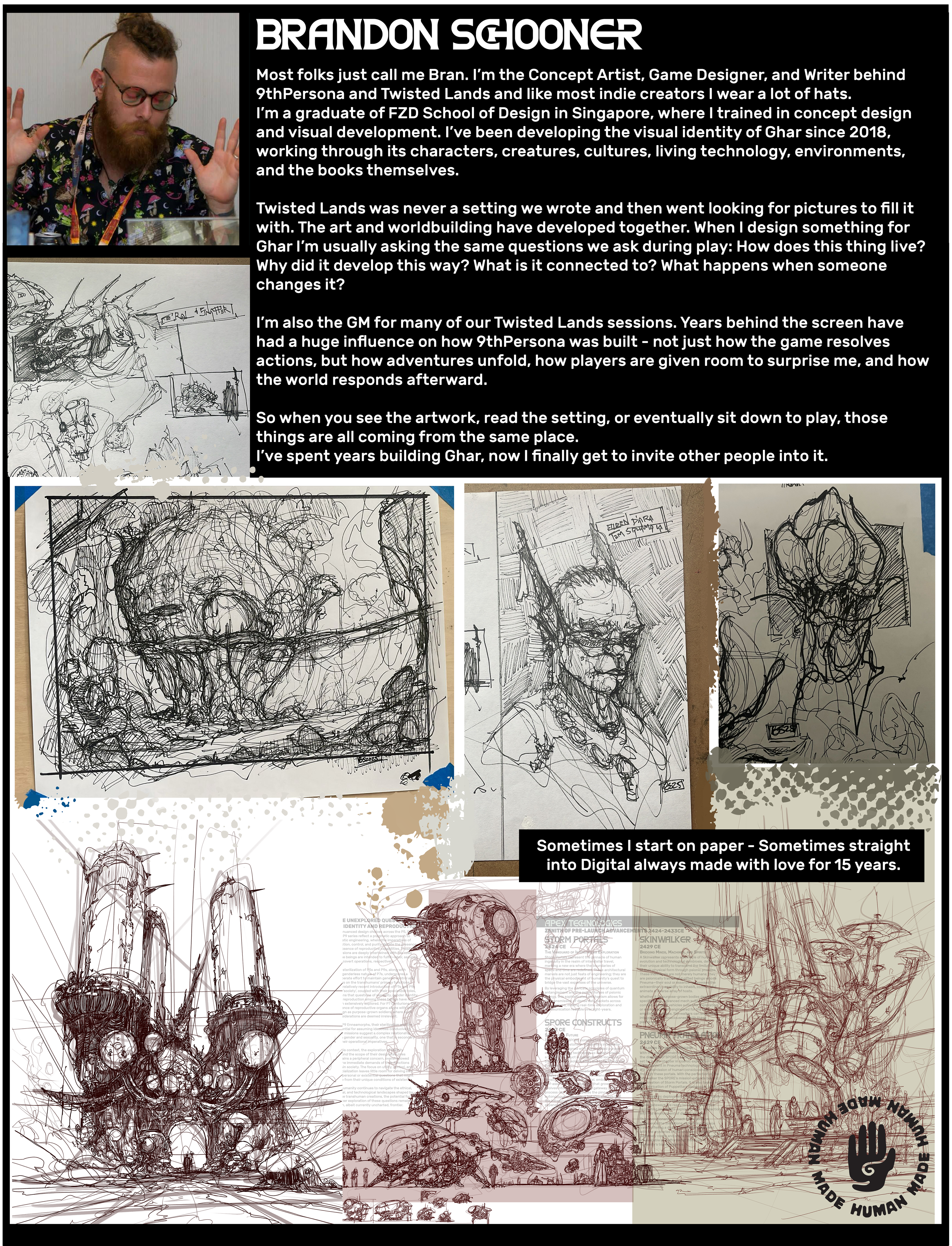
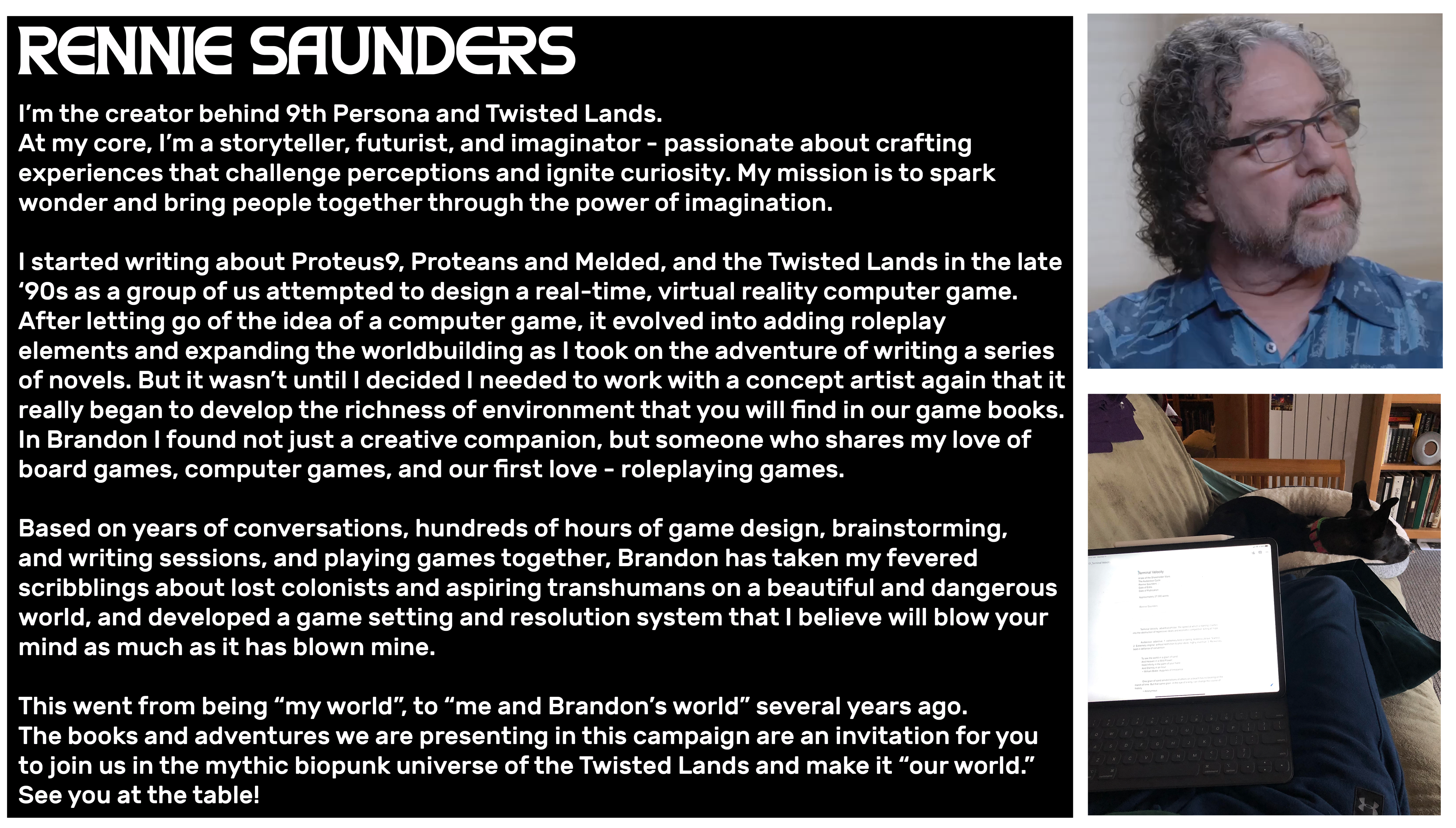
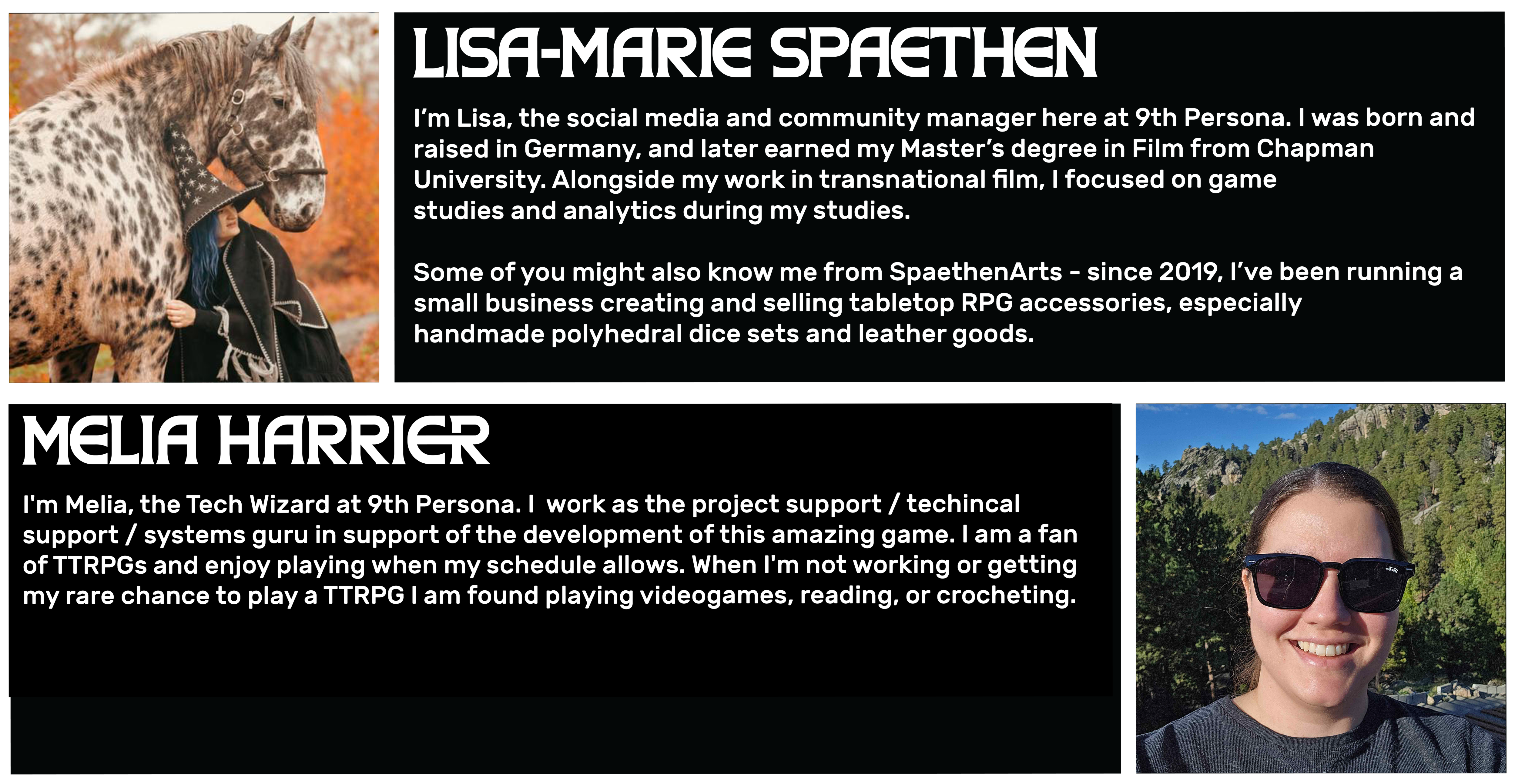
Meet the Artist and Team
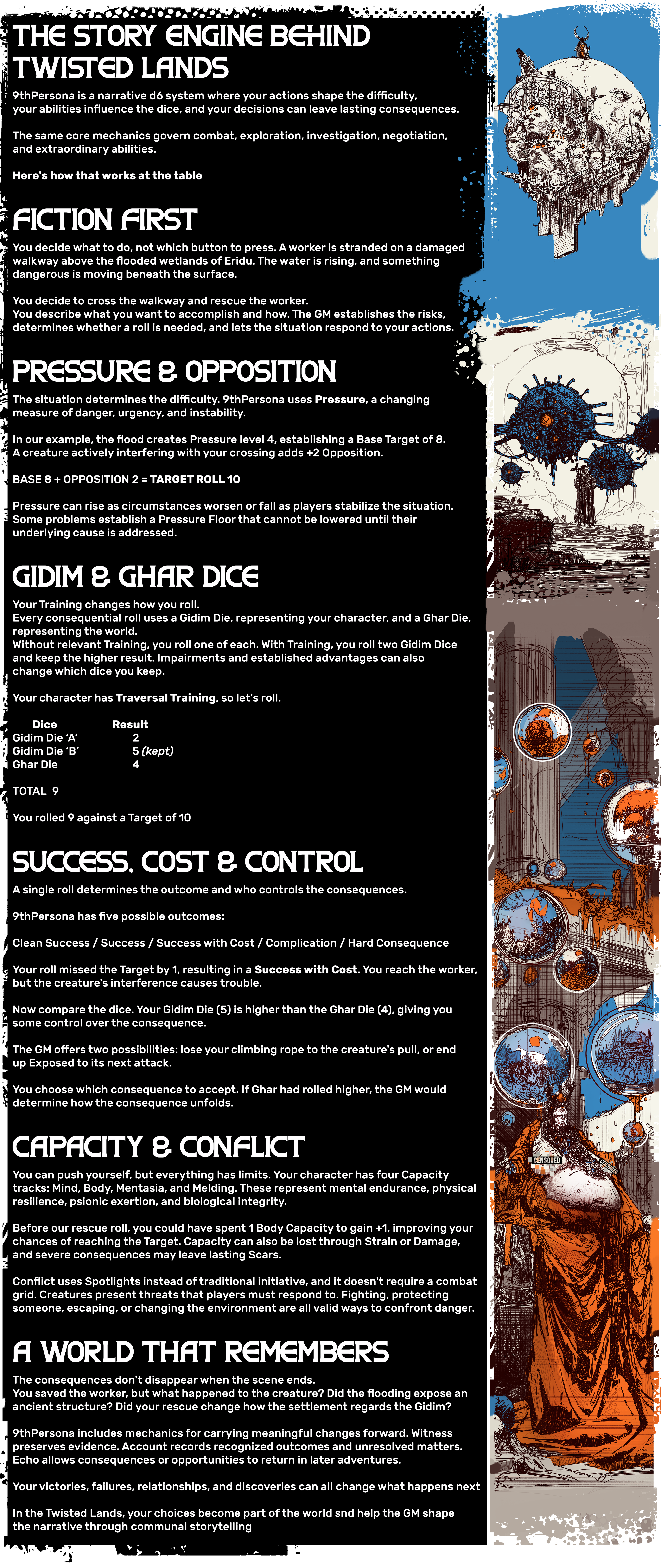
9thPersona Story Engine Built for the Twisted Lands
Words from Rennie
Two Books - One Living World
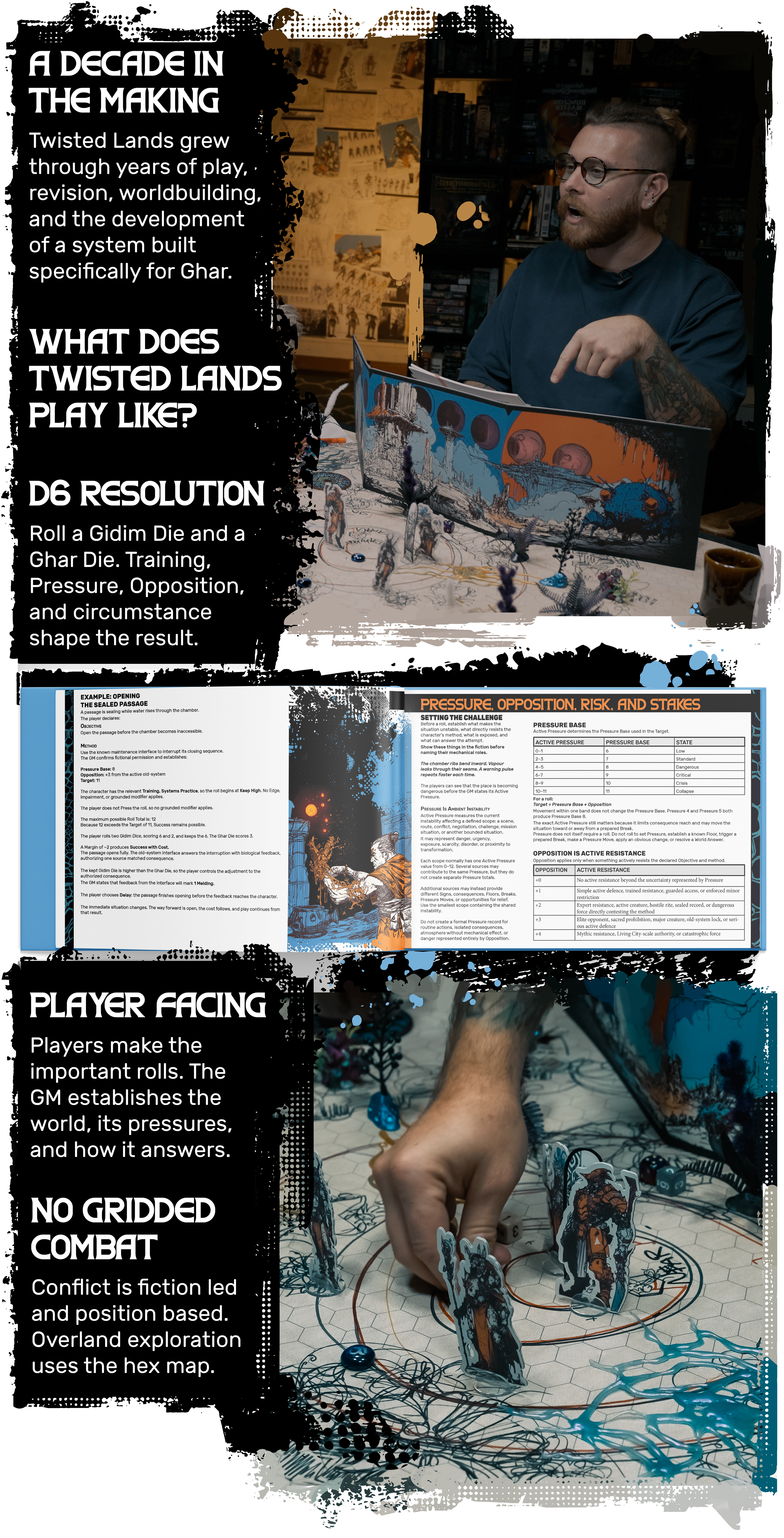
Your role in this world
x
Lets play part 1!
Sample Character - La'Tek
Monsters dont take turns - You do!
Campaign Plain Body Text
WELCOME TO THE TWISTED LANDS
I've always been interested in what happens after the players have solved a problem.
Say a settlement has been losing livestock to a dangerous predator. The people want it killed, and understandably so. The Gidim arrive, track the creature, and eventually bring it down. A successful hunt by most accounts.
But what was that predator eating before it started taking livestock? Why did it move into the area? Now that it's gone, what happens to everything else that lived in its territory?
These are the kinds of questions I want players to start asking when they explore Ghar. Not because every creature is secretly innocent or because every problem needs some grand moral dilemma. Sometimes a dangerous animal really does need to be killed.I just want the world to have enough substance that the answer matters
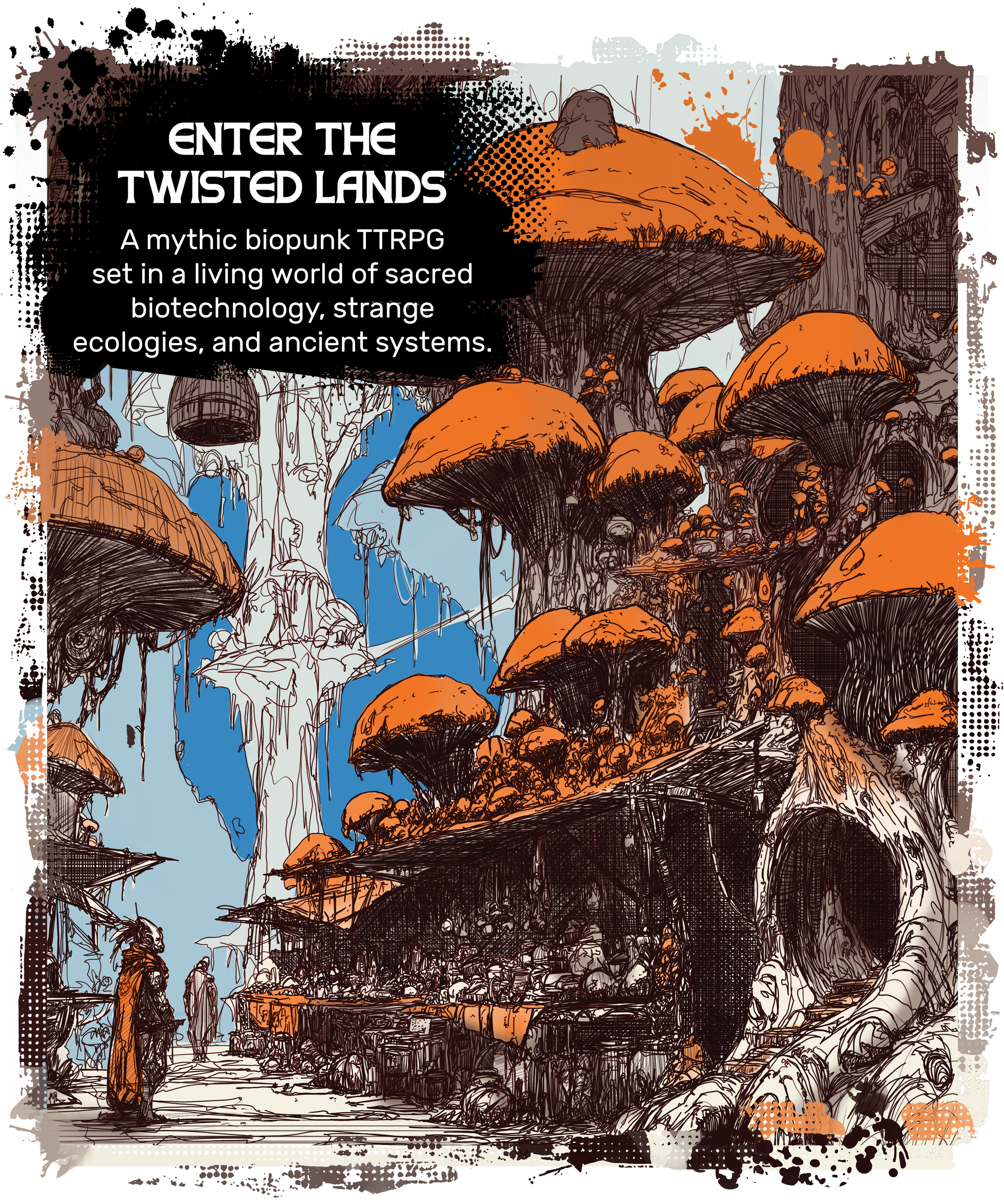
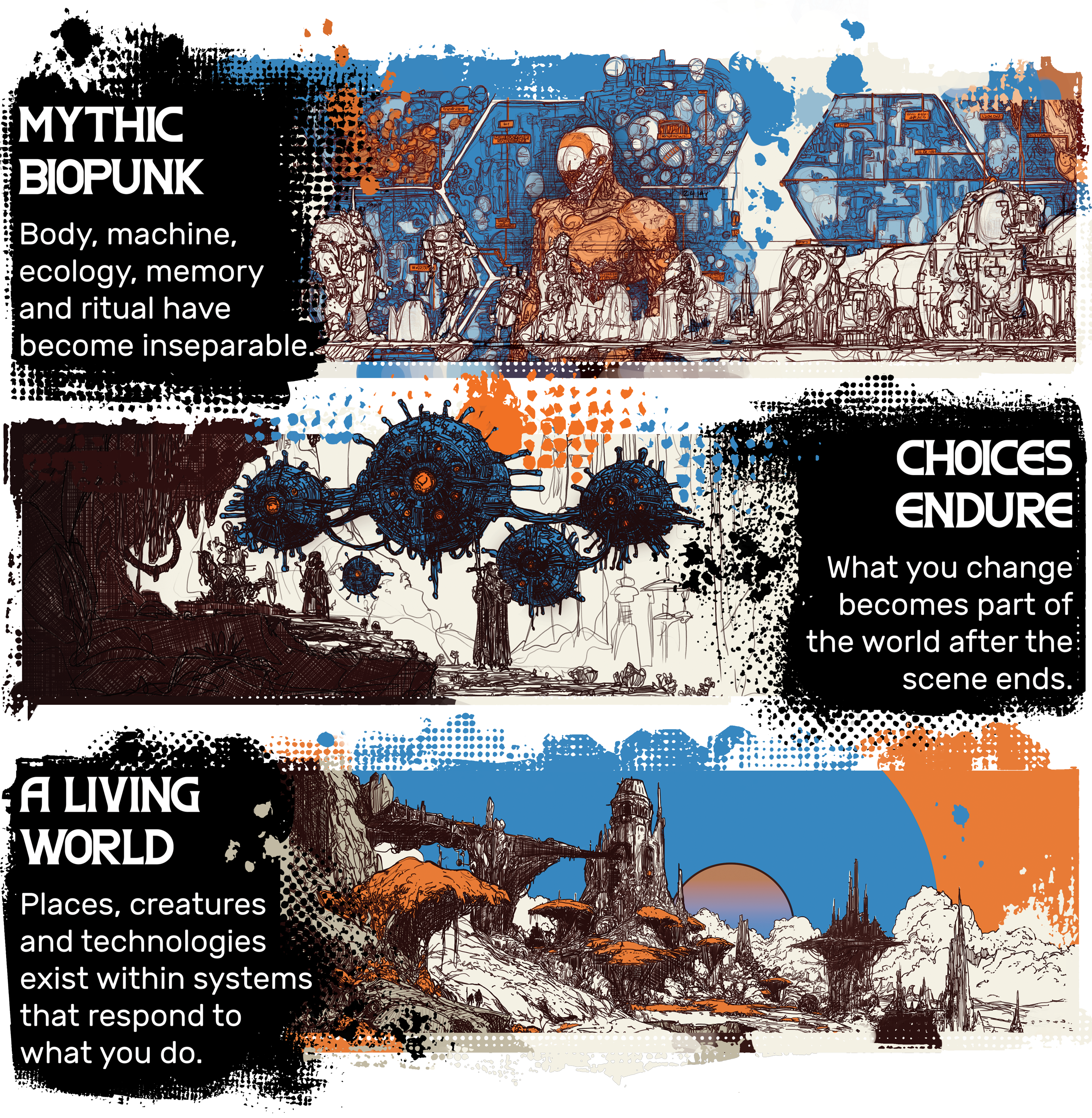
Twisted Lands is a mythic biopunk tabletop roleplaying game set on Ghar, a distant world where humanity has survived, adapted, and changed beyond what its ancestors could have imagined.Its people live among vast biological cities, ancient technologies, and environments that have continued evolving long after humanity's arrival. Some of these technologies are understood and maintained. Others have become inseparable from religious practice, or have been left to operate according to purposes nobody living can quite remember.
The creatures are just as varied - you'll encounter familiar ecological relationships expressed through extraordinarily unfamiliar bodies, along with things created by the Twisting that have little resemblance to anything their ancestors might have been.
There is a great deal to discover here, and considerably more going on than any one settlement, city, or faction understands. We've divided the game into two books, one intended for players and the other for Game Masters
BECOMING GIDIM
The Player's Guide
Becoming Gidim is where you'll begin - It contains the rules for playing 9thPersona, the character creation system, and the options available to players entering the Twisted Lands.Character creation is something we've approached a little differently.
Your character isn't determined by a single class or profession. We wanted people to be able to build someone whose abilities make sense in relation to their body, upbringing, education, and the work they've actually learned to do.
That means choosing your Kin and Form, the Culture that shaped you, an Order and Duty, and the Trainings and extraordinary abilities you've developed along the way.
These choices affect what you can accomplish during play, but they also help establish where you belong in the world and the people or institutions you have relationships with.
Inside Becoming Gidim: Character creation, the 9thPersona player rules, Kin and Forms, Cultures, Orders and Duties, Trainings, Expressions, equipment, and character records.
DREAMS OF THE BOUNDLESS
The GM & Setting Guide
Dreams of the Boundless is where we open up Ghar for the Game Master.It contains the rules and procedures for running the game, building adventures, managing threats, and developing campaigns. It also covers the setting itself, including its peoples, histories, Living Cities, wilderness regions, political relationships, and many of the things that make Ghar such a peculiar place to live.
Something I particularly wanted from this book was for the lore to be useful at the table.It is one thing to tell a GM that a region has dangerous wildlife or that a Living City has an unusual political structure. It's another to give them enough information to understand how those things might affect an expedition, a negotiation, or the consequences of a decision.
The setting and mechanics are intended to support each other. The book provides both the background and the procedures needed to bring that information into play.
Inside Dreams of the Boundless: GM rules and procedures, adventure creation, missions and campaigns, creatures and conflict, peoples and factions, Living Cities, regions and locations, ecology, and the deeper histories and mysteries of Ghar.
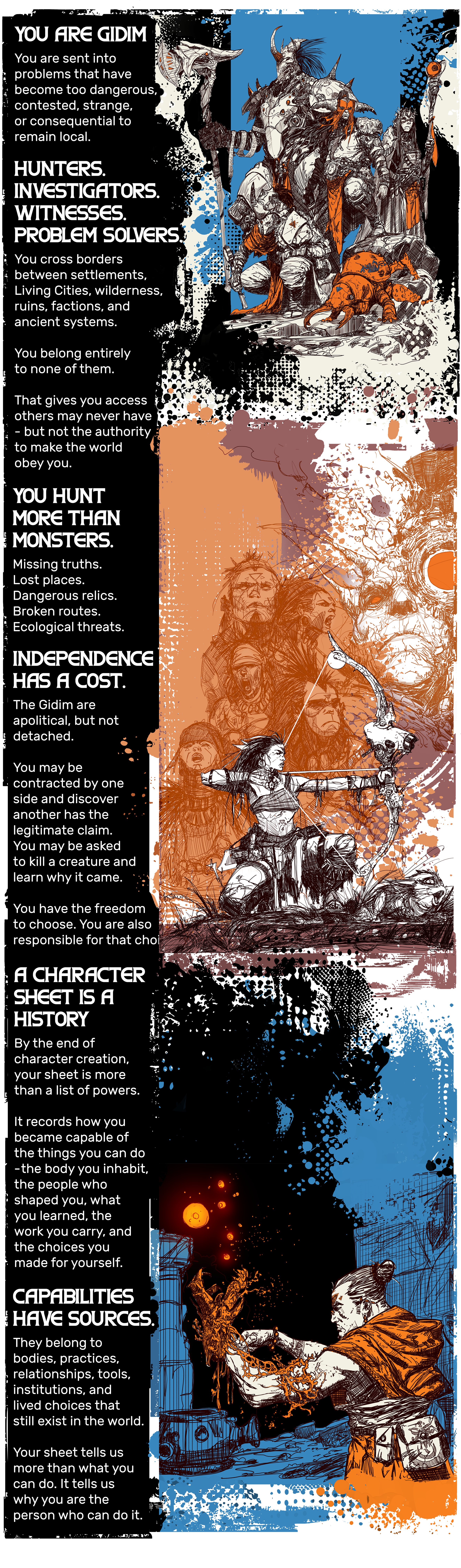
YOU ARE GIDIM
The players of Twisted Lands take the role of the Gidim, members of an elite order whose work takes them into some of the most dangerous and contested places on Ghar.
The Gidim have a long tradition of hunting, but the meaning of that work extends well beyond killing creatures.
They investigate unusual events, recover lost knowledge and technologies, explore unfamiliar territory, escort people through dangerous regions, and intervene when a problem has grown beyond the means of those living with it.
A Gidim might be a formidable warrior, but they might just as easily be an investigator, scholar, naturalist, or someone whose particular expertise makes them invaluable to an expedition.
Their independence is an important part of the setting - and what shapes the narrationThe Gidim are an apolitical, contract bound order. They may work on behalf of a Living City, settlement, faction, or individual, but they are not intended to become the private instrument of any one power - That inherently creates some interesting circumstances.You might be hired to recover something that another community considers sacred.
You might be asked to remove a creature from an area only to discover that its presence is the result of someone's negligence. Perhaps the people paying you have a perfectly reasonable request, but their preferred solution would cause more harm than the original problem.
There isn't always an obvious answer, and your authority as Gidim doesn't mean everybody has to agree with your decisions. In fact, a lot of the interesting situations arise because they don't.
CREATING A CHARACTER IN 9THPERSONA
I wanted character creation to answer a fairly basic question: how did this person become capable of doing the things they do?
The answer should involve more than picking a class and selecting abilities from a list.
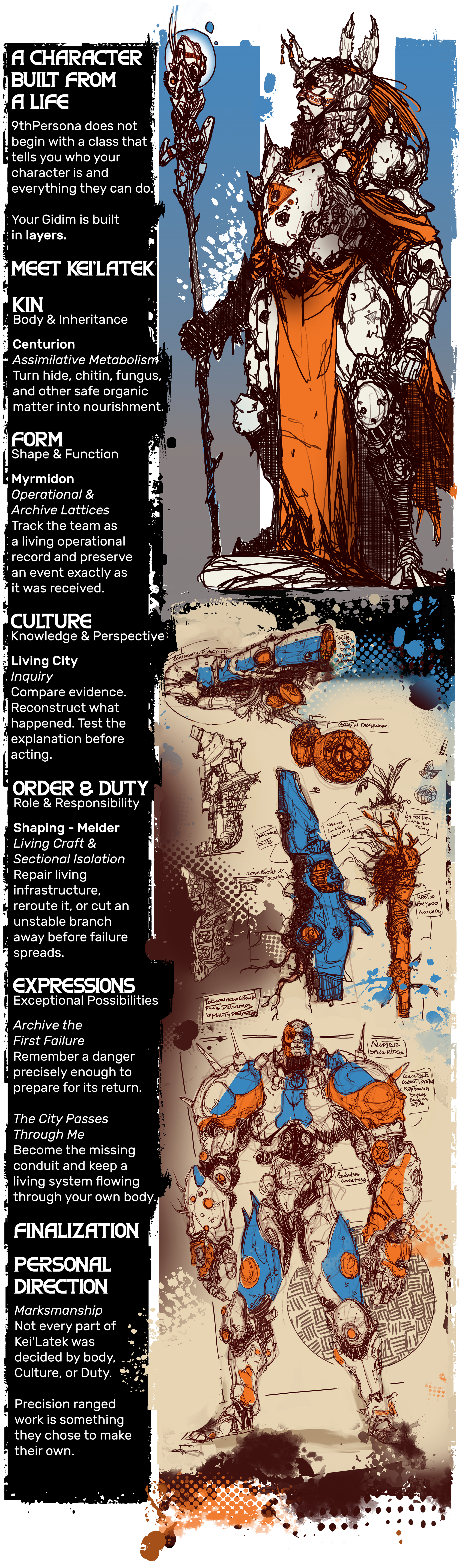
In 9thPersona, we build characters through several connected parts of their identity.
Kin / Form / Culture / Order & Duty / Expressions / Finalization
Kin establishes your biological foundation - form describes the particular body and adaptations you possess.
For example, the Proteans are transhumans whose biology is influenced by their ancestral Totems. Depending on their Form, they may manifest characteristics associated with feline, simian, caniform, or archosaurian ancestry.
Centurions, on the other hand, are cultivated biological beings whose bodies incorporate extraordinary living technologies. Their different Forms were developed around particular physical functions and capabilities.
Neither of these choices tells us everything about the person - that is where Culture becomes important.
Where were you raised? What kind of community shaped your understanding of the world? What practical knowledge would you have learned simply by growing up there?Culture provides Training and connections to the people and practices that formed you.
Your Order and Duty then establish the work you were prepared to perform. Two characters might share the same Kin, Form, and even Culture, yet develop very different abilities because of the responsibilities they undertook.Expressions add another dimension. These are exceptional capabilities drawn from your character's biology, upbringing, or practiced disciplines.
They might involve psionic abilities, specialized biological functions, or techniques that would otherwise be beyond an ordinary person's means.
Training is different - It represents methods you've actually learned and practiced, and it has a direct mechanical effect on how you roll dice.By the time you've finished, your character has a collection of abilities, but there's also a history behind them. You know something about their upbringing, what they were trained to do, who might recognize them, and where some of their responsibilities lie.
Those relationships aren't necessarily finished when character creation ends, either. They can become useful, complicated, or even troublesome as the campaign progresses.
Your character sheet should give you a good idea of who this person is before they ever answer their first Call. And hopefully, quite a different picture after they've answered a few.
HOW DOES 9THPERSONA ACTUALLY PLAY?
We developed 9thPersona as a narrative d6 system for Twisted Lands.
The basic procedure is straightforward. You describe what your character wants to accomplish and how they intend to go about it. If there's genuine uncertainty and something meaningful at risk, the GM establishes the difficulty and you roll.
This same underlying system is used whether you're crossing dangerous terrain, investigating an old structure, attempting to negotiate with someone, or fighting a creature.
Of course, each of those situations has its own considerations, but players don't have to learn an entirely different method of rolling dice whenever the activity changes.Here's an example of how several of the central mechanics work together.
AN EXAMPLE FROM ERIDU
A worker has become stranded on a damaged walkway above the flooded wetlands of Eridu.
The water has risen over the lower supports, and a large amphibious creature is moving beneath the structure.Your Gidim wants to cross the walkway and reach the worker before the creature can get to them.
How you approach this is up to you.You could try crossing quickly, carefully picking your way along the remaining supports, or perhaps use an ability that lets you avoid the damaged section entirely.
For this example, we're going to use Traversal Training and attempt to cross the walkway.
PRESSURE & OPPOSITION
One of the central mechanics in 9thPersona is Pressure.
Pressure represents the current instability of a situation. It might come from environmental danger, urgency, scarcity, a deteriorating negotiation, or any number of other circumstances that make an action more difficult.
Pressure is measured from 0 to 12 and establishes the starting Target for a roll.In our example, the flooding and unstable walkway have created Pressure 4, giving us a Base Target of 8.
The creature has begun pulling against the submerged supports, actively interfering with our attempt to cross. That adds +2 Opposition.
Our final Target is 10.
Pressure 4 = Base 8+ Opposition 2 = Target 10
What's useful about Pressure is that it can change throughout the scene.If another section of the walkway collapses or the flooding grows worse, Pressure may rise. If the players secure the structure or manage to stabilize the immediate danger, it can fall.Some problems also establish a Pressure Floor.
This represents an unresolved source of danger that prevents the situation from becoming fully stable.You might temporarily secure the walkway, for instance, but that doesn't stop the river from flooding. Until the underlying problem is addressed, there is only so much you can do to make the area safe.
GIDIM DICE & THE GHAR DIE
Now we roll
9thPersona uses two kinds of ordinary* six sided dice The Gidim Dice represent your character's competence and control. The Ghar Die represents the world's resistance and response to what you're attempting.
Under normal circumstances, you roll one Gidim Die and one Ghar Die, adding them together.Training changes this If your character has relevant Training, you roll two Gidim Dice and keep the higher result. We call this Keep High.
Impairments can reduce your control, and certain advantages can improve it. Under particularly difficult circumstances, you might end up rolling two Gidim Dice and keeping the lower result instead, or Keep Low.
Since our character has Traversal Training, we get to roll two Gidim Dice.
Here's what we rolled:
DieResult
Gidim Die 1: 2
Gidim Die 2: 5 (Kept)
Ghar Die 4
Total 9
We needed a 10 - We rolled a 9
In many games that would simply mean the attempt failed.
9thPersona handles the result a little differently:
SUCCESS, COST & CONTROL
There are five possible outcomes in 9thPersona, determined by how far above or below your Target you roll.
Margin Outcome
+3 or more Clean Success
0 to +2 Success
−1 to −2 Success with Cost
−3 to −4 Complication
−5 or less Hard Consequence
A Clean Success means you accomplished your objective and normally gained an additional benefit. A regular Success means you achieved what you intended.
Success with Cost is where things get interesting - you accomplish your objective, but something happens as a consequence.
A Complication means the situation moves forward, although your original intention may be delayed, reduced, or changed. A Hard Consequence means the approach didn't accomplish what you intended, and the GM establishes what happens as a result.For our example, we missed the Target by 1
That's a Success with Cost
Your character reaches the stranded worker, but the creature's interference has created another problem, now we compare the individual dice.
Your kept Gidim Die was 5, while the Ghar Die was 4
Because the Gidim Die is higher, you get some control over the consequence.
The GM might offer two possibilities: The creature's violent pull could tear your climbing rope loose and drag it underwater, or it could leave you Exposed to the creature's next attack.You choose which consequence you're prepared to accept
Had the Ghar Die been higher, the GM would have determined how the consequence unfolded instead.
There are other ways this control can be used. Depending on the circumstances, you might reduce the severity of a cost, narrow who or what it affects, or delay when it occurs.
What I particularly like about this is that the dice are doing two related jobs, their combined total determines the outcome of your attempt. Comparing the individual dice then tells us how much control you have over an applicable consequence.
You might get exactly what you wanted - you might succeed and have to sacrifice something along the way. Or you might find yourself dealing with a situation that has become substantially worse.
The result isn't entirely decided by the GM, and it isn't entirely decided by the player, either.
CAPACITY
Characters in 9thPersona have four Capacity tracks.
Mind covers mental endurance, attention, concentration, and composure.
Body covers physical exertion, endurance, and injury.
Mentasia covers psionic exertion and the strain associated with extraordinary mental abilities.
Melding covers biological adaptations, integrated systems, and the demands placed on living technologies.
Capacity is not added directly to your dice. It represents what your character can endure or choose to expend. You can voluntarily spend Capacity for certain effects, including improving your chances on a roll.
Remember our attempt to rescue the stranded worker?
We rolled a 9 against a Target of 10, resulting in a Success with Cost.Before rolling, we could have chosen to spend 1 Body Capacity to gain a +1 modifier, provided Body was the track at risk.
That would have brought our total to 10, giving us a normal Success instead.
Of course, spending Capacity has its own considerations. Characters can accumulate Strain and Damage, and a track that has been pushed too far can leave them unable to function normally.
Severe injuries or other lasting changes can also create Scars.You can push yourself when the situation demands it. The question is how much you're willing to spend now, and what you might need that Capacity for later.
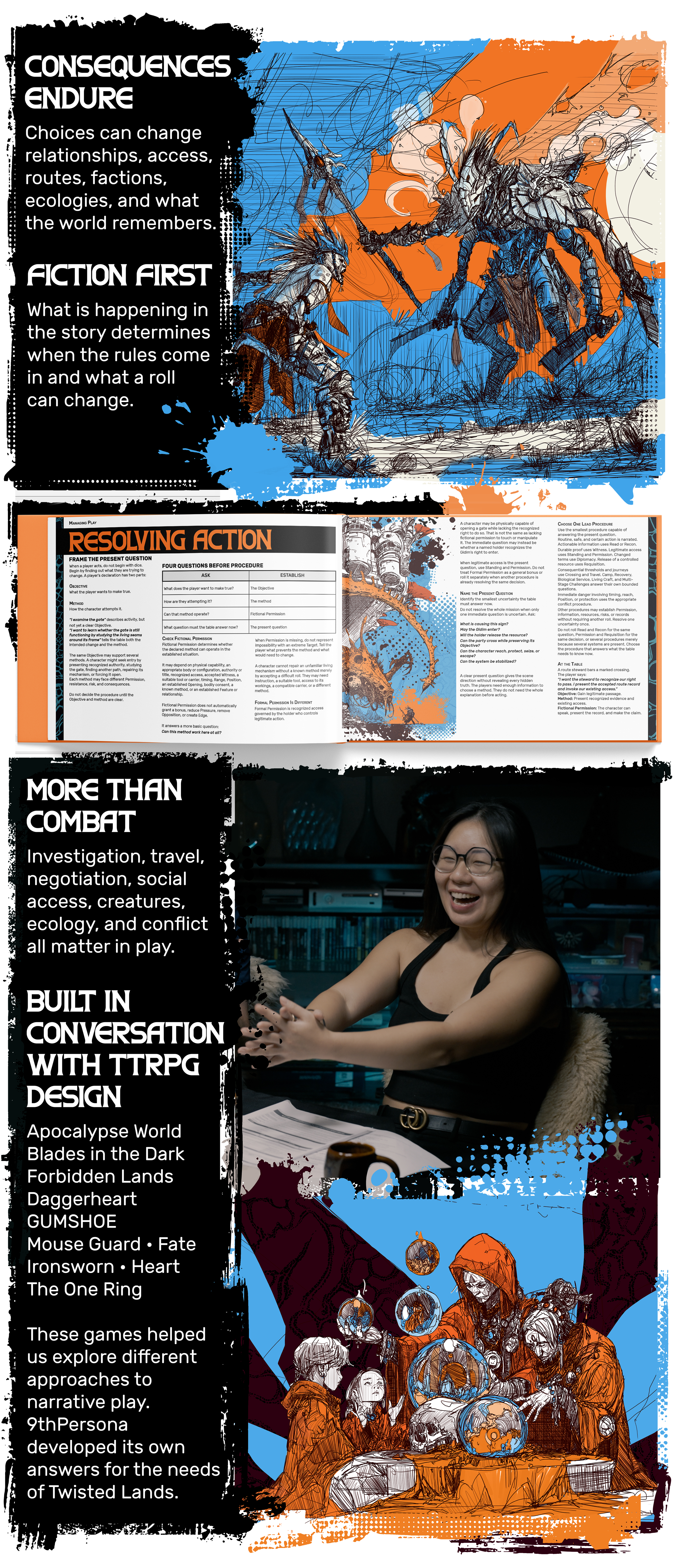
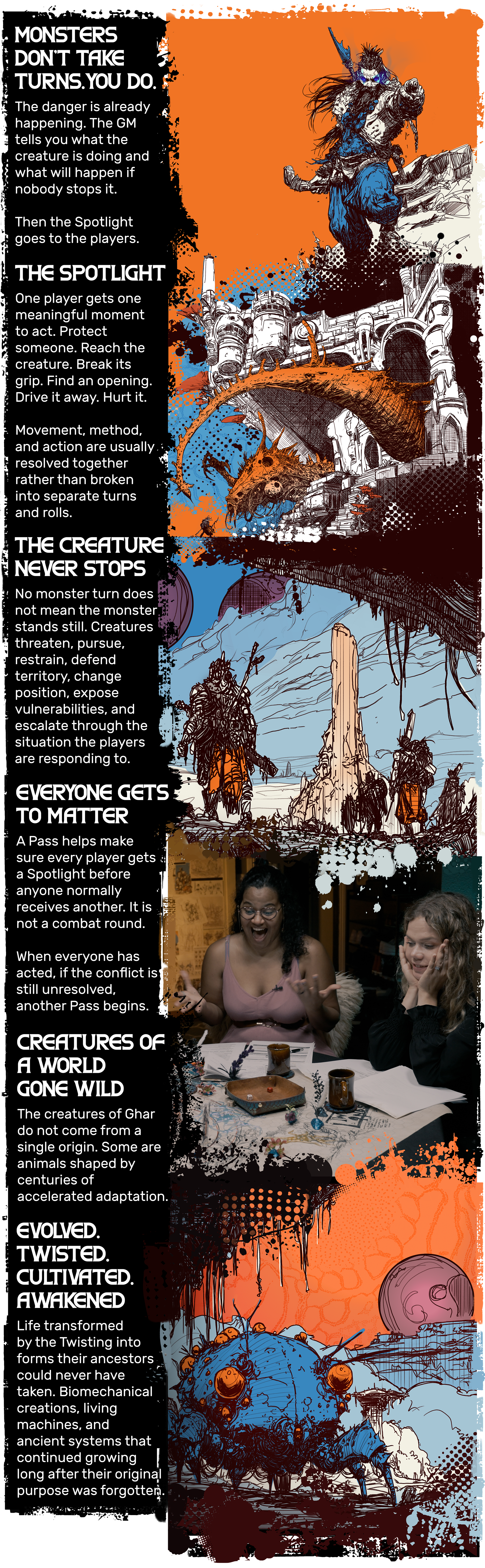
MONSTERS DON'T TAKE TURNS. YOU DO.
Combat was another area where we wanted to approach things differently. There is no traditional initiative order in 9thPersona, and we don't use a combat grid.
We still care about distance, positioning, protection, and the relationship between combatants. Those things are important. We just don't think every confrontation needs to be measured in squares or broken into a sequence of individual attacks.Instead, conflict is organized around Spotlights and Passes
A Spotlight is an opportunity for a player to make a meaningful decision.
You might attack the creature, protect a companion, attempt to break free from something holding you, or move into a better position.
Your action can also involve changing the environment. Perhaps you want to collapse a section of the walkway to prevent the creature from following, or use your psionic abilities to move the stranded worker out of danger.
The system resolves what you're trying to accomplish, using the method you've chosen.A Pass simply makes sure everyone normally receives a Spotlight before somebody gets another. It's a way of sharing attention around the table, without treating the conflict as a rigid sequence of turns.
The creatures? They don't wait around doing nothingThe GM presents Immediate Threats, explaining what a creature is doing and what may happen if nobody intervenes.Imagine the amphibious creature from our example has managed to reach the walkway. Its weight is pulling the damaged structure apart, and the worker is still within reach.
The GM tells the players what's happening - now somebody needs to respond.One character might try to drive the creature back into the water. Another could attempt to reach the worker, while a third might focus on stabilizing the structure.
The creature continues to behave according to its nature and the changing situation. It can pursue, defend itself, retreat, attack, or change its objective as events unfold.
Distance is handled through four general ranges: Engaged, Near, Far, and Distant. Position tells us whether someone is Secure, Open, or Exposed. These matter when determining what a character can reach and which consequences are possible and address the concerns a gridless system brings to the fore.
A creature might be too far away to strike directly, but close enough to threaten someone you are trying to protect. A character behind secure cover may be protected from consequences that would be dangerous to someone standing exposed.So while the conflict isn't played out on a grid, your position and decisions still have practical importance.
Perhaps most importantly, you don't have to defeat the creature to resolve the conflict.
You might only need to get the worker to safety.
CREATURES OF A WORLD GONE WILD
I've spent a great deal of time thinking about the creatures of Ghar, particularly how they fit into the environments they inhabit. There are animals that have undergone centuries of accelerated adaptation, developing characteristics that would seem extraordinary to us but are perfectly ordinary parts of their own ecology.
There are creatures transformed by the Twisting, whose bodies and behaviors have become something considerably stranger.And there are organisms whose existence blurs the distinction between biology and technology. Living machines, cultivated organisms, and old biological systems that have continued operating and evolving long after their original purpose was forgotten.
Some of these things are extraordinarily dangerous
Others might be relatively harmless unless disturbed, threatened, or encountered under the wrong circumstances - I want players to be curious about them.
Where does this creature live? What does it eat? Does it migrate? What keeps its population under control? Why has it appeared here, and what might happen if we remove it?
A creature can still be a monster. It can still be terrifying, aggressive, and fully capable of killing the party. Understanding it doesn't necessarily make it less dangerous.It might, however, change what you decide to do about it.
CONSEQUENCES THAT ENDURE
One of the larger goals behind 9thPersona is allowing the events of a campaign to have some permanence.I don't mean that every choice needs to create a major consequence, or that the GM should constantly punish players for decisions they made several sessions ago.
Sometimes you fix a problem, everyone is grateful, and life genuinely improves - that's a perfectly good outcome.But when something significant changes, I want the game to have a way of remembering it.
9thPersona includes several mechanics for this, along with systems for tracking relationships, reputation, obligations, injuries, and changes to the world itself.
Witness concerns evidence. Something you've discovered, recovered, or established might become important when you need to prove what happened or convince someone to recognize it.
Account concerns what a mission has accomplished and what remains unresolved. The results of an expedition may matter to the people who commissioned it, the communities affected, or the institutions that have some responsibility for what happened.Echo allows a particular consequence or opportunity to return later. Perhaps an earlier decision has set something in motion that won't become apparent until another expedition, or until the players return to a place they've already visited.
These aren't simply ways of adding complicationsA settlement you've helped might remember you favorably and offer support when you return. A route you've restored might remain accessible. A faction that once distrusted the Gidim might become willing to cooperate - and of course, the reverse can happen.
An abandoned settlement might deteriorate. A creature removed from its territory might allow another population to expand. Something the players disturbed during an expedition could begin affecting an area long after they've moved on.The world doesn't need to remain frozen between adventures.
This is especially important to the System because I want Ghar to feel like a place that exists beyond the immediate experiences of the party.Its people have lives, responsibilities, and relationships. Its ecologies continue functioning whether the Gidim are present or not. Its institutions have their own histories and concerns.
The players become part of those things through their actions.
THE WORLD ANSWERS BACK
There is a particular moment I'm hoping players eventually experience in Twisted Lands.At first, they might approach Ghar much as they would any other fantasy setting. A strange creature is something to fight. A ruin is somewhere to explore. A settlement offers a contract, and completing that contract means the adventure is finished. All of those things are still here - But I hope that after spending some time in the world, players begin to look at them a little differently.
Perhaps they start asking why a creature has moved into an area before deciding how to deal with it. Or they recognize that an old ruin may still serve some purpose, even if the people living nearby have forgotten what it was built to do.
Maybe they return to a settlement they helped several adventures ago and discover that something they did has changed how the community lives.
Those are the experiences I want 9thPersona to help create
The rules are there to resolve uncertainty, provide structure, and make sure the risks and consequences of an action have some consistency. They should give players room to be inventive without requiring the GM to make up an entirely new system every time someone tries something unusual.
The setting should provide enough substance that those decisions have somewhere to go.I want players to arrive on Ghar as people playing a tabletop roleplaying game, and eventually begin thinking about the world as Gidim.
To me, that's when the Twisted Lands really begins to open up:
Ghar remembers what you do.
Do you have specific questions I didnt answer here or on this page? Shoot me a message and I would love to talk with you
- Brandon
▶ Vidéos (0)
Pas encore de vidéo pour ce jeu.
Commentaires (0)
Connecte-toi pour commenter ou répondre.
Pas encore de commentaire. Lance la discussion.